
In today’s media landscape, short-form content dominates nearly every platform. From TikTok to Instagram Reels, thirty- to sixty-second clips dictate how information is consumed, how culture is shared, and increasingly, how art is experienced. Short-form content excels at grabbing attention, but it often does so at the expense of depth. By compressing meaning into digestible bursts, we risk losing the very context that gives art its resonance.
Art is inherently layered and relational. A painting, sculpture, or installation is rarely just a visual object; it exists within a constellation of the artist’s intentions, cultural references, material choices, and temporal processes. Thirty-second clips can show what a work looks like, but they rarely illuminate why it exists, how it was made, or what it seeks to communicate. In compressing the narrative, the richness of the creative process is flattened, and viewers are left with a surface-level encounter rather than an understanding of the work’s significance.
What Gets Lost in Speed
When conversations are reduced to soundbites, nuance disappears. Long-form dialogue allows for hesitation, contradiction, and digression—moments often edited out in the rush to create “punchy” content. Yet these elements are not distractions; they are windows into how ideas form. They reveal doubt, experimentation, and the iterative thinking process that underpins meaningful artistic practice.
Editing a conversation down to a single quote or viral moment may create clarity on the surface, but it distorts the record of thought itself. For artists whose work develops over months or years, short-form summaries can never fully capture the evolution of their ideas. The slow, sometimes messy process of creation—the revisions, the failed experiments, the internal debates—is essential to understanding not just the final artwork, but the artist behind it.
The Value of Time
Long-form conversations restore time to the equation. They offer artists the space to think aloud, to revise their statements, and to sit with uncertainty. These qualities are not inefficiencies; they are central to the intellectual and emotional labor of art-making. A conversation that spans an hour or more allows ideas to unfold gradually, revealing connections and insights that would never emerge in a five-minute clip.
For the audience, this temporal expansion transforms listening from a passive act into an active engagement. Instead of consuming pre-packaged conclusions, viewers experience the slow emergence of thought. They witness the tension between intuition and intention, the negotiation between memory and imagination, and the dialogue between what is said and what is left unsaid. This engagement cultivates empathy, curiosity, and critical thinking—qualities that are diminished when media is designed solely for speed.
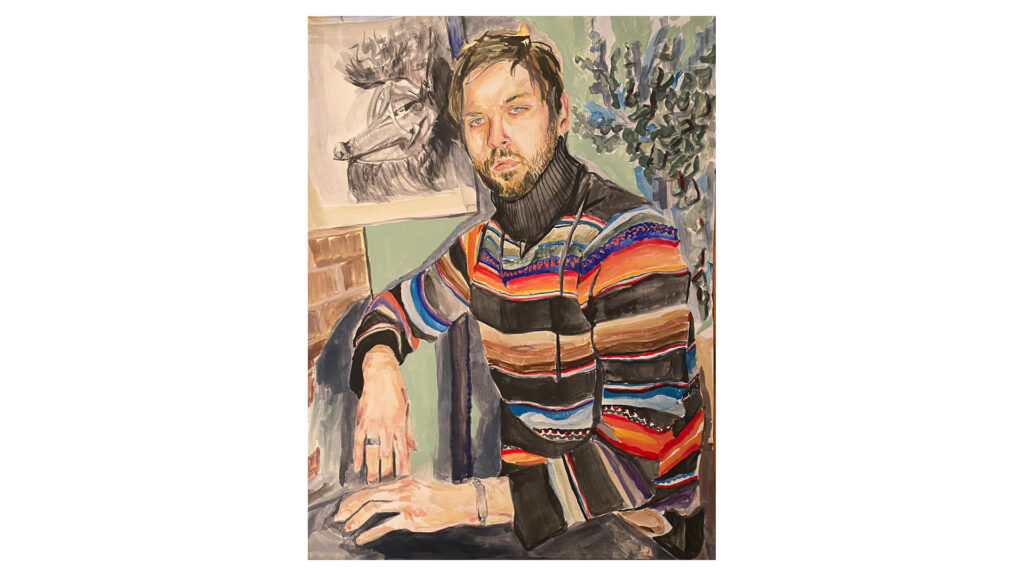
Kirk (2021)
Watercolor and gouache on paper
24×18 inches
Depth as Cultural Preservation
In an environment optimized for speed, choosing depth is an act of preservation. Long-form interviews and extended conversations serve as cultural archives, capturing the subtleties of artistic practice that are otherwise at risk of disappearing. They do not compete with short-form content; they counterbalance it. While TikTok clips can spark initial interest, long-form documentation ensures that the knowledge, methods, and intentions of artists are preserved for future generations.
For contemporary art, this form of documentation is not indulgent—it is necessary. It provides historians, curators, educators, and audiences with a record that contextualizes work within broader cultural, social, and political frameworks. In essence, long-form conversations function as a bridge between the immediacy of present-day attention economies and the enduring value of intellectual and creative labor.
Beyond the Artist: Building Community Through Conversation
Long-form dialogue also expands the potential for audience connection. By inviting viewers into a sustained exploration of ideas, these conversations foster a sense of community and shared understanding. They allow audiences to encounter complexity, engage in reflection, and return to the material multiple times with new insights. In contrast, short-form content encourages fleeting attention, where meaning is often ephemeral and engagement superficial.
Moreover, long-form interviews can highlight the relational and collaborative aspects of art-making. Many contemporary works emerge from networks of influence, dialogue, and shared experimentation. A conversation that captures these dynamics provides a more holistic picture of artistic practice, showing not just the product, but the ecosystem from which it arises.
Conclusion
In an era dominated by short-form content, long-form conversations are more than a countercultural choice—they are a necessity. They preserve the nuance, time, and depth that art requires to be fully understood. They capture the iterative, often contradictory, and deeply human process of creation. They offer audiences an opportunity to listen actively, to reflect, and to engage with ideas that unfold slowly, rewarding patience and curiosity.
For contemporary art, the value of long-form conversation cannot be overstated. It is through these extended dialogues that we honor the complexity of artistic practice, safeguard cultural knowledge, and foster a public capable of appreciating not just the image of art, but the rich web of thought, labor, and intention behind it.
About the Author
Matthew Moloney is an American artist and the founder of Timestamp, a platform dedicated to documenting contemporary art through long-form conversations and interviews. He creates, curates, and amplifies voices in the art world, emphasizing depth, context, and the preservation of creative thought over fleeting trends.
Support Timestamp
Timestamp is made possible through the generosity of its audience. By supporting Timestamp, you help preserve long-form artistic dialogue, fund new interviews, and ensure that contemporary artists’ ideas are documented for future generations. Consider contributing or subscribing to help sustain this vital resource for art and culture.