Björn Heyn does not describe his studio as a workplace. He calls it a playground.
For him, that distinction matters. Being an artist, he explains, means holding on to a particular state of mind that can easily disappear in adulthood. Bills arrive, emails pile up, the mailbox fills with responsibilities that feel far removed from curiosity or play. The everyday routines of adult life can flatten the imagination if they are allowed to take over completely.
“I think it’s very important as a grown up not to be confronted with all those boring adult tasks all the time and get pissed about them. Receiving invoices or answering emails and opening your mailbox and it’s full of un-nice things. So it’s good to keep playing and not lose the lightness.”
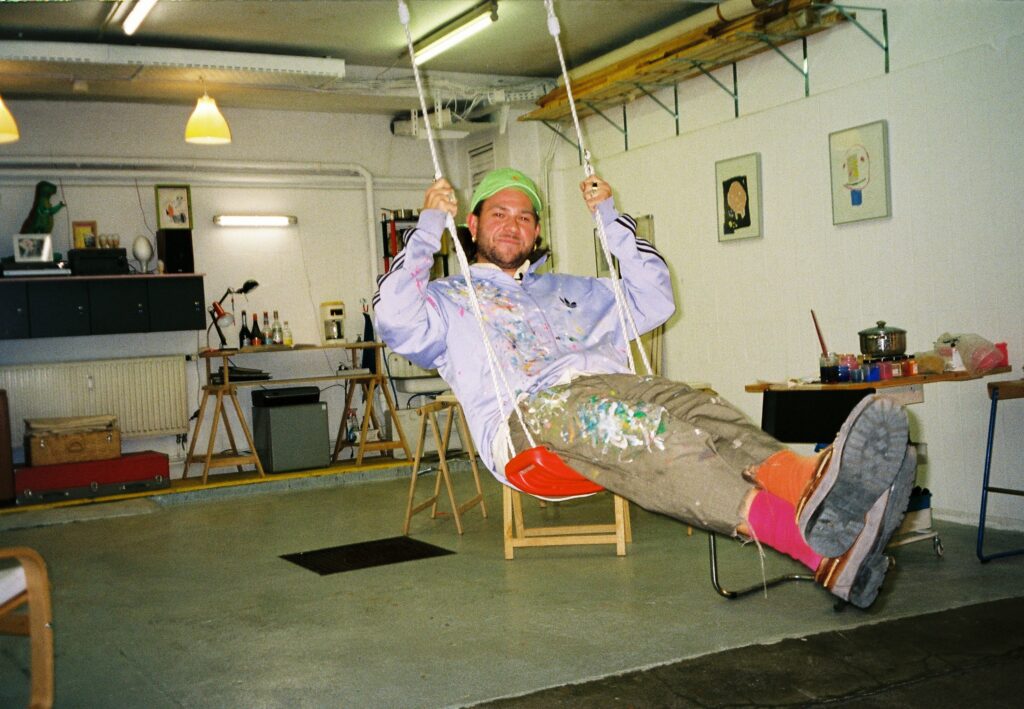
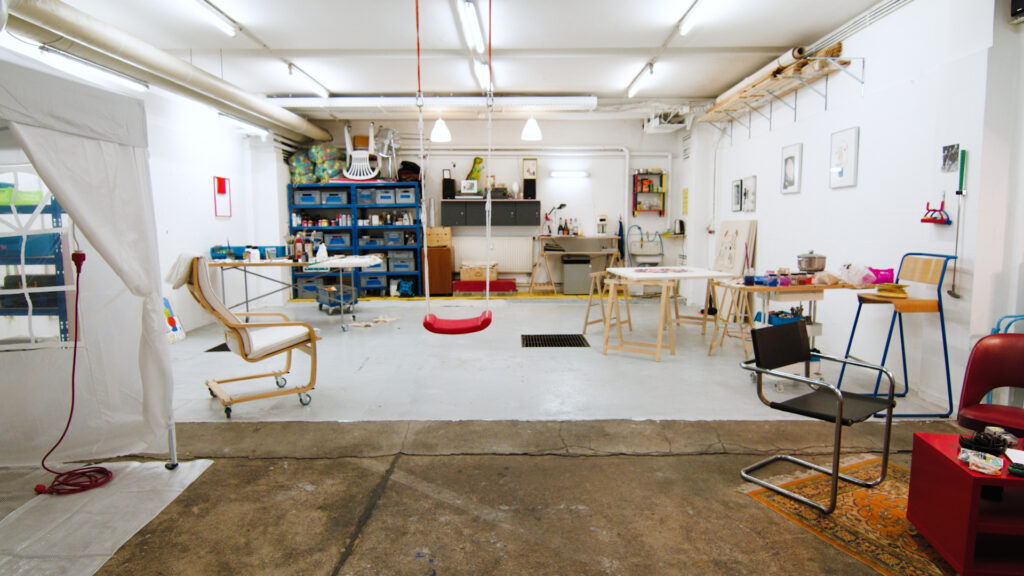
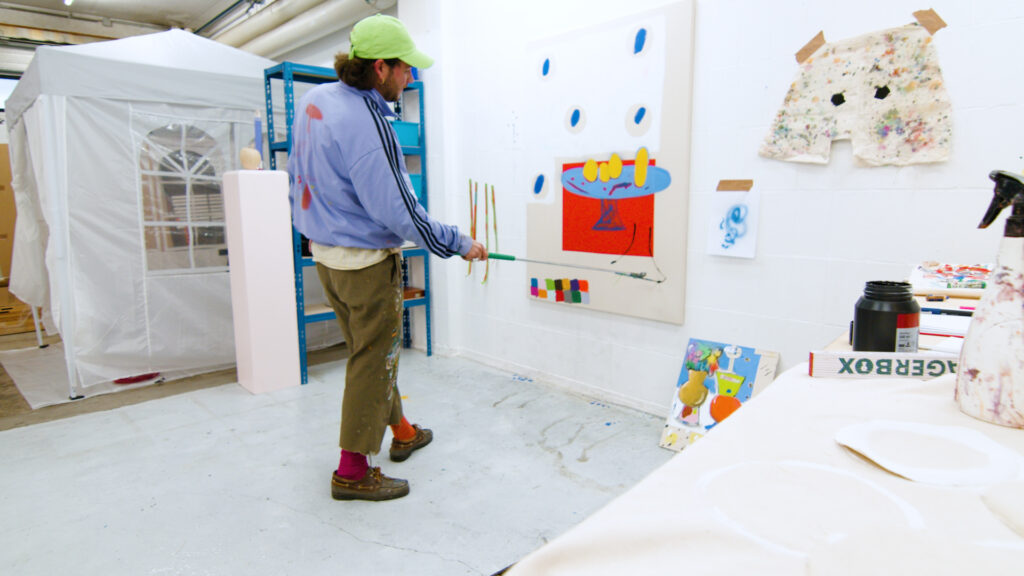
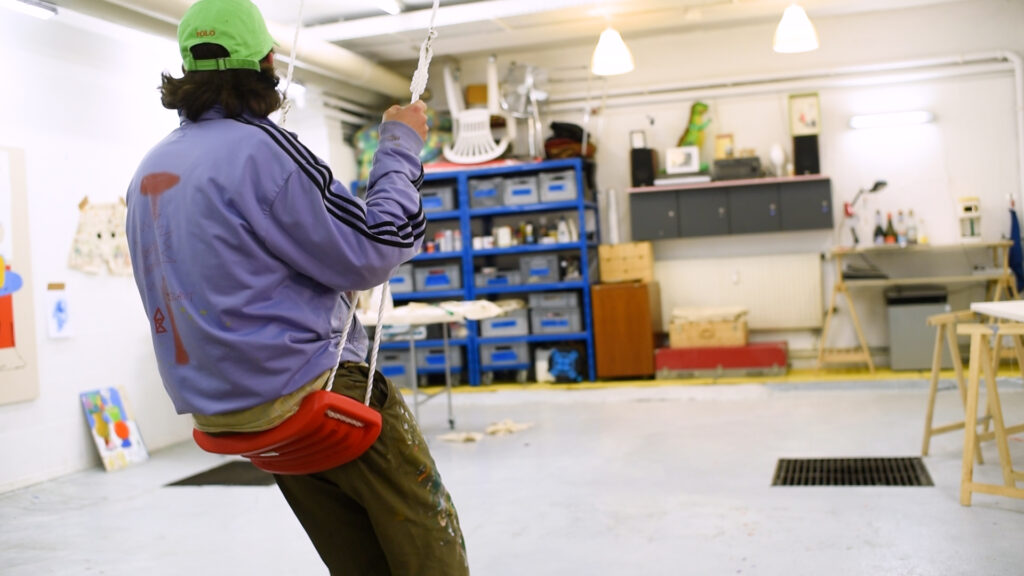
Inside his Berlin studio, that philosophy is immediately visible. The space is filled with materials, experiments, objects collected over time, and half finished ideas. Sculptural tools share tables with crayons, pigments, and brushes. A swing hangs in the room. Chairs of different shapes and styles are scattered around for visitors who come and go throughout the day.
The atmosphere reflects the way Heyn approaches art making. Instead of rigid systems or strict rules, he works through experimentation, accident, and discovery.
His relationship with art began early. Like many children, drawing and making things were simply natural ways to spend time. Creative workshops, ceramics classes, and different forms of hands on experimentation were part of his childhood. The impulse to make things never really disappeared.
As he grew older, his interests shifted toward graphic and illustrative work. Eventually that direction opened into something broader and less defined. Over time the practice expanded beyond drawing into painting, sculpture, collage, and installation.
The path he followed into the art world was not through formal training. Heyn did not attend art school. Instead he learned by trying things, failing at them, and then figuring out how they worked.
“I’m a big fan of trial and error and failure,” he says. “Most of the things are based on that. I didn’t study. I didn’t go to art school. So most of the things are just I tried, and then I asked some people how because it didn’t work very well.”
That approach shaped the way he thinks about making art. Rather than starting with a detailed plan, the process begins with curiosity. Materials are tested, mistakes are made, and unexpected results become part of the final work.
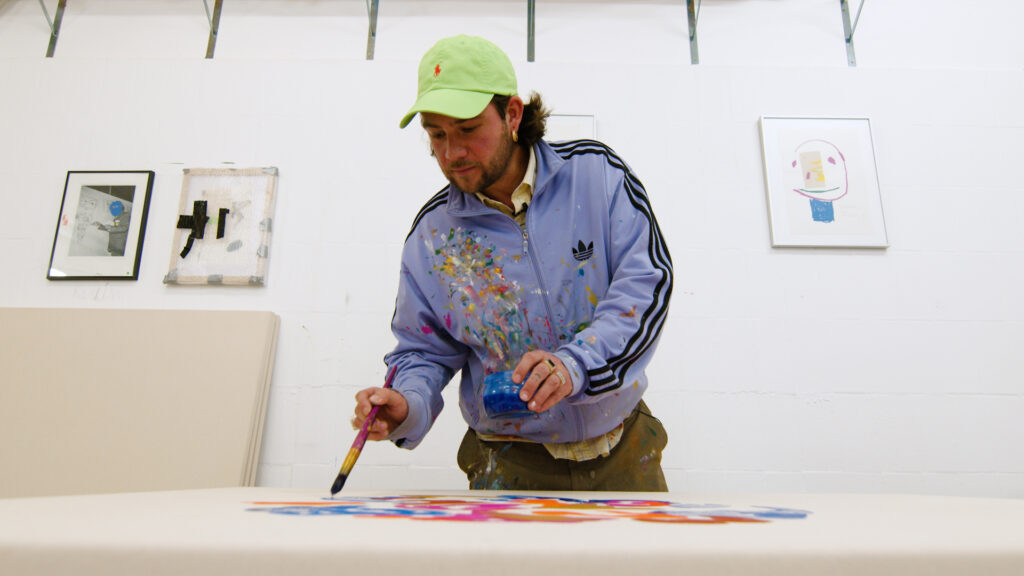
The studio routine reflects that philosophy. A productive day does not require finishing a large painting or completing a major piece. Sometimes simply making something small is enough.
“It feels very good to create something even if it’s a very small thing after a day of studio work,” he explains. “It doesn’t need to be a big object or a finished painting. It can be just one dot on a blank page. But it feels good to go to bed after having the idea that I created something.”
Over time, that daily commitment to making things gradually developed into a body of work that moves fluidly between painting, sculpture, collage, and installation. The works are connected through shared interests in color, composition, and intuitive decision making, but they rarely follow a single rigid format.
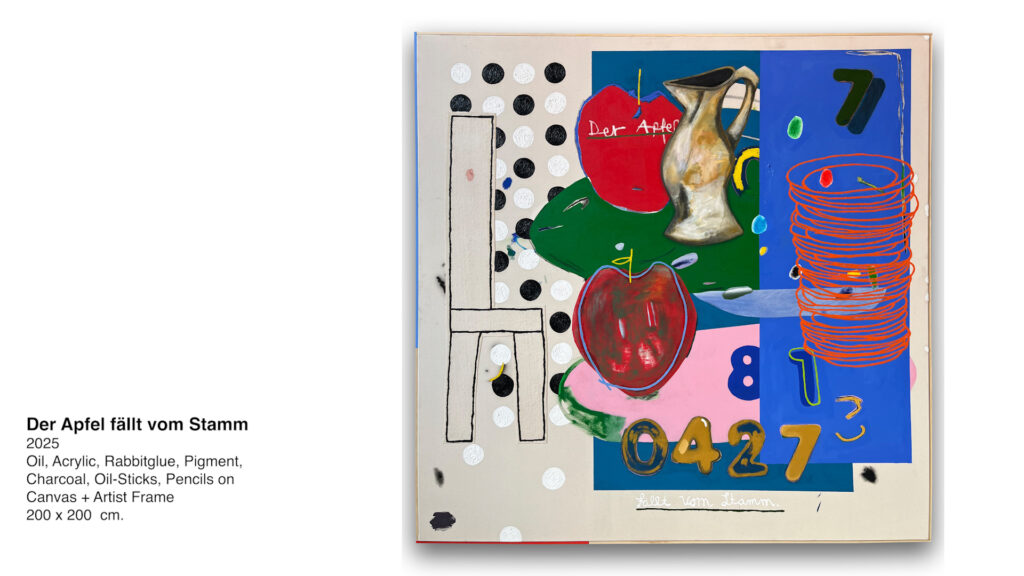
Some pieces relate directly to each other while others stand more independently. The overall structure of the practice comes less from predetermined concepts and more from the habits and guidelines that shape the studio process itself.
“I’m in the very comfortable position that I can just do my art and be in the studio and come here to work and try things out,” he says.
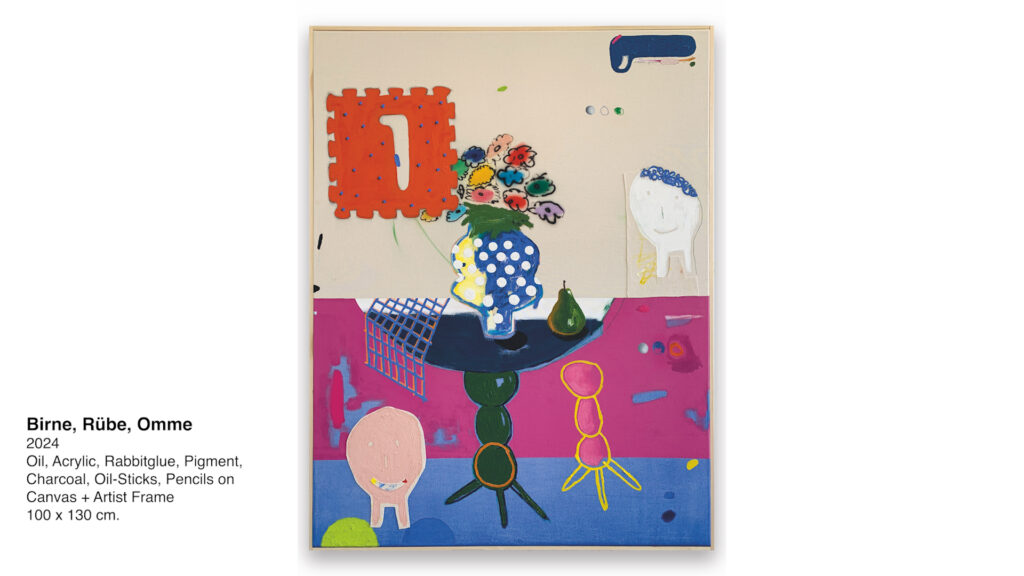
One of the central ideas behind Heyn’s work is accessibility. He wants the visual language of his paintings and objects to remain open and inviting rather than overly complicated.
“I think accessibility is a big point for me,” he explains. “I try not to make it too complicated for people to see or feel the things I do.”
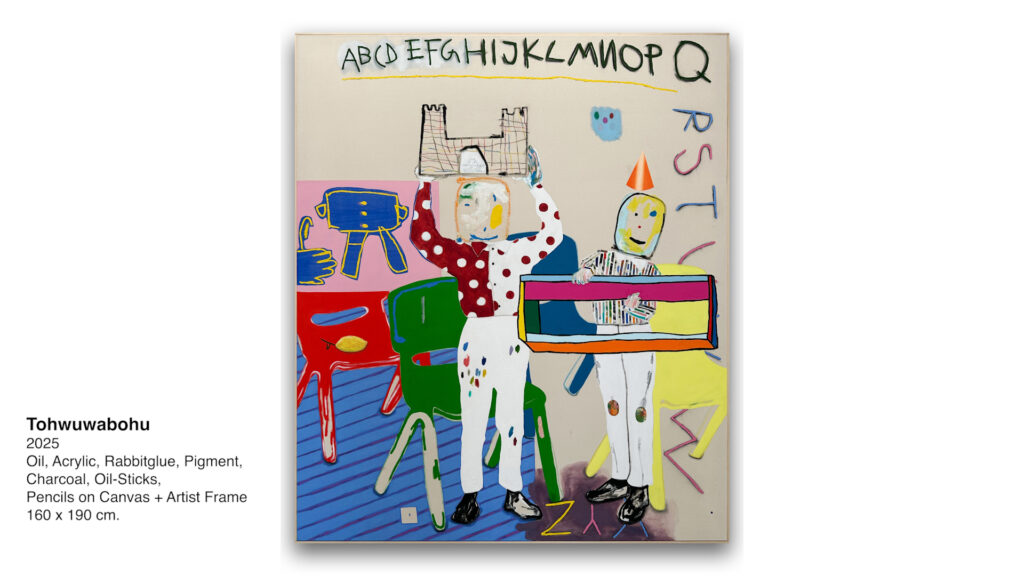
He recognizes that traditional gallery spaces can sometimes create an invisible barrier for viewers who feel unsure about entering.
“There’s always a barrier when you’re exhibiting in a gallery space,” he says. “Many people wouldn’t go in there even though they’re attracted by a shape or a color because maybe it feels too fancy for them.”
That awareness shaped the early years of his career. Before working with galleries, many exhibitions were organized independently with friends and collaborators.
Heyn is part of an artist collective that was founded nearly a decade ago. The group organized exhibitions, created temporary spaces for showing work, and invited other artists to participate. These projects often took place in unconventional locations rather than traditional white cube galleries.
“In the beginning there were many self organized shows,” he explains. “We did big group shows to create a platform to invite people. We always did things in whatever kind of places.”
The collective provided more than just exhibition opportunities. It created a support system during a period when many of the artists involved were navigating the practical difficulties of building a creative life.
“I think having the idea of a collective really helped a lot,” Heyn says. “You weren’t alone. There was always a group of people that would help each other out.”
Many artists understand the cycle he describes. Maintaining a studio requires money, which often means working another job. But that job can take time away from the studio itself.
“You have another job that you have to work that much that you can’t go to the studio to pay the studio rent,” he says. “It’s this kind of circle that many artists know.”
What helped sustain the momentum during those periods was the presence of others who were facing the same challenges.
“Everyone was more or less in the same state,” he explains. “You wanted to do projects, you wanted to do your own work, and not be alone in a little chamber doing drawings that maybe nobody would see.”
Working collectively made the process feel less isolating and more energizing.
“It was very helpful to have other people around who were like, let’s just do something.”
Another unexpected influence on his practice came through working with children. Heyn’s mother worked in a kindergarten, and through that connection he occasionally began helping with creative activities.
“My mother is a kindergartener,” he explains. “And when there was not enough people working she asked if I could come in and do something with the kids.”
At first he simply organized small art workshops. Over time those sessions became an important part of his life.
Working with children reinforced the qualities he already valued in his own practice. Their approach to making images is instinctive and direct. They experiment freely without worrying about whether the results are technically correct.
“They are very free in their ways of working,” he says. “Very intuitive. Not thinking too far in the process. Just trying something and seeing if it works.”
That openness mirrors the method he tries to maintain in the studio.
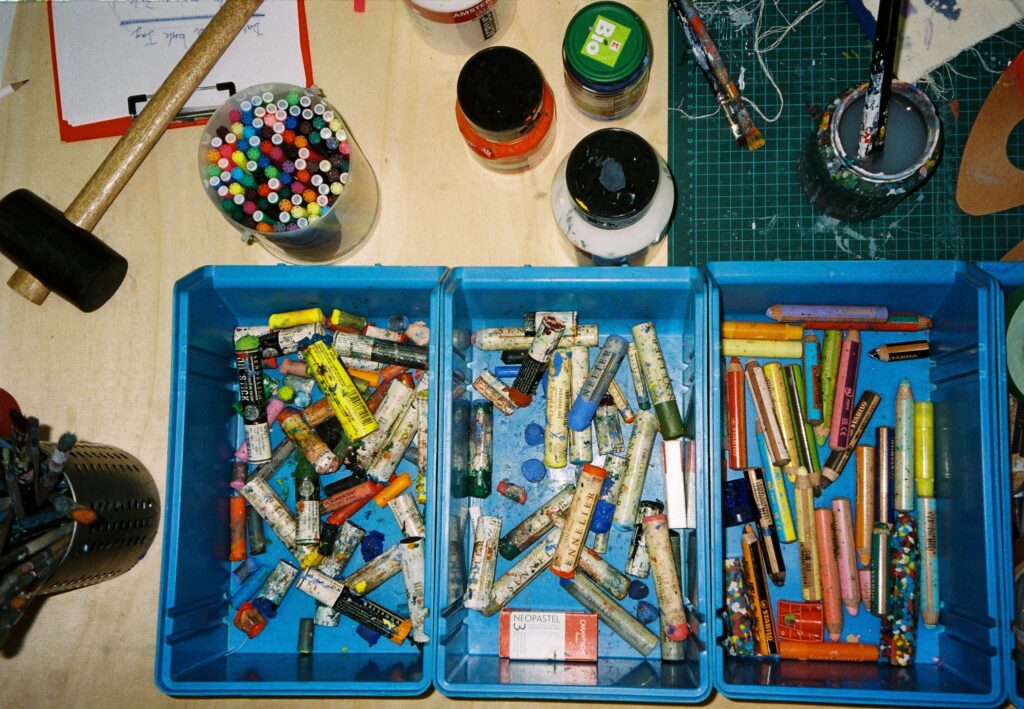
The materials he uses are similarly varied. Rather than limiting himself to a single medium, he moves between techniques depending on what feels appropriate for the work.
A residency early in his career introduced him to one of the processes that now forms the foundation of many paintings. During that residency he met a sculptor who worked with pigments, marble dust, and rabbit skin glue.
“He showed me how to use rabbit glue,” Heyn recalls. “It’s a very old fashioned classic way to prime the canvas.”
The mixture creates a surface that absorbs pigment directly into the fabric of the canvas rather than leaving it sitting on top like many modern paints.
“I mostly use raw canvas as a background,” he explains. “The color of the material stays the same and it has a very poppy contrast compared to white.”
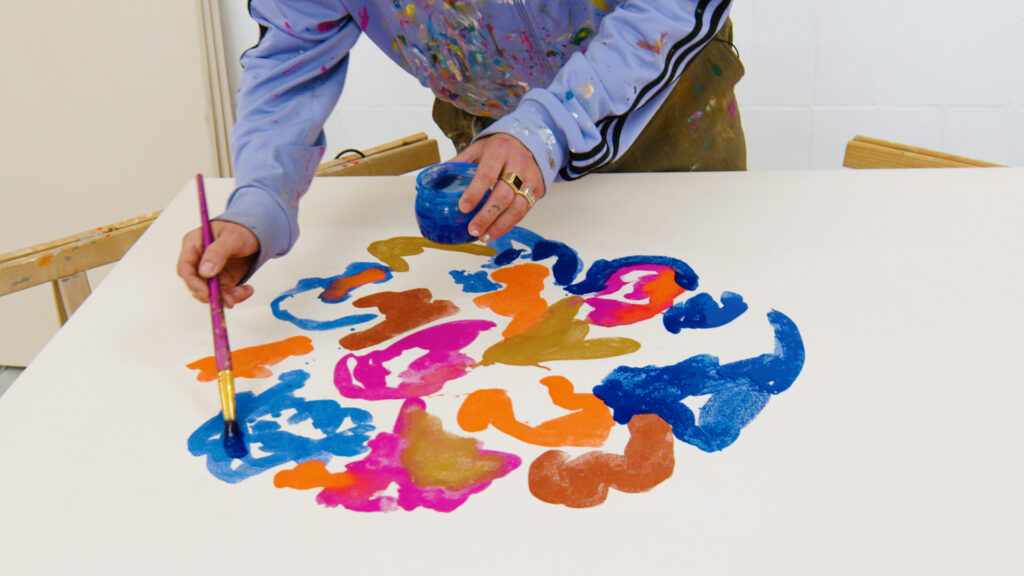
Preparing the canvas becomes its own ritual. The glue must be heated and applied carefully before pigment and marble dust are added. The process is slow and meditative.
“You cook your rabbit glue and then you prime the canvas,” he says. “It’s kind of meditative but not very creative because you don’t see what you did afterwards.”
Once that groundwork is complete, the more expressive stage begins. Pigments, charcoal, and other materials are layered onto the surface in a deliberately chaotic way.
“I like to create a mess in the beginning,” he explains.
A portion of the canvas becomes a field of marks, textures, and accidental effects. Later, as the painting develops, much of that chaos disappears beneath carefully placed geometric forms.
“It’s like making a mess and then cleaning up the mess afterwards,” he says.
Through this process, earlier layers remain partially visible beneath the surface. Small fragments survive inside the final composition, traces of earlier gestures embedded within the structure of the painting.
The works often combine still life imagery with abstract elements. Chairs, flowers, vases, and interior objects appear alongside shapes and color fields.
“I’m a big fan of classic still life paintings,” he says. “And I like interior objects. Chairs, vases, flowers.”
These familiar elements act as anchors within compositions that otherwise remain fluid and open.
Materials shift constantly throughout the process. Brushes, thick crayons, cheap pencils, charcoal, airbrush tools, and handmade instruments all appear in different works.
Heyn sometimes builds his own painting tools to change the way marks behave on the canvas.
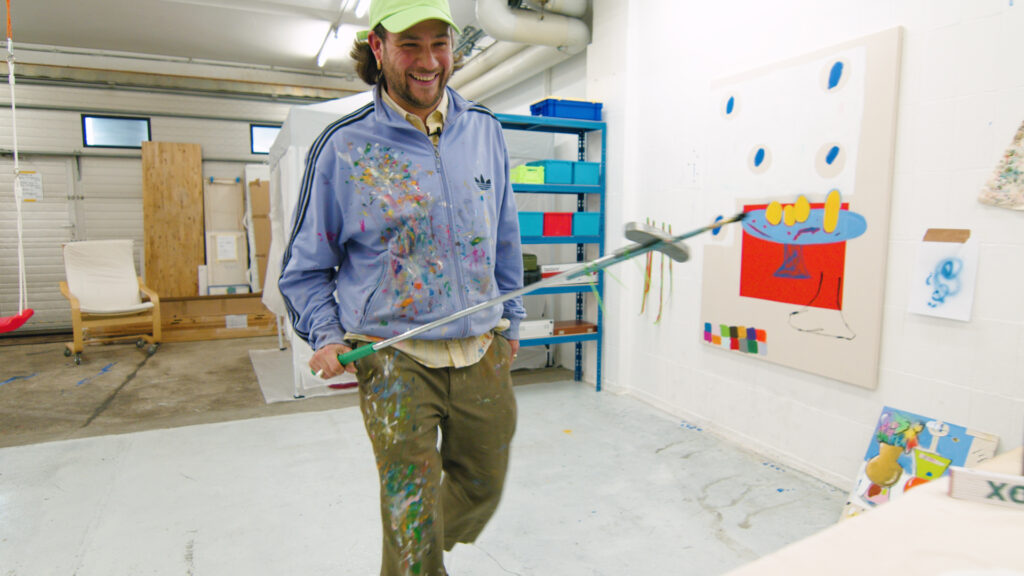
“I like to make tools to paint,” he says. “Because it’s more fun. You don’t know if it will work in the end or not.”
That uncertainty is essential to the excitement of making something new.
Beyond painting, sculpture has also become an important part of his practice. Recently he began carving into lightweight building materials used in architecture. The material allows him to work somewhere between painting and sculpture.
“When you paint you add something to the canvas,” he explains. “When you sculpt you take away material.”
Combining those approaches allows him to think about space in new ways. Some projects extend paintings outward into the room, turning flat images into objects that viewers can walk around.
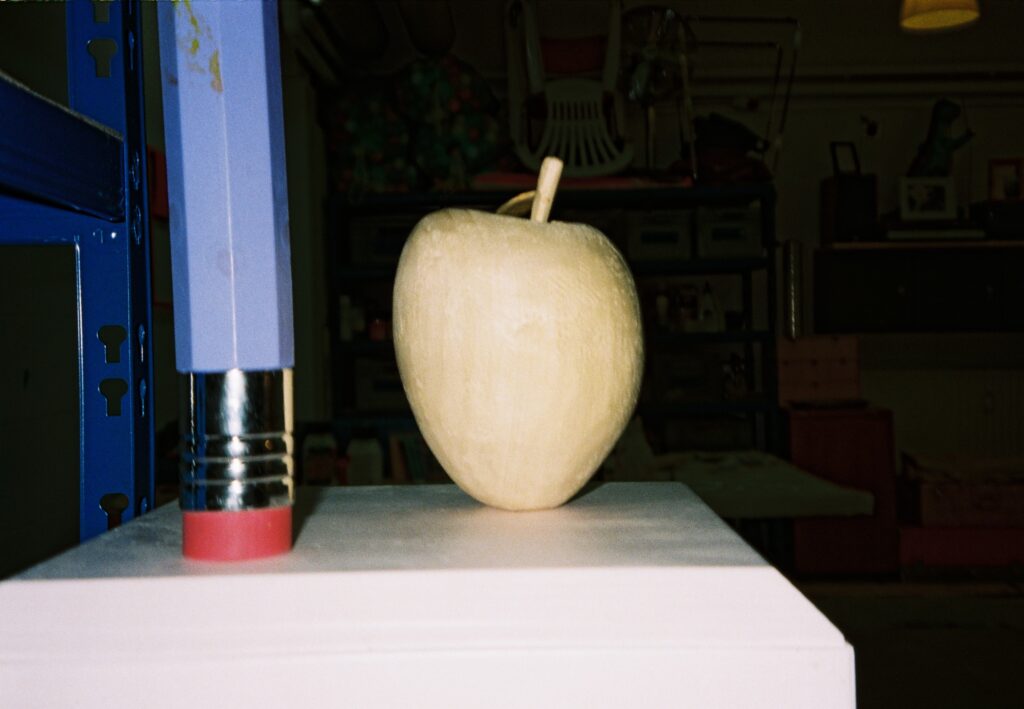
He recalls one piece where a sculpted apple was placed in front of a painting so that the object seemed to emerge directly from the image behind it.
“You can walk around it and touch it,” he says. “It’s not just a flat painting.”
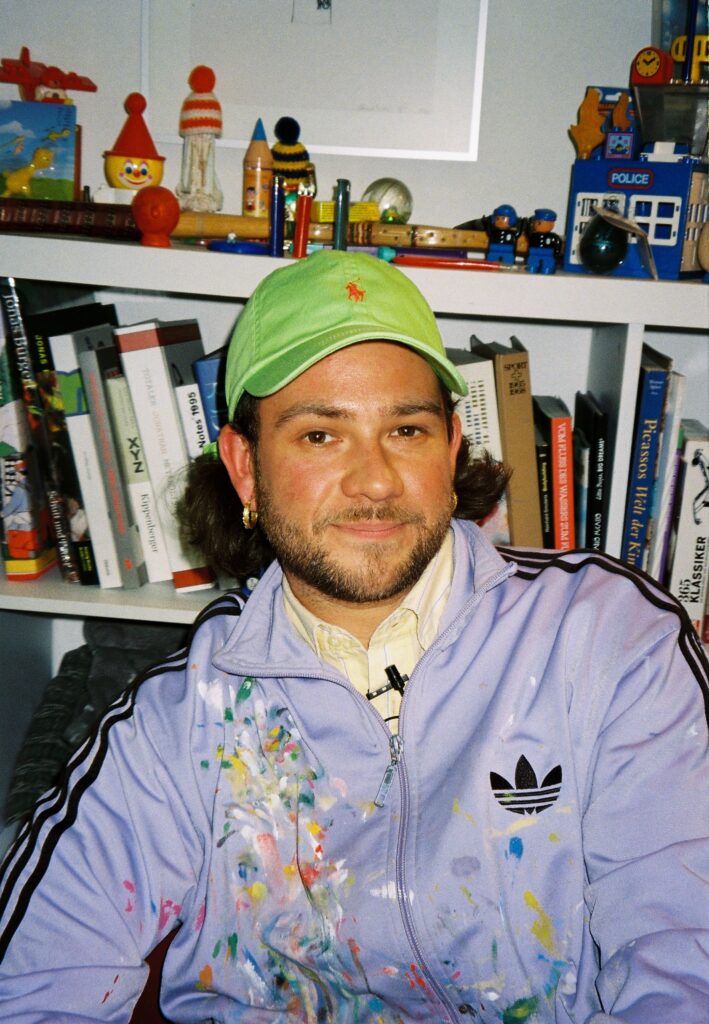
The studio itself reflects the same curiosity that drives the work. Objects collected over time form a kind of personal archive. Bright colors, unusual shapes, gifts from friends, and small discoveries all accumulate in the space.
“I like collecting things,” he says. “Especially colorful things.”
Among them are toys, found objects, handmade items from family members, and fragments that later find their way into artworks.
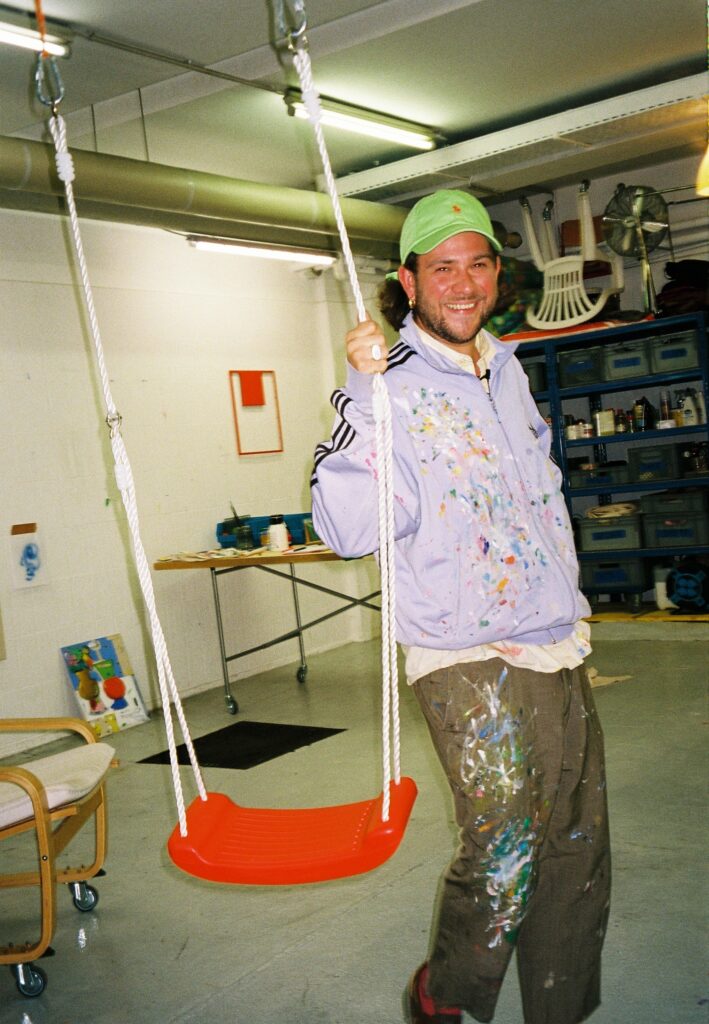
One corner of the studio holds a swing that hangs from the ceiling. It began as part of a performance based installation where Heyn attempted to paint while swinging across a canvas.
The experiment proved difficult but entertaining.
“I was super excited about swinging while painting,” he says.
The swing remained in the studio long after the project ended. Now it serves as a place for conversation as visitors stop by throughout the day.
Music and sound also shape the atmosphere while he works. Instead of carefully selecting playlists, he usually turns on the radio.
“I like listening to radio because it’s pre curated,” he explains.
The background voices and music drift through the studio without demanding too much attention. Occasionally a phrase from a caller or a radio host slips into his thoughts and later appears briefly in a painting before being covered by another layer.
“It will disappear in the end,” he says. “But it’s there in a way.”
The same openness to chance appears in the materials he uses. If a tool is nearby, it might suddenly become part of the composition.
“Sometimes I just grab things that are around,” he explains. “Like a hammer instead of a fork or a knife next to a table.”
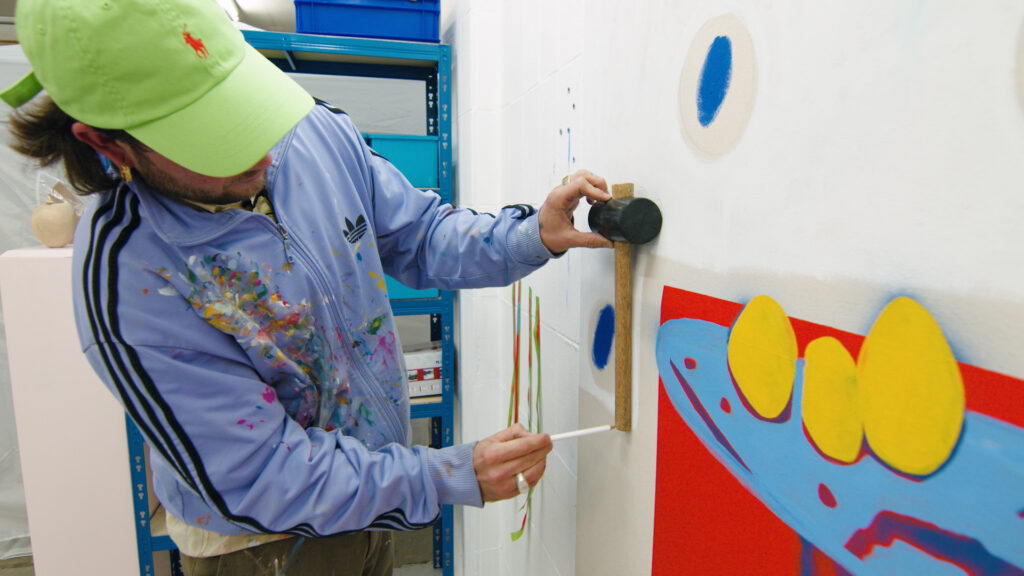
Objects migrate from the studio environment into the imagery of the paintings themselves.
In the end, the process remains deliberately loose. There are no strict rules about materials, techniques, or outcomes.
“No limits, no rules,” he says simply.
Each work grows out of the previous one through experimentation, intuition, and a willingness to follow unexpected directions.
For Heyn, the purpose of the studio is not to produce perfect results but to maintain that sense of play that first drew him to art as a child.
Keeping that energy alive remains the central challenge of adulthood.
And inside his Berlin studio, surrounded by pigments, tools, chairs, radios, and swings, the playground is still open.
About the Author
Sam Burke is an American artist and writer based in New York City. Working across film, performance, and writing exploring storytelling, identity, and place. As co-founder of Timestamp, Burke interviews artists, shares insights, and highlights conversations shaping art world today.

Björn Heyn
Björn Heyn does not describe his studio as a workplace. He calls it a playground….
Hugo Winder-Lind
Hugo Winder-Lind does not talk about art as if it is something that can be…

What Curators Are Looking For in 2026: Insights From Across the Art World
In 2026, curators aren’t just responding to aesthetic trends – they’re shaping how art is…
Ranny Macdonald
Ranny Macdonald describes painting as a threshold experience, a place where something begins to take…
Cathleen Clarke
Cathleen Clarke has always been drawn to the spaces where memory begins to thin out….
Kara Su
Born and raised in Berlin with Kurdish roots, Kara Su grew up far from the…