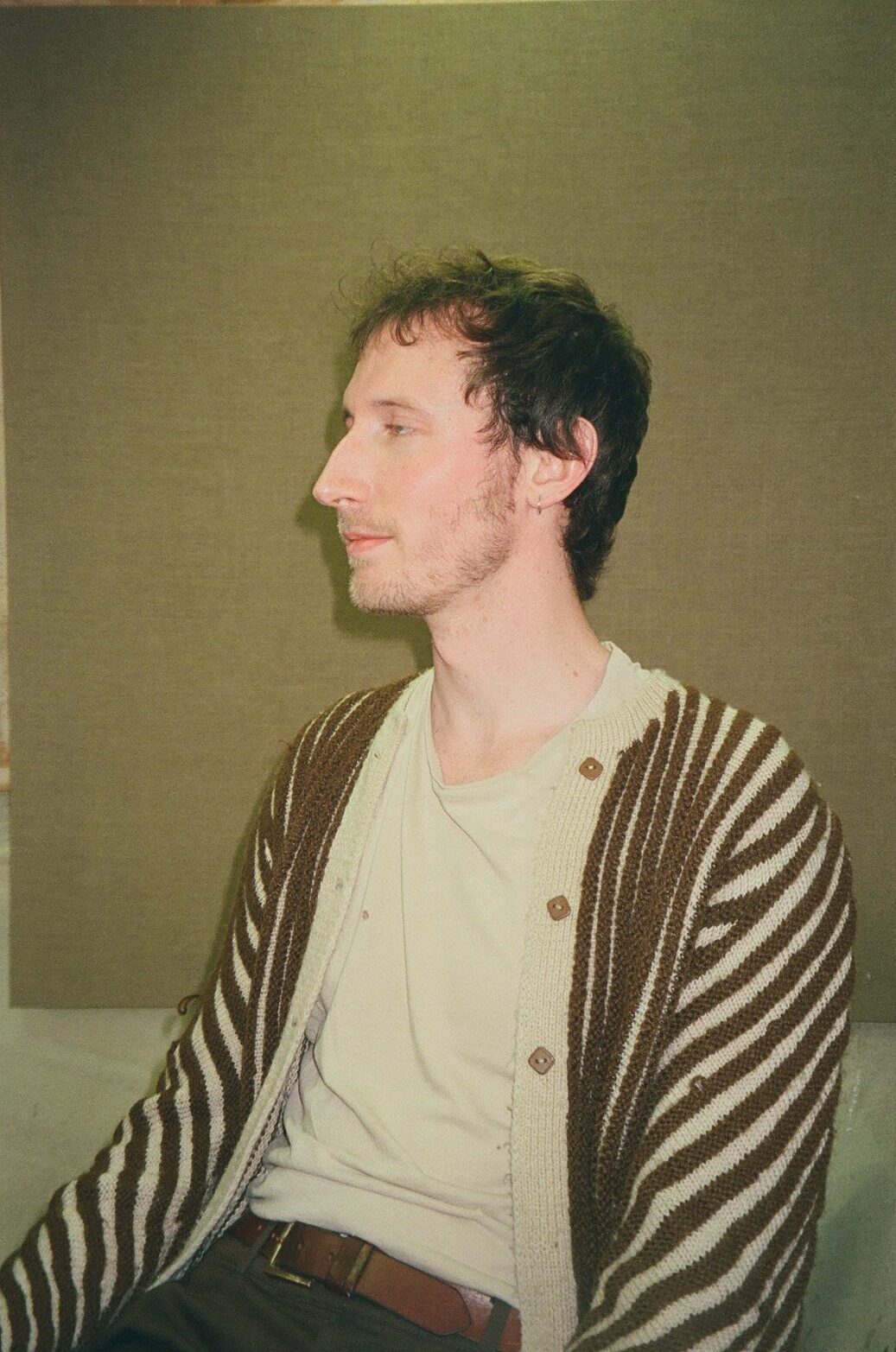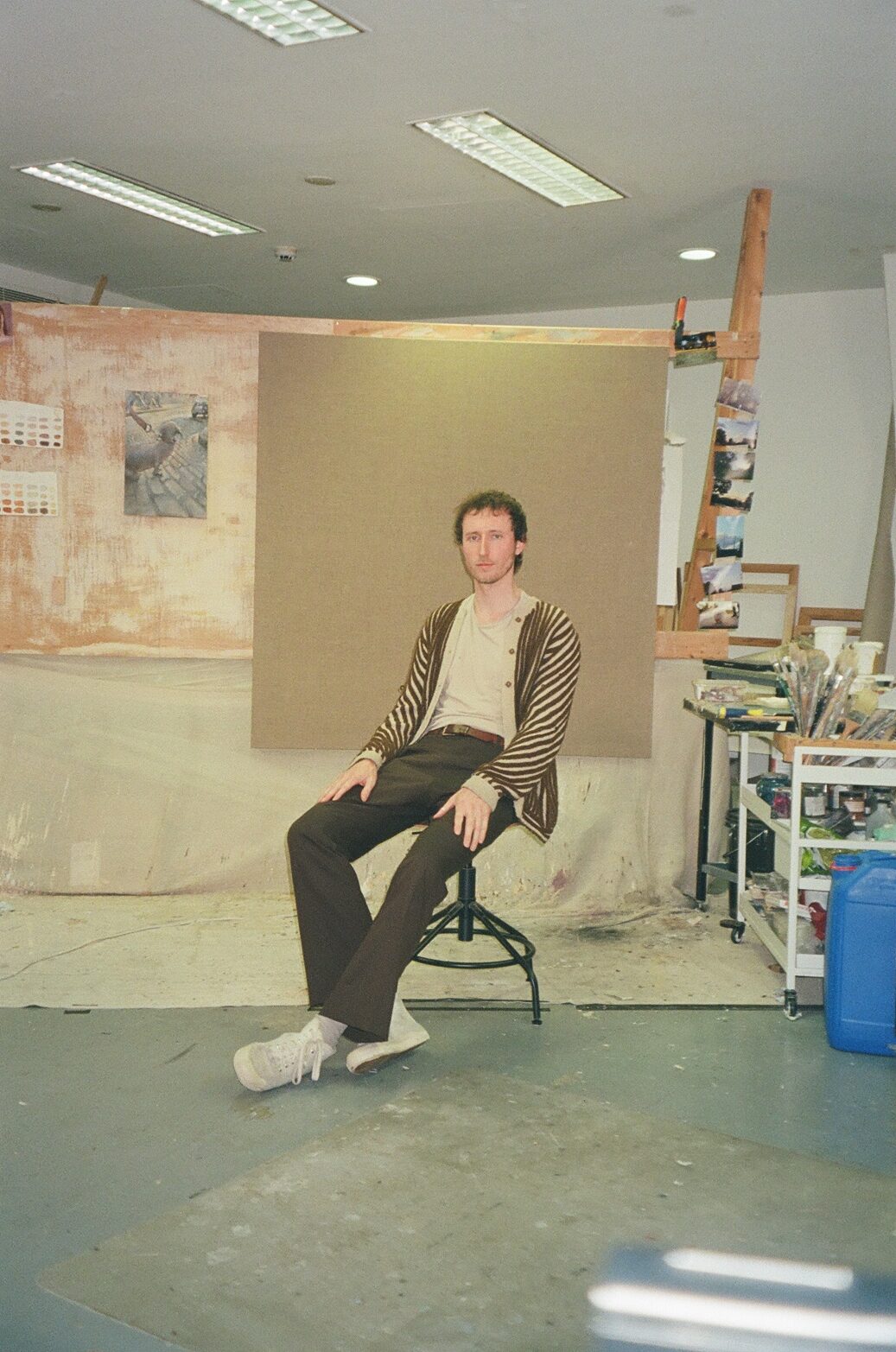
Ranny Macdonald describes painting as a threshold experience, a place where something begins to take over. “I get a sort of rush from it,” he says, “to be on that threshold… it feels like something else is kind of taking over, you know what needs to be done and you’re listening.” In those moments, the work becomes alive. It carries its own logic. It suggests its own next move. For Macdonald, that sensation is the reason to make anything at all.
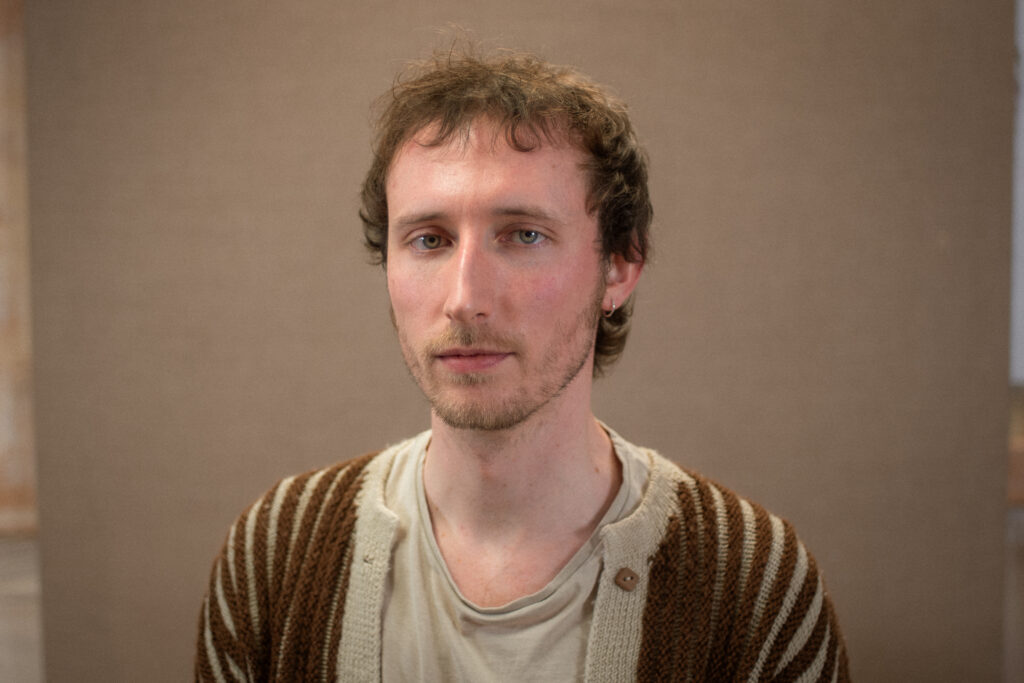
He is a British artist based in London who makes paintings and music. The two practices run alongside one another, sometimes intersecting, sometimes diverging, but always connected by the same impulse. Art, whether it is music or painting or sculpture, occupies what he calls a “completely mysterious” place. It is a realm of possibility. Without it, things feel rigid. With it, anything could be possible.
When he looks back at drawings he made as a very young child, he sees continuity. “It’s the same thing,” he says. “It’s the same thing over and over again somehow.” He remembers vividly a drawing of a dinosaur coming out of the ocean. The sky was black, the cloud white. He was thinking about light and dark, about how they worked together. He did not yet have the tools to resolve the problem, but the instinct was there. Something was trying to understand value, contrast, atmosphere. That early preoccupation has never really left.
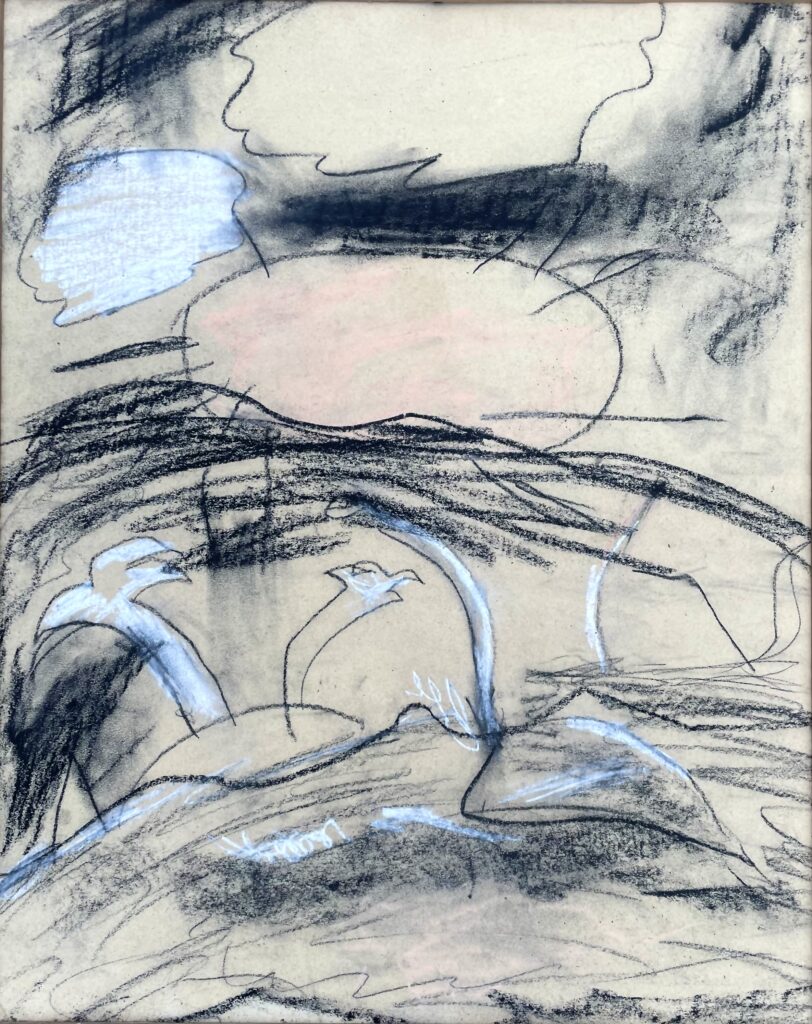
Nearly a decade ago, after spending time doing music more or less full time, he felt the need to return to painting more seriously. One afternoon, walking someone else’s dog in a park, he saw a Boston terrier run down a tree lined path. The scene struck him as strange and sad, somehow loaded. He wanted to paint it, to capture the atmosphere he felt in that moment. He tried repeatedly, but could not quite reach the place he imagined. So he left it, worked on other things, and returned to it years later when he was studying at the Royal Drawing School. By then he had become obsessed with clouds, painting them over and over. Eventually he realized the dogs and the clouds could come together.
His decision to go to art school had arrived earlier, in the summer before his final year of secondary school. It felt like stepping toward something unknown but necessary. Art was the thing that made him feel alive. He did not know what would come of it, but he sensed that studying would allow the mystery to remain intact, to stay “in the air.” He went to the Slade School of Fine Art and stayed for a year and a half before an unexpected opportunity intervened. A band he had been playing with needed someone to join them in America after a member left. He deferred his place and followed the band. They toured for several years before eventually breaking up. When it ended, he returned to finish his degree at City and Guilds of London Art School, completed two years there, and then undertook the postgraduate Drawing Year at the Royal Drawing School, graduating in 2022.
Throughout these shifts between music and painting, the underlying drive remained constant. When he is not making work, he feels it immediately. “If you’re not doing it you just get very sad and don’t feel like yourself.” Painting and music become almost an addiction, an obsession. They are practices into which he can put his whole body, entering a state of total involvement. In that immersion, he feels connected to the world differently. It is not that he feels disconnected otherwise, but art intensifies that sense of connection.
For a work to feel successful, it must create space. Macdonald describes his paintings almost as sculptures, worlds that can hold the viewer. The subject is a way in, a map or a game board. What matters is whether the space can sustain multiple meanings and experiences. Different people will encounter the same painting differently. They bring their own histories and interpretations. A painting succeeds if it can contain those varied narratives without collapsing under them.
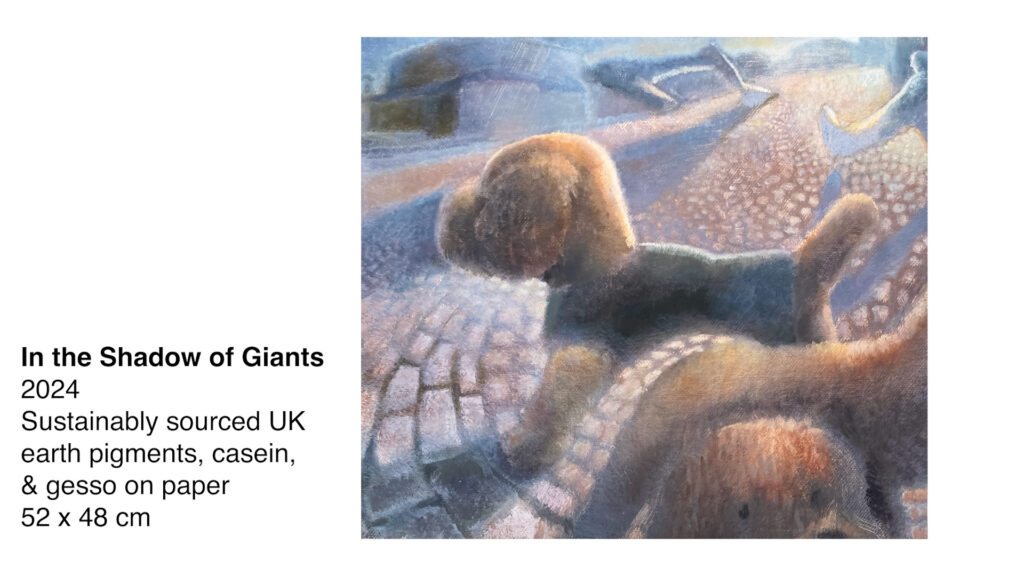
He thinks often about value, both in the technical sense and in the broader sense of systems. In painting there are light and dark, rising and falling, shape and form. Playing with those values creates tension and meaning. Early on, when he began painting dogs and pigeons, he was drawn to subjects that were not considered serious. Painting itself felt serious, weighted with history and expectation. He wanted to see whether a cute dog could carry that seriousness without losing its identity. Perspective became another tool for altering value, for shifting how a subject might be perceived.
Finishing a painting, for him, is a matter of timing rather than completion. He compares the process to making popcorn. At first, changes happen quickly and constantly. Then the pops slow. There comes a point when leaving it on the heat will burn more than it will produce. That is when you stop. Declaring a work finished is, in some ways, artificial. The painting will continue to change over time, physically and conceptually.
The same is true of songs. Melody travels through time and space, carried by different voices. He thinks about how Hallelujah exists across multiple versions and how the image of the song in his mind sits somewhere between those interpretations. The ending of a work is a decision, but the work itself remains alive.
The goal, then, is to keep it alive. To bring something into being that feels animated, and not to kill it while it is in your hands. That requires listening to the work itself and, eventually, letting it go.
Mistakes are essential to that process. Advice can only go so far, because until something is experienced, it remains abstract. The art world once felt mysterious to him. It still does, though less so than before. There are moments of disillusionment, followed by new sources of inspiration. He recalls a story told by Andrew Stahl at the Slade about receiving terrible reviews for a show and then, a week later, glowing praise. Nothing about the work had changed. Only the opinions had. The lesson was not to listen too closely to either praise or criticism. What matters is one’s own conviction.
As a teacher, Macdonald believes deeply that everyone has a voice. Skill is less important than the relationship between intention and skill. He describes skill as a threshold. Inside it are things you can do easily. Outside it are things you cannot yet do. Interesting work happens at the boundary, where you are dancing on the edge of what you can manage. To move slightly beyond your footing is risky but alive.
Material experimentation has been central to his practice. After working with oils and acrylics, he began experimenting with dry pigments mixed with gesso. He was searching for texture and immediacy. Around the same time, he became increasingly focused on anthropomorphism and the relationship between humans and nature. Animals with faces, charged perspectives, and shifting scales populated his canvases. He began reading Donna Haraway and thinking more explicitly about how images might reflect the entanglement between people and the natural world.
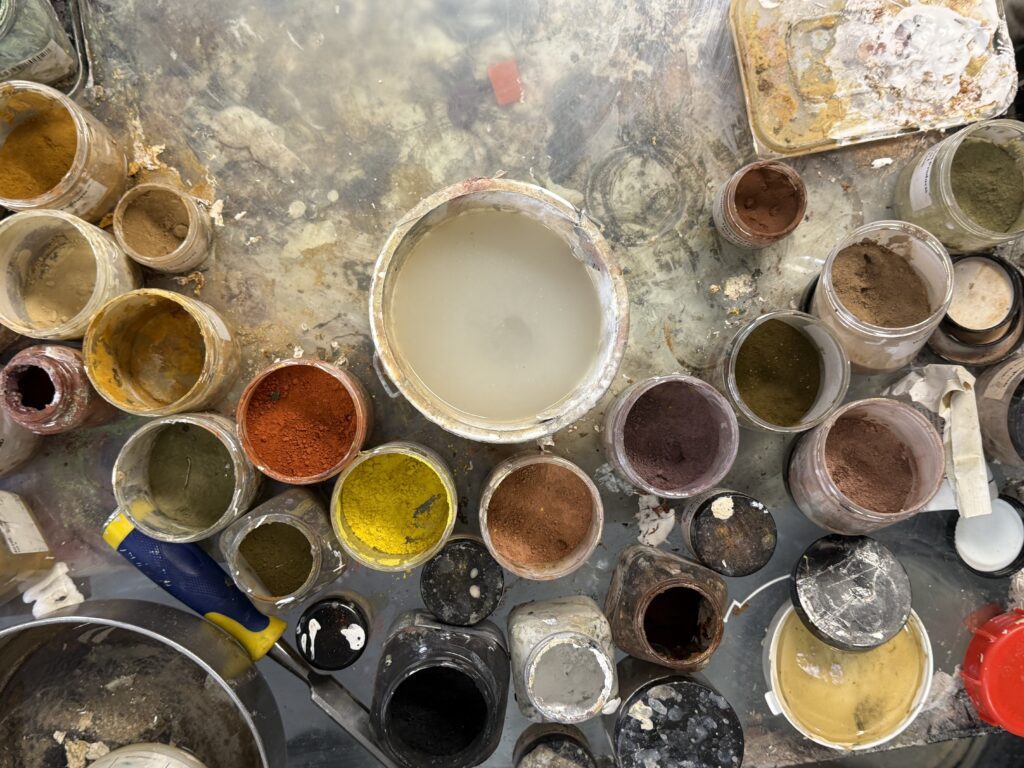
Using natural earth pigments felt like a logical extension of that research. Earlier, he had been drawn instinctively to bright colors, to cartoons, advertising, and post impressionist painting. Turning to muted, unprocessed colors was a deliberate counter move. He wanted to see how those earth tones might interact, how they might create intensity without relying on saturation. He describes colors as if they were people at a party. Some combinations are harmonious and deep. Others introduce tension. A single unexpected mark can function like a cameo appearance in a film.
Clouds have become one of the most persistent motifs in his work. He wrote his dissertation about them. He is fascinated by their ability to operate as physical forms and as metaphors. A cloud can signify heaven, data storage, an idea, or something entirely intangible. It sits on the threshold between the visible and the invisible. That threshold mirrors his broader concerns. He wants to make paintings that feel soft and cloudy, spaces that gesture toward something beyond what is immediately seen.
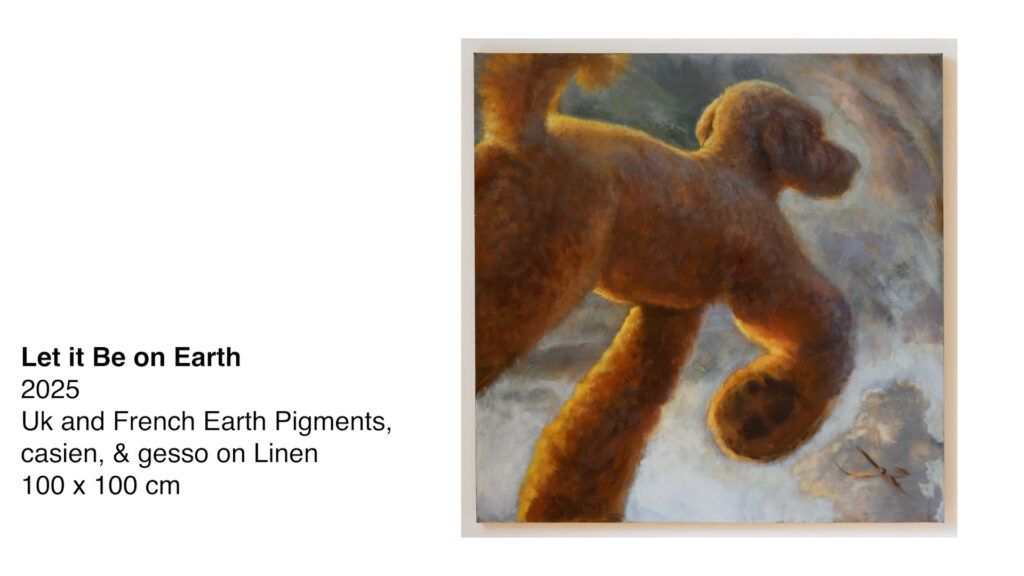
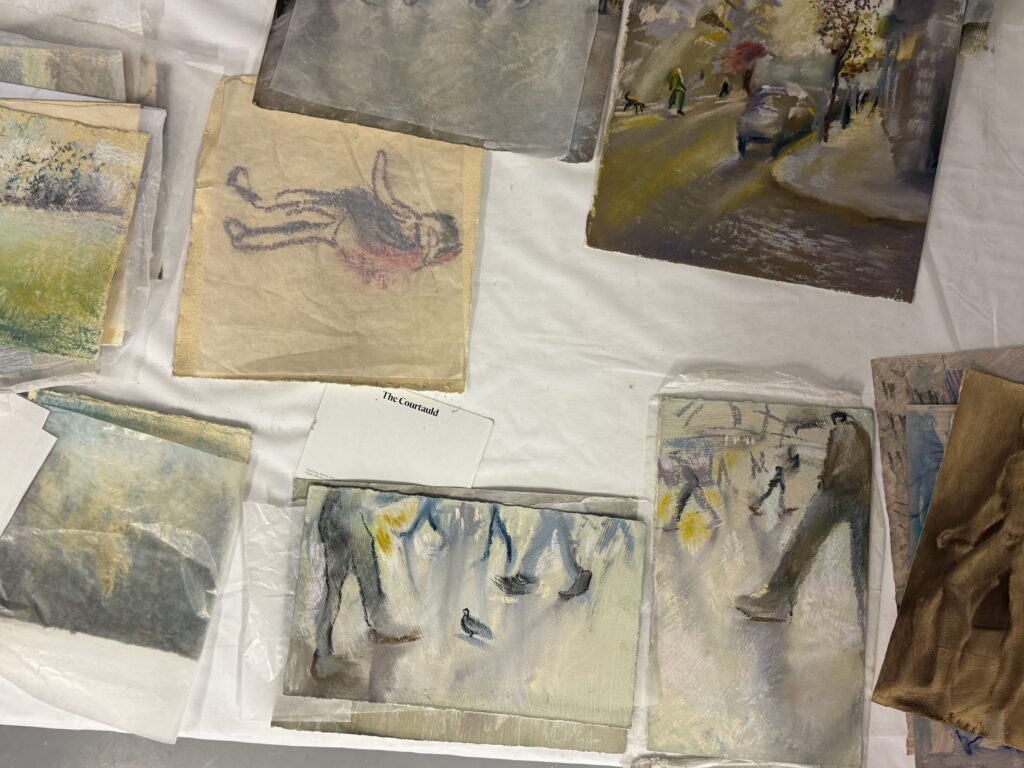
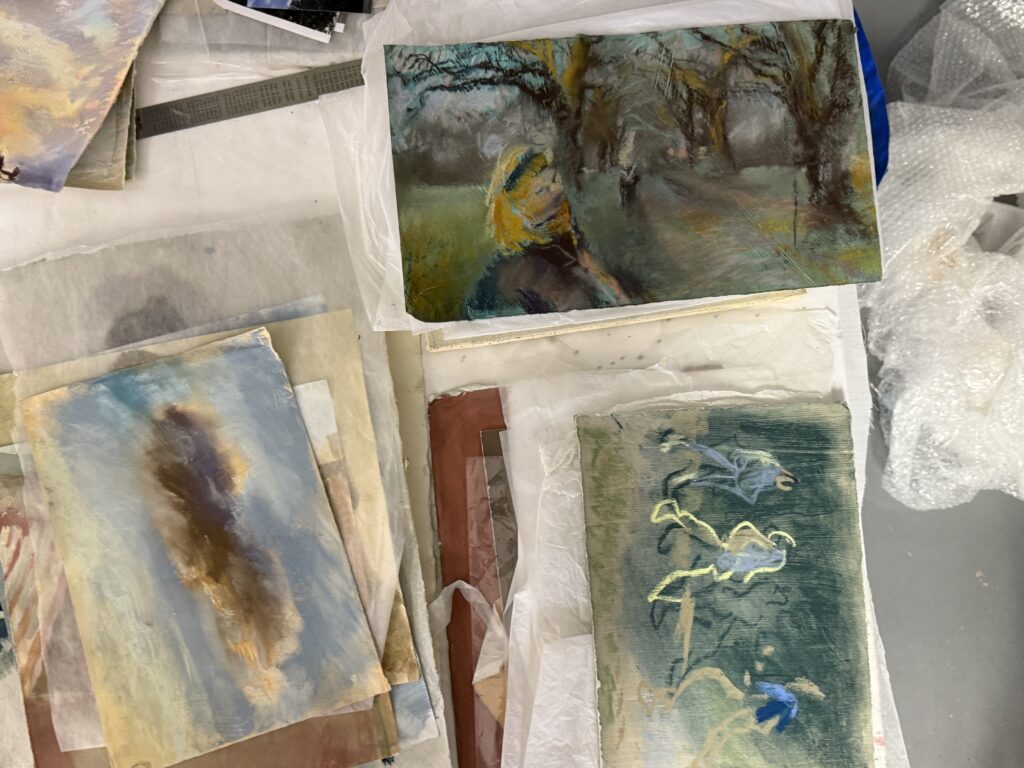
His studio materials reflect his emphasis on texture and immediacy. He favors thick, grainy linen and also works on paper and wood panels. He uses bristly brushes that resist too much control, allowing marks to retain their roughness. Chalk pastel on primed paper forms a significant part of his drawing practice. Sketchbooks contain quick attempts at resolving narrative and composition before larger paintings begin.
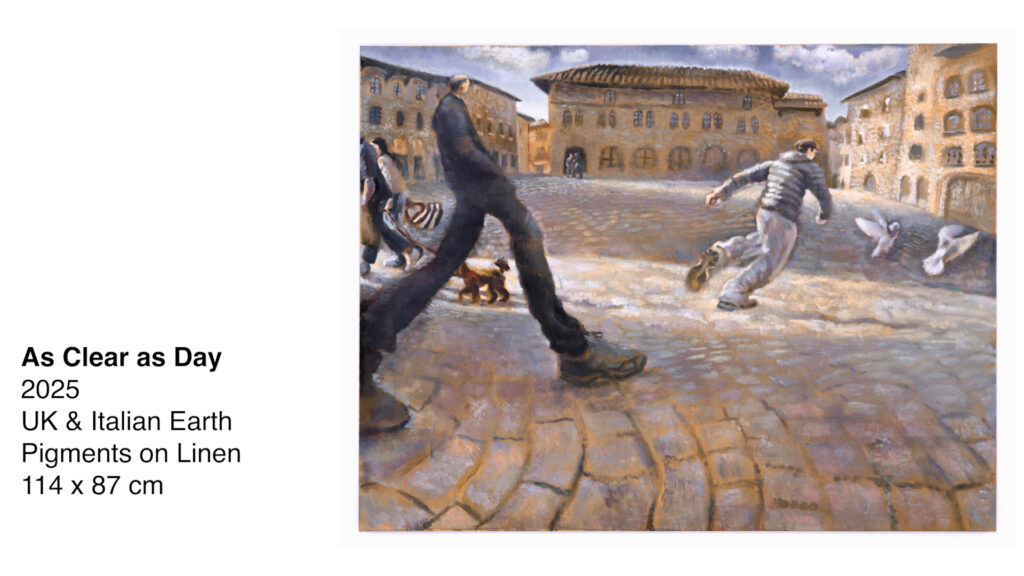
What ties all of this together is the pursuit of that initial glimpse. He describes it as a half remembered image, like a fragment of a dream upon waking. The painting process becomes a way of chasing that glimpse, holding onto it without letting it dissipate. Sometimes, if it is going well, the work flips. The thing he was pursuing transforms into something he does not fully understand, and he finds himself inside it.
For Ranny Macdonald, art is not about resolution. It is about maintaining contact with that edge, where skill and uncertainty meet, where the visible hints at the invisible, and where a painting or a song can become something alive enough to carry more than one meaning at once.