
Caroline Absher describes painting with oils as “the most enjoyable thing in the world,” it’s a way of living inside the material rather than controlling it. For her, oil paint is not something to be mastered through precision or restraint. It is something that wants to move, to change, to figure itself out. Control enters only briefly, maybe ten percent of the time. The rest belongs to the paint itself.
Absher is a painter living in Brooklyn, New York, originally from Greenville, South Carolina. She started painting because it was simply something children do. She painted, and then she never stopped. There was no decision point where she chose art over something else. It remained present because she could not imagine letting it go.
Her childhood unfolded far from cities or formal art spaces. She grew up surrounded by nature, with three brothers, in a place where there was very little to do except invent ways to fill the time. That absence of structure became fertile ground. The siblings built things constantly. In those early years, Absher thought of herself less as a painter and more as a sculptor. They constructed forts, huts, and makeshift houses. She became obsessed with fairies and built small fairy houses everywhere. Creation was not a scheduled activity. It was compulsive, intuitive, and constant. Looking back, she recognizes how rare that kind of childhood was and how grateful she is for it.
That impulse to make things never disappeared. She still works because she can, because free time naturally fills itself with making. For Absher, passion is not something abstract. It is simply what occupies your hours. She believes deeply in paying attention, in staying present with time instead of letting it slip away unnoticed. Making art has always been her way of doing that. Over years of repetition, that instinctive behavior slowly became a consistent practice, and eventually something more defined.
The first moment she recognized that what she was doing might be art came later. She insists that everything is art, but sometime in middle school she noticed a difference. Her drawings did not look like those of her peers. It was not about skill in a competitive sense, but about approach. She realized she was seeing and translating differently. That recognition did not arrive with clarity or ambition. It simply settled in as an awareness that something distinct was happening.
Today, her goal is not to force meaning into her work but to build a relationship with it. She wants to allow the paintings to transform her while she transforms them in return. She works to keep that relationship free from expectation. She does not ask the painting to be anything specific, and she does not ask herself to perform a role. That open space between artist and work is something she actively protects. She believes it is easy to lose, and she has noticed how quickly it can slip away.
For Absher, one function of art is deeply personal. It allows the artist to come back home to themselves, to remember who they are through the act of making. That moment exists only while the work is still in the studio. Once it leaves, it becomes something else entirely, with a life of its own. Because of that, she is intentional about how she engages with the work while it is still hers. That intimacy matters.
Inspiration, for Absher, is everywhere. She tries to remain open to small synchronicities that unfold throughout the day. The movement of a tree. The way someone speaks. Language itself. She finds poetry in film, which she loves deeply, and in music, which she listens to almost constantly. Music is not background for her. It is essential. She also draws inspiration from people, from love, from romance, and from the desire to extract as much meaning as possible from experience. Learning, growing, changing, and integrating new ways of seeing are not optional. They are part of her artistic responsibility.
Recently, her studio has been filled with sound. Classical music. Ancient sounding flute recordings that feel connected to forests. Whale songs that she describes as magical. She paints while immersed in these sounds, letting them shape the emotional environment of the work. One artist who has stayed with her since childhood is Sufjan Stevens, whose music created a lasting sense of connection and influence that she still feels today.
Sound does not just accompany her paintings. It lives inside them. When Absher encounters a painting that resonates deeply, she feels as though she can hear it. Some paintings are lyrical and musical in a way that defies explanation. She believes this quality cannot be consciously constructed. It emerges through the magic of painting itself. Her own work shifts depending on what she is listening to, how she feels, and where she is in her life. Years later, when she looks back at older paintings, the sound she hears often matches the emotional tone of that period. The painting becomes a time capsule, holding not just an image but an atmosphere.
Her advice to younger artists is simple and firm. Make things constantly. Do not worry about how they look or whether they are good. She rejects the idea that goodness in art is a fixed category. Time is the most valuable resource available, and free time should be used with intention. Everything can be art. You do not have to paint. You can write poetry, make music, or create in any form. It is all connected. She cautions against thinking of work primarily as something to market or sell. The focus should remain on making what feels right.
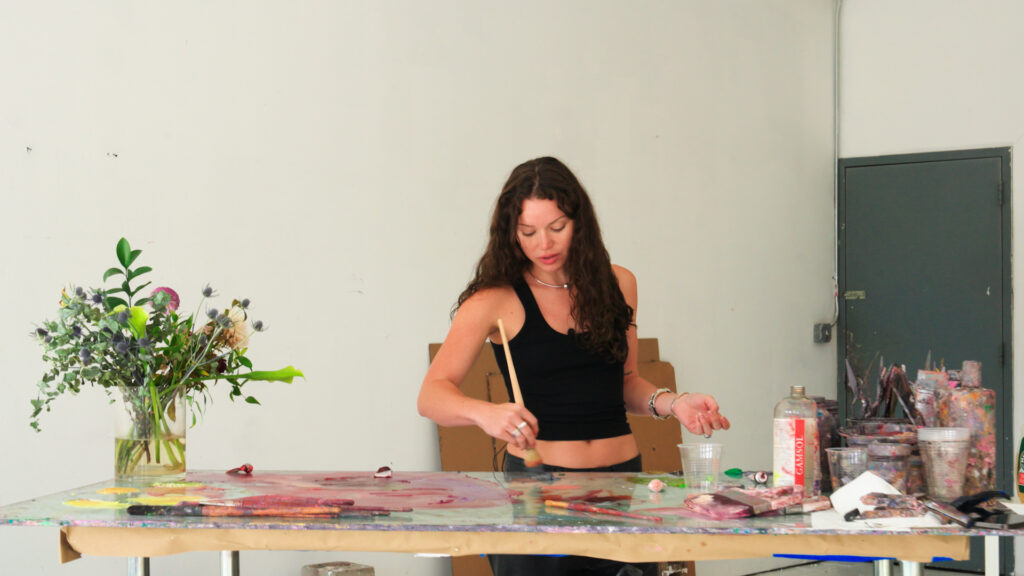
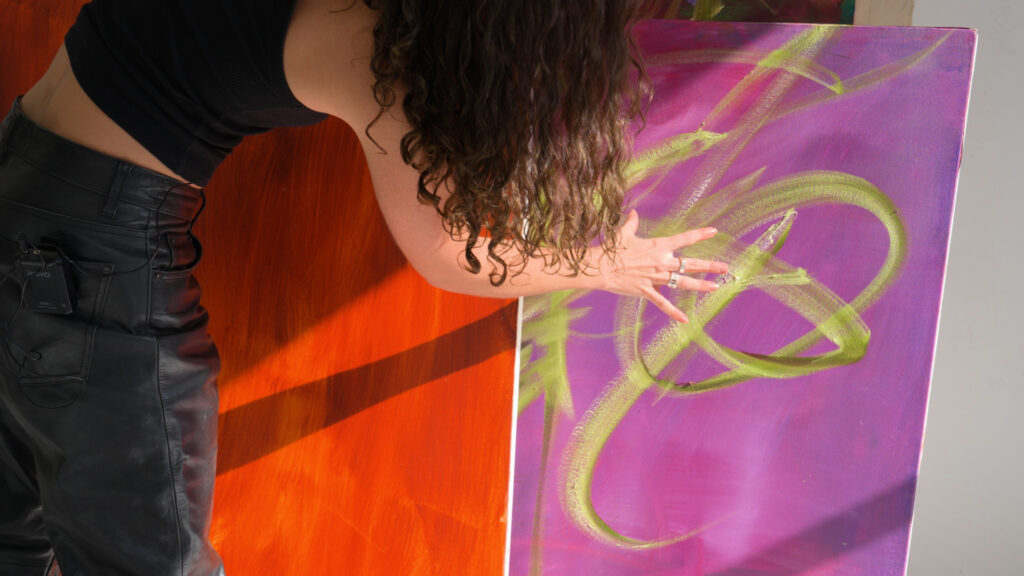
Her process is physical and immersive. She stretches and primes her own canvases. She begins with abstract, expressive painting, using all her paint, all her energy, everything she has. She paints until the surface is saturated with movement. Then she often destroys what she has made. This cycle repeats again and again. Addition and subtraction. Layering and scraping. The paintings move from wall to floor. She uses anything that will create texture, broomsticks, tools, improvised instruments. She continues until the surface feels balanced.
Only then does she consider introducing a figure or a narrative. She studies the shapes and atmosphere that already exist and tells herself a story about what she sees. The first idea that comes to mind is usually the one she trusts. She commits to it without hesitation. If it works, the painting moves forward. If it does not, that failure becomes another layer to build upon. There is no endpoint where something is lost. Everything feeds the next iteration.
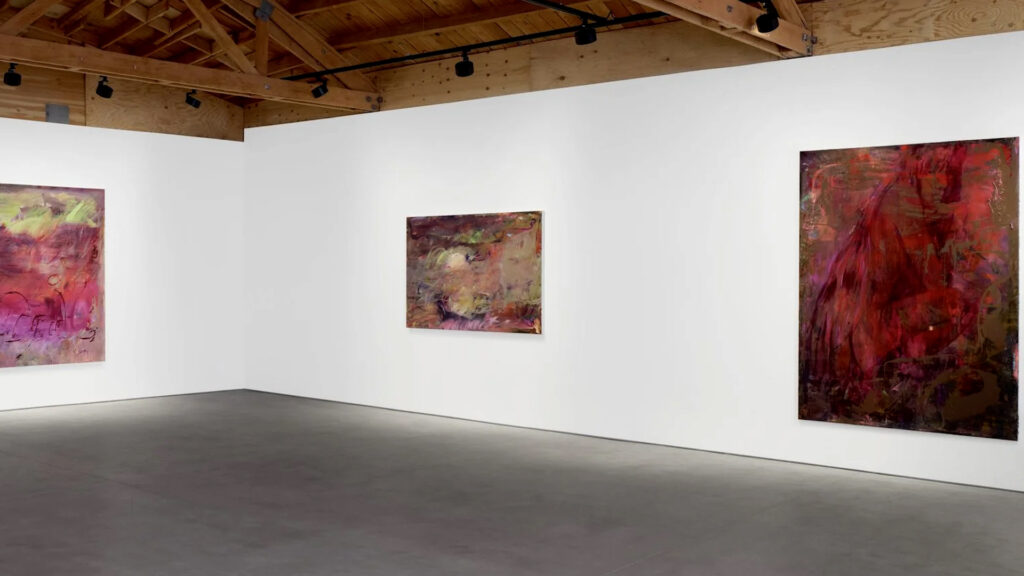
Color plays a central role in her work because of its emotional weight. She is drawn to the tension and balance that color creates. Having the full spectrum available can feel overwhelming, but she leans into that abundance rather than restricting it. She seeks nuanced combinations that feel as though they are saying something new. She allows colors to blend, to become strange, to behave in ways she did not plan. The process begins with everything and narrows gradually.
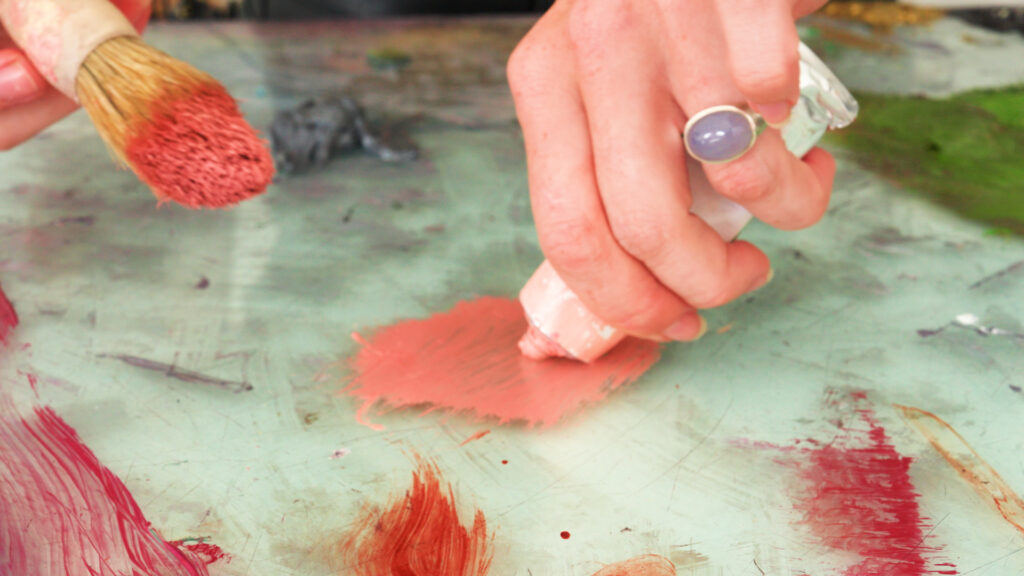
Absher works exclusively with oil paint. She uses standard materials like linseed oil and gamol, and recently began mixing her own paints from raw pigments. For her, this is both a science experiment and a return to the fundamental pleasure of the medium. One of the aspects of oil painting she loves most is its impermanence. When oil dries, it becomes a new surface. She describes it as similar to a dry erase board. The pressure disappears. She works wet on wet with intensity, knowing that nothing has to remain permanent if she does not want it to. That knowledge creates freedom.
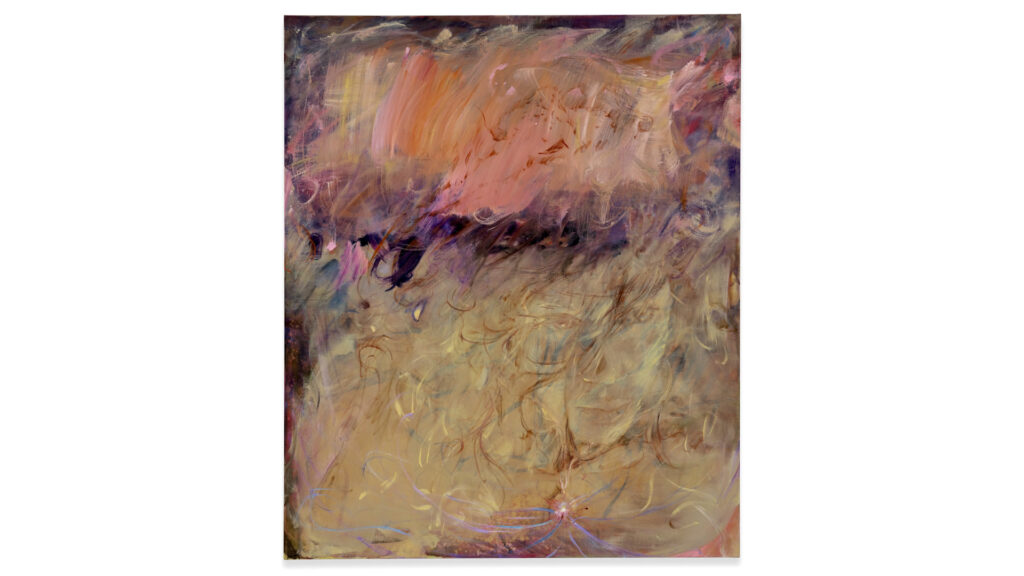
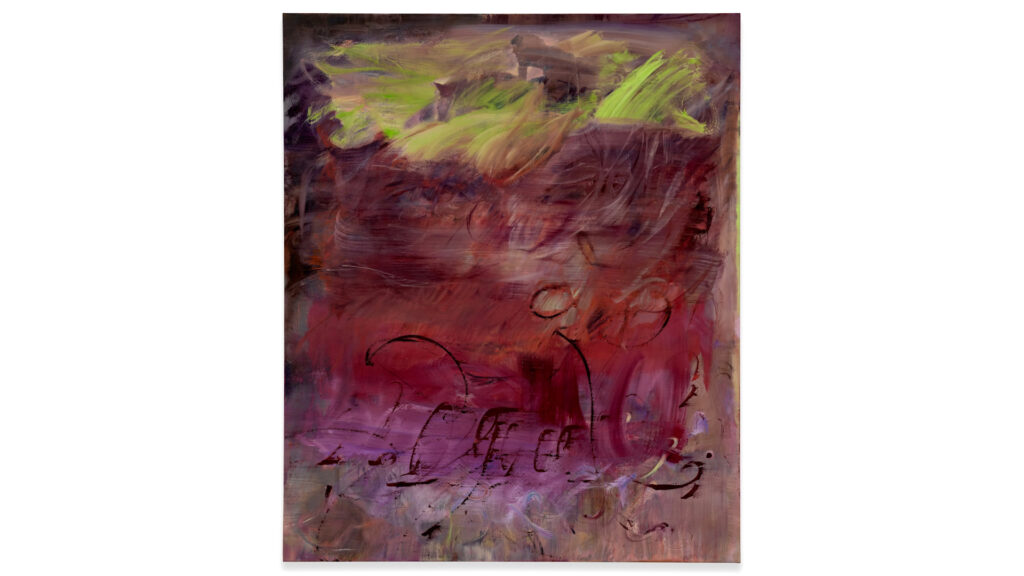
Over the past few years, she has noticed a shift in her work. There has been an unraveling. She has begun releasing control and paying closer attention to the places she consistently returns to within the paintings. Patterns have emerged. Her next body of work will focus on listening to those patterns and allowing them space to develop. Place has become increasingly important. She has been making work in different studios, locations, and countries. Her next series will be shaped directly by its environment. She plans to paint in the woods, in the forest, and ultimately in the rainforest.
For Caroline Absher, painting is not about resolution. It is about staying present, remaining open, and allowing the work to lead her somewhere she could not have predicted. The studio is not a place of answers but of attention. And that, for her, is where the real work happens.
Help support Timestamp (we’re an Amazon Associate) when you buy art supplies with our affiliate links (we earn a small commission at no extra cost to you):
Shop for Oil Paint: https://amzn.to/43UkZLA
Shop for Williamsburg Brand Oil Paint: https://amzn.to/3XSODNV
Shop for Canvas: https://amzn.to/4nG9q1I
Shop for Brushes: https://amzn.to/4nJQJdQ
About the Author
Sam Burke is an American artist and writer based in New York City. Working across film, performance, and writing exploring storytelling, identity, and place. As co-founder of Timestamp, Burke interviews artists, shares insights, and highlights conversations shaping art world today.
Amélie Caussade
Amélie Caussade’s journey as an artist began unexpectedly, born from a moment of sudden disruption….
Amy Bravo
Amy Bravo’s work unfolds as a raw, layered exploration of emotion, memory, and identity. An…
Why Long-Form Conversations Matter in an Era of Short-Form Art Content
In today’s media landscape, short-form content dominates nearly every platform. From TikTok to Instagram Reels,…
Cathleen Clarke
Cathleen Clarke has always been drawn to the spaces where memory begins to thin out….
Vasco Del Rey
Vasco Del Rey’s journey as a painter began with a small, bright green and yellow…
Eleanor Arbor
There has never been anything Eleanor Arbor enjoys more than making. It is not about…
That idea of letting the paint “figure itself out” is really interesting – it feels like a different approach to creativity than I’m used to thinking about.