
Carlo D’Anselmi is a painter based in New York whose work builds believable colorful worlds on canvas, pictorial spaces with their own internal logic, where objects, figures, and symbols sit in relationships that are meant to surprise the viewer rather than settle into a single, closed meaning. He works primarily in oil painting, though largely private practice of wood carving run underneath everything he makes, feeding into a way of thinking about images that treats painting almost like sculpture: he wants the forms in his paintings to feel real and three-dimensional, not flat illusions borrowed from a picture plane.
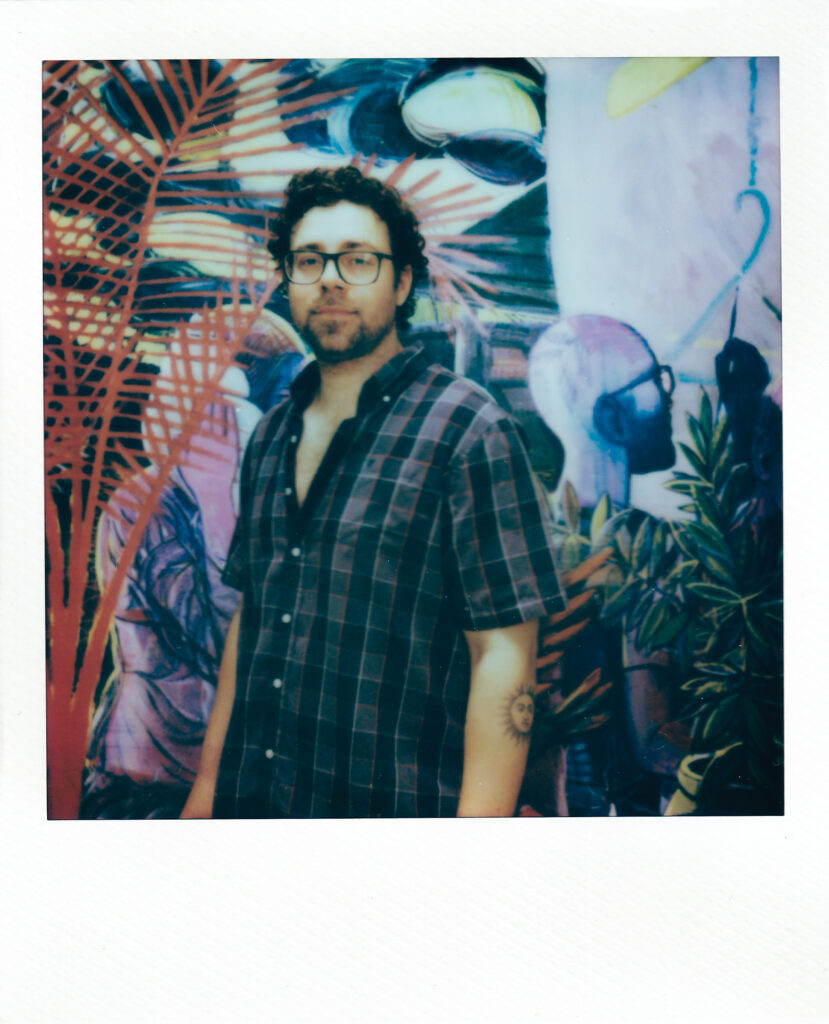
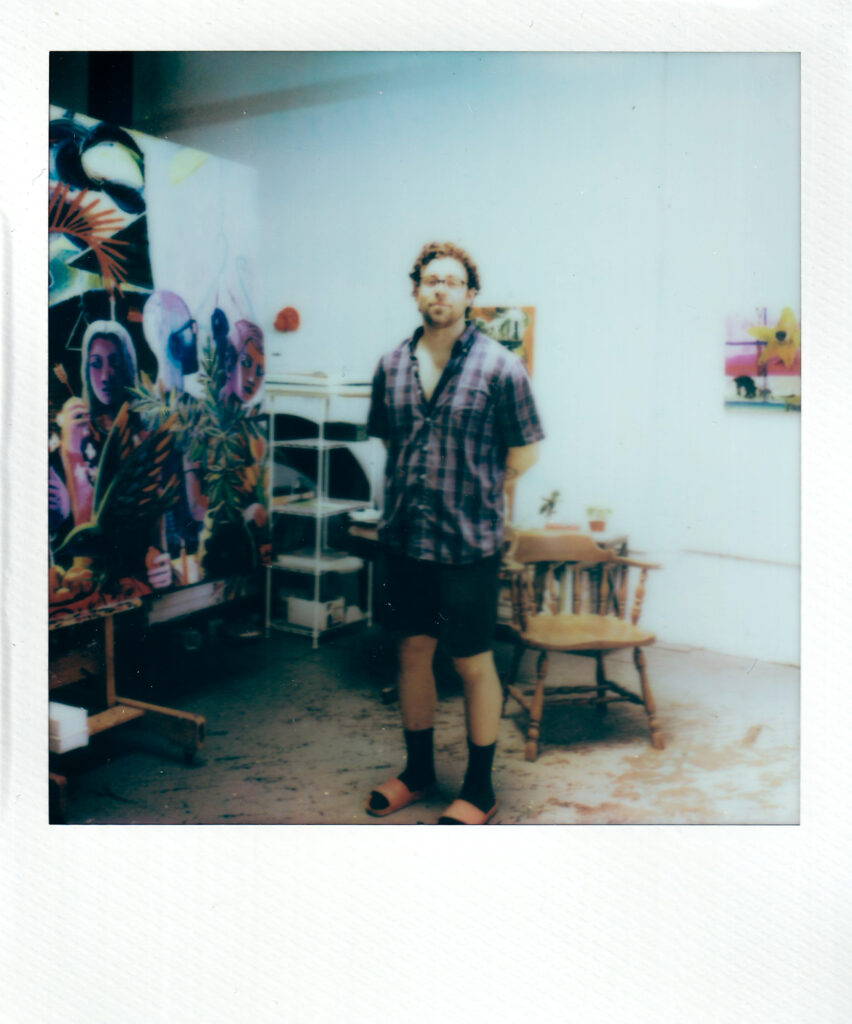
D’Anselmi didn’t have a single moment when he discovered art, because art was never separate from his life to begin with. Both of his parents are artists, and his earliest memories are already full of the material culture of painting, watching his father stretch canvas, mix rabbit-skin glue, and paint, and being brought along to the Metropolitan Museum as a small child. The family moved out of New York City when he was four, and he grew up with an atypical, homeschooled childhood that left him with long stretches of unstructured time. Much of that time was spent outdoors, where he developed a habit of carving pieces of wood into animal forms, a practice he now describes as a kind of “proto-schooling” in art-making, something he gravitated toward naturally rather than being taught. He also drew constantly with his father on Saturdays, describing him as an unusually good teacher who would set up an idea and then sit down and work through it alongside him. Unlike many artists who had to fight family expectations to pursue a creative life, D’Anselmi never faced that particular battle. Art was simply treated as a normal, encouraged part of living.
That ease didn’t last uninterrupted, though. In high school, he clashed badly with an art teacher who insisted he follow her specific direction and would draw over his work to correct it, which he experienced as deeply invasive. The friction left him angry enough that he decided, after graduating, that he didn’t want to make art anymore. He went to college as a classics major instead, studying Latin and Greek, developing a real love for ancient culture, Roman history, and Italy, and even participating in an archaeological dig. For about three years he stayed genuinely committed to that path, until he was forced to confront the practical question of what he actually wanted to do with his life. In hindsight, he realized he had been clearing his required classics coursework early so he could make more room for the art electives he was still quietly taking. The realization arrived, in his telling, almost like a light switching on: this was what he had always wanted to do. He applied to art schools immediately, skipped any gap after college, and moved straight into New York, where he studied at the New York Studio School under a mentor named Graham Nixon, who sadly passed two years ago. D’Anselmi credits Nixon with shaping how he thinks about painting as a kind of adventure, and describes falling in love, during that period, with color and with paint itself, a relationship that’s now thirteen years old.
Art school gave him two lasting things: a community of fellow painters, some of whom remain his closest friends today, and a specific resistance he’s carried with him ever since. He noticed what he calls a “cult worship” dynamic among some students, an eagerness to adopt a favored teacher’s ideas wholesale, and it repelled him. He describes himself, half-joking, as a natural contrarian, someone who takes in an idea, lets it settle, and then insists on doing it his own way. That instinct has hardened into an explicit standard for his own work: everything he paints has to feel entirely his, generated from within rather than borrowed. He compares his process to being a sponge, absorbing outside influence, then squeezing it back out until it becomes unmistakably his own. He’s aware of the paradox sitting inside that ambition, the old argument that nothing under the sun is truly new set against the equally true fact that no one has ever made exactly this painting, in exactly this way, before. He holds both ideas at once. But his personal test remains simple: if he looks at a finished painting and recognizes the idea from somewhere else, it isn’t good enough yet.
That refusal to settle for a single, legible idea extends into how he thinks about subject matter generally. He’s suspicious of paintings built around one closed subject, arguing that work gets more interesting once it stops answering a single question and starts raising several at once. He’d rather a painting pose more questions than it resolves. Underlying this is a genuine, almost philosophical commitment to the reality of pictorial space. He recounts a conversation with a Hungarian philosopher who challenged his casual use of the phrase “drawing from life,” pointing out that what’s real is ultimately a matter of the mind, that a Vermeer painting is, in its own way, just as real as anything sitting in front of you. D’Anselmi took that seriously. For him, once a viewer enters a painting’s internal world with real belief, the things happening inside that world become real in a meaningful sense, governed by their own rules the way a dream is. He returns to the dream comparison more than once, noting that a dream can feel completely convincing while running on entirely different logic than waking life, a person who looks nothing like someone but is somehow understood to be them, physical rules that bend without breaking the experience of belief. He thinks a painter has to trust their own pictorial space with that same totality, without cynically exploiting it, in order to make something that carries real weight.
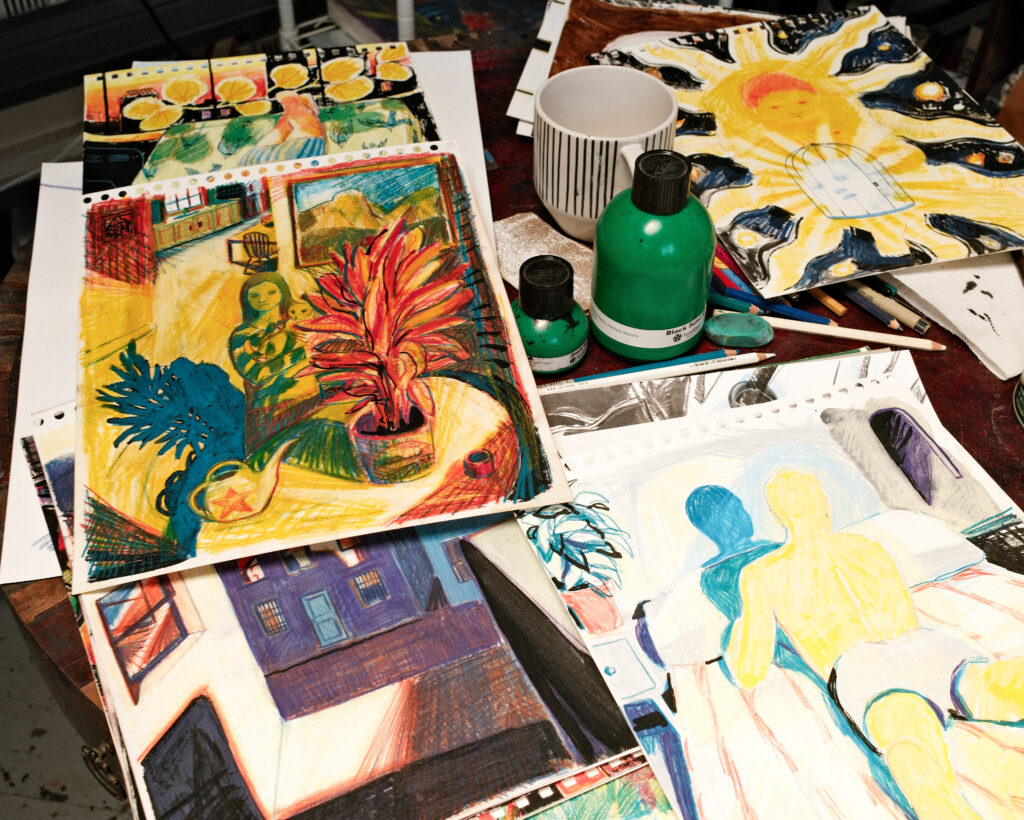
His studio process starts, deliberately, from nothing. He begins with a blank canvas, working against emptiness rather than from a fixed plan, letting an image emerge and then editing what surfaces. Drawing plays a specific, non-planning role in this process: it functions less as preparation than as an escape hatch, something he turns to nine times out of ten when he hits a wall in a painting, using it to reroute his thinking, almost the way a new neural pathway might open. He also keeps up an entirely separate practice of drawing purely for its own sake, sometimes from life, a residency in Switzerland, a balcony in Naples where he sketched in the morning while visiting his brother, and sometimes purely from imagination, invented compositions with no external reference at all. He describes discovering as a kid that image-making came naturally to him in a way other skills didn’t; he spent thirteen years learning piano but could never improvise, unlike his brother, who could simply sit down and play. Handed a pencil and paper instead, though, he found he could generate something immediately, almost without thinking about it, a fluency he still treats as something worth protecting, because it lets him keep the work moving indefinitely.
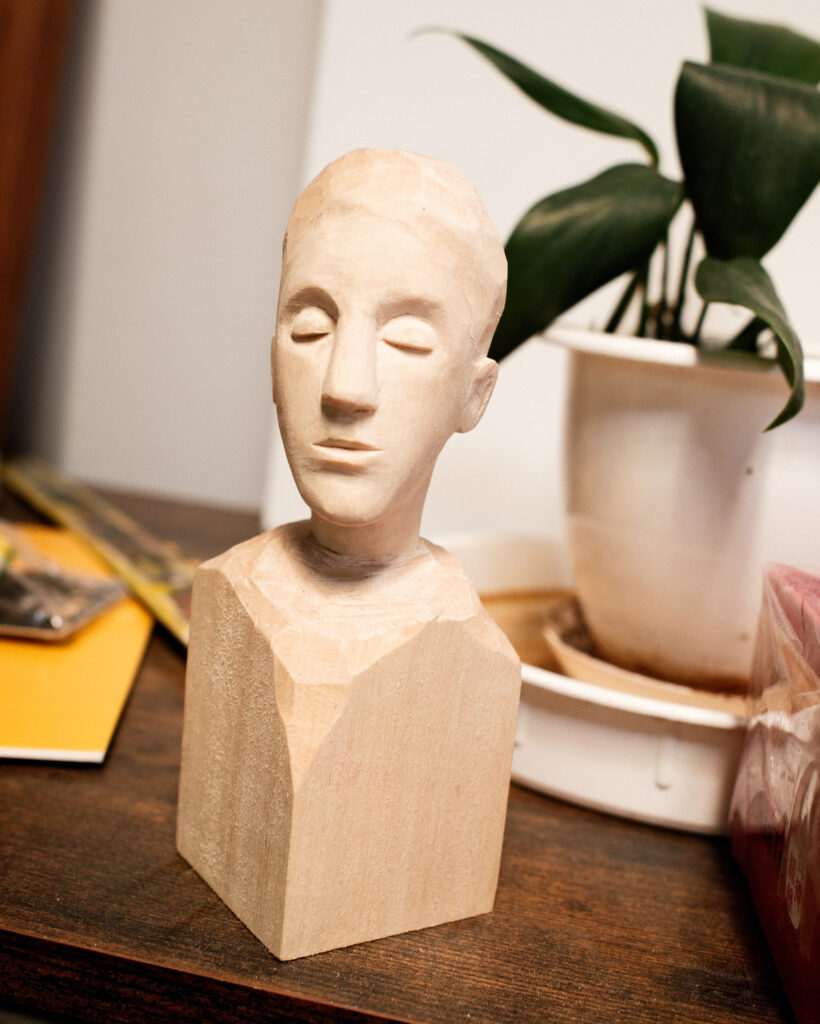
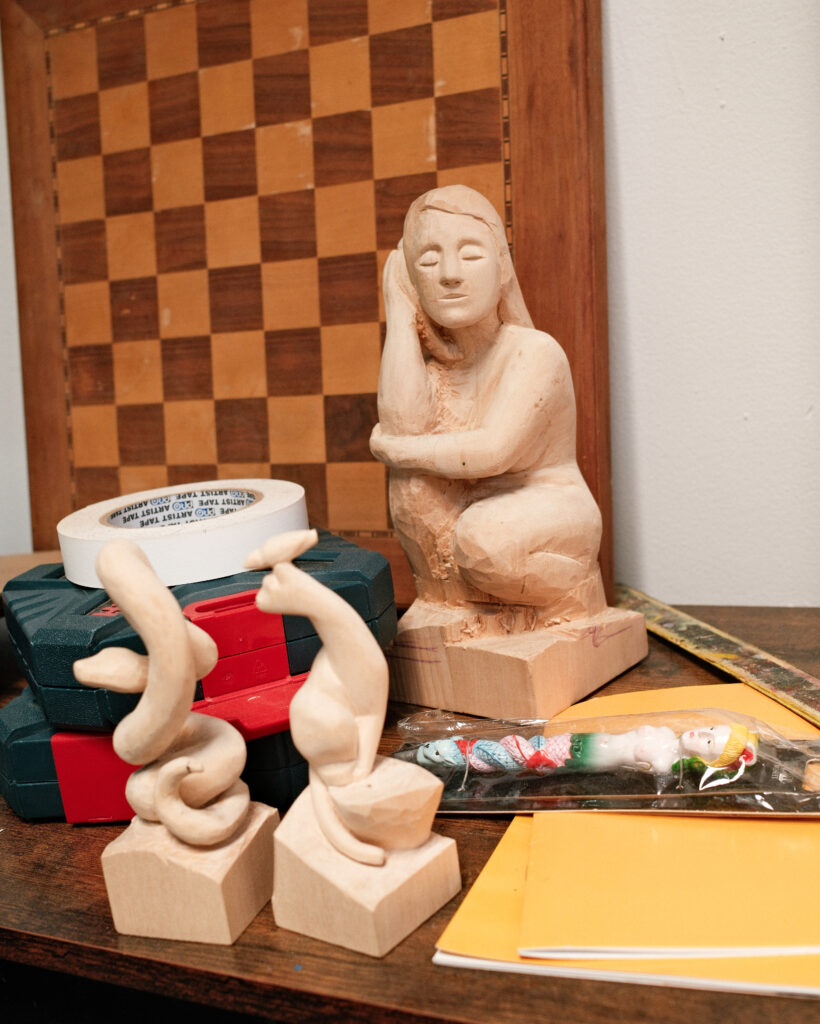
Sculpture completes what he thinks of as a triangle with drawing and painting, each point informing the others. Though he’s shown only one sculpture in his life, a single clay piece, he’s spent years quietly carving wood, mostly basswood, working in a reductive process he approaches with real caution, since removing material is a decision that can’t be undone. He invokes the old idea, associated with Michelangelo, of freeing a figure already trapped inside the block, and treats that mode of thinking as something that reshapes how he approaches painted forms as well, imagining a shape as an actual, sculptural object occupying real space in a room, rather than a flat illusion resting on the convincing power of drawing alone.
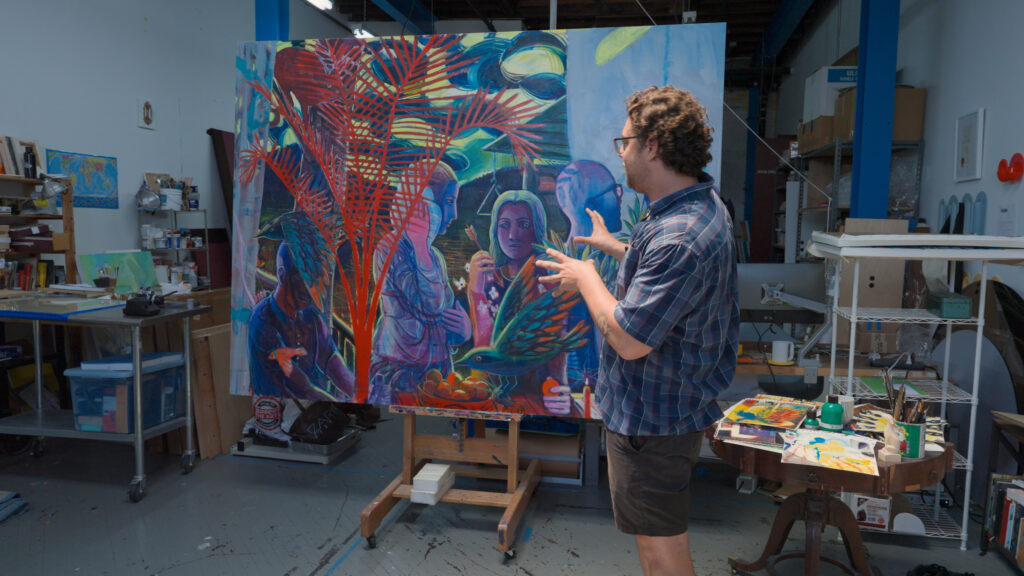
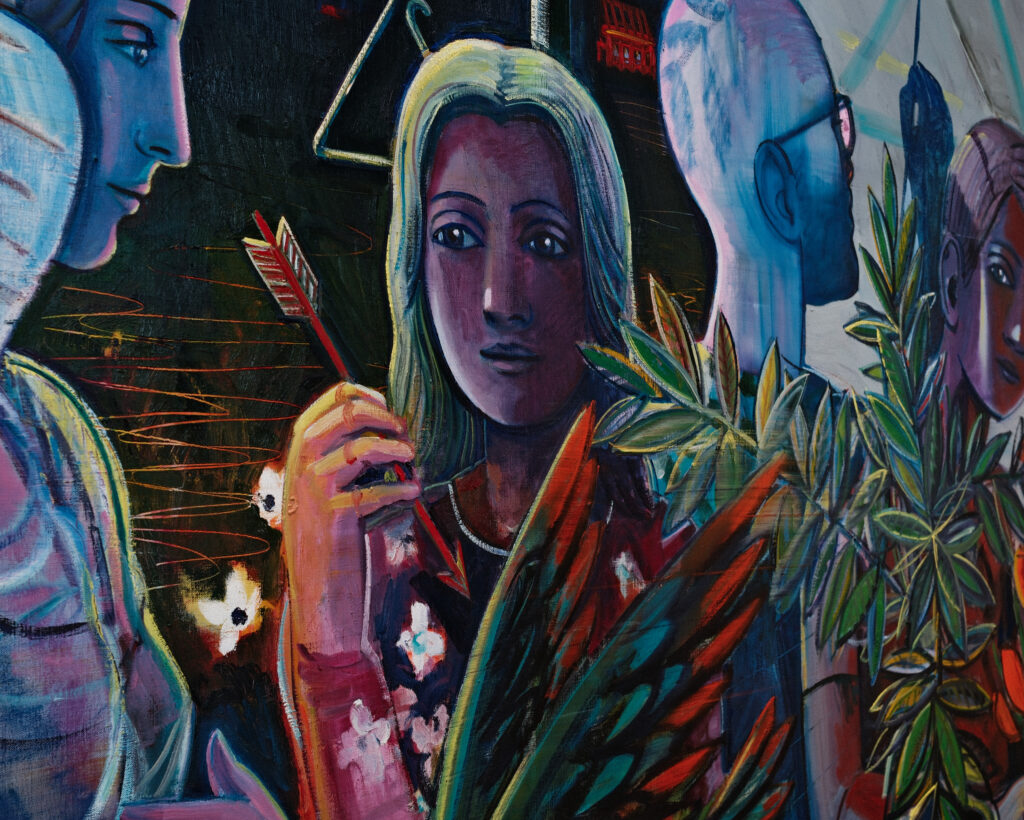
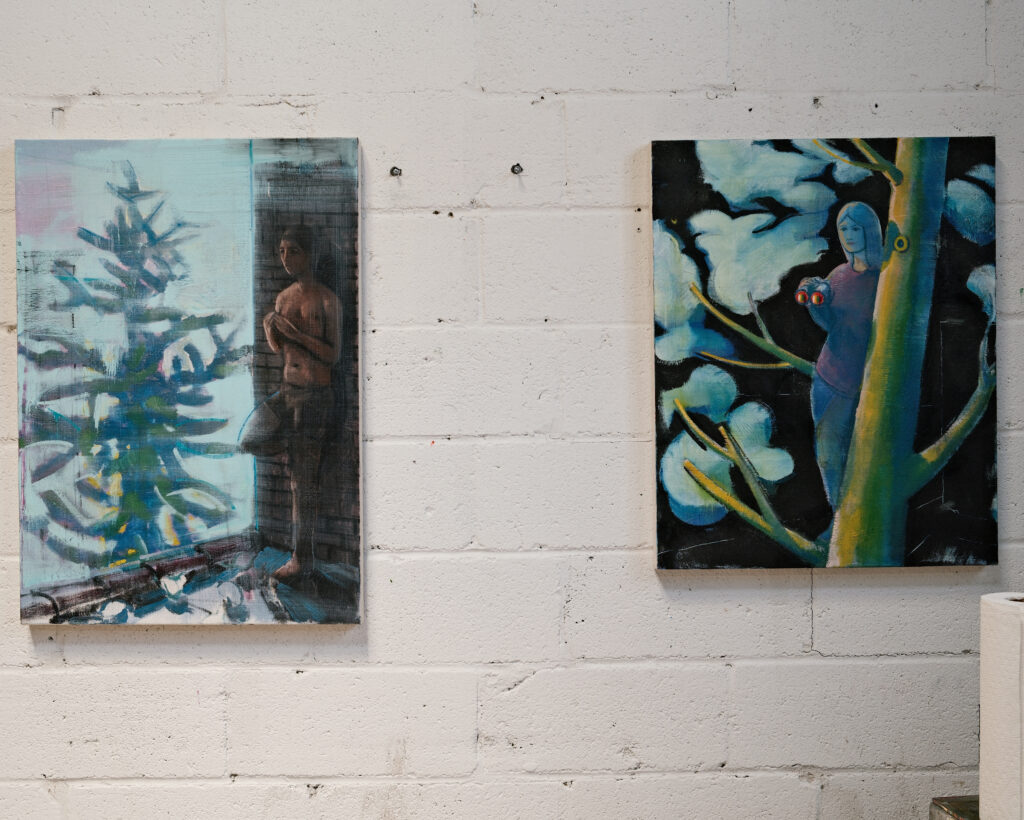
That layered, associative approach to imagery is visible in how individual paintings come together. One recurring symbol, the arrow, functions for D’Anselmi as a love metaphor with real violence embedded in it, Cupid’s arrow, the tradition of St. Sebastian, the strange fact that piercing someone is the oldest shorthand culture has for romantic feeling. A 2023 show in Taiwan, titled Point Blank Range, built an entire body of work around arrows driven into apples, worked through that same tension between tenderness and threat. In one painting he describes at length, a figure prepares to puncture an orange with a small arrow, not lethal, just enough to hurt a little, while other unrelated elements accumulate around her: a cat stuck in a houseplant, watching from a tree; a triangular architectural detail lifted from his grandmother’s summer house, a place she sold nearly a decade ago that he was trying to reconstruct from memory; birds introduced partly for the movement they created in the composition; a sheet of fabric enlarged into a towering shadow, an idea borrowed directly from watching a Michael Jackson performance where his shadow, thrown enormous against a curtain, magnified every small gesture. None of these elements arrived with a fixed explanation. They accumulated, the way ideas do across years of working on related bodies of work, until the painting became a kind of self-portrait built from unrelated fragments rather than a single legible scene.
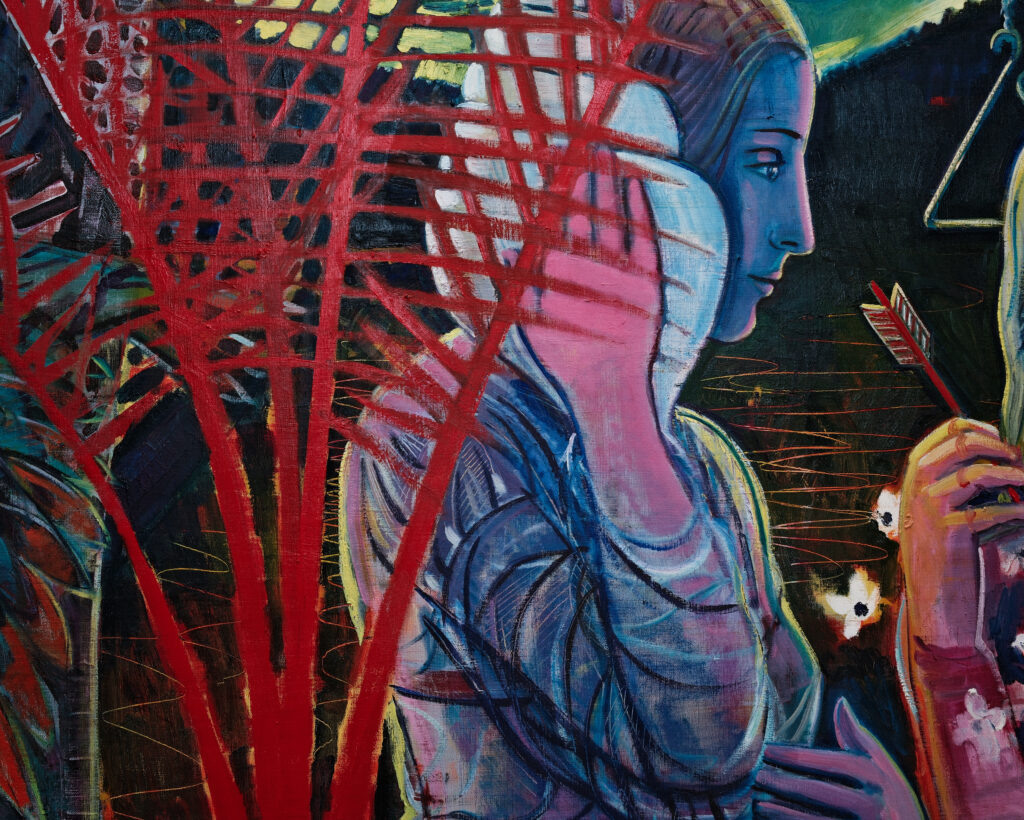
D’Anselmi is unusually candid about how visible he wants his own uncertainty to remain inside a finished painting. He values pentimenti, the traces of earlier, abandoned decisions still faintly present under a resolved image, because they let a viewer follow the actual thought process that produced the final result, rather than presenting only a clean, settled answer. He compares this to erasing and redrawing a line repeatedly until it’s right, and considers the visible evidence of that struggle almost sculptural, since it lets you trace the hand and mind of the person making it rather than just the outcome they landed on.
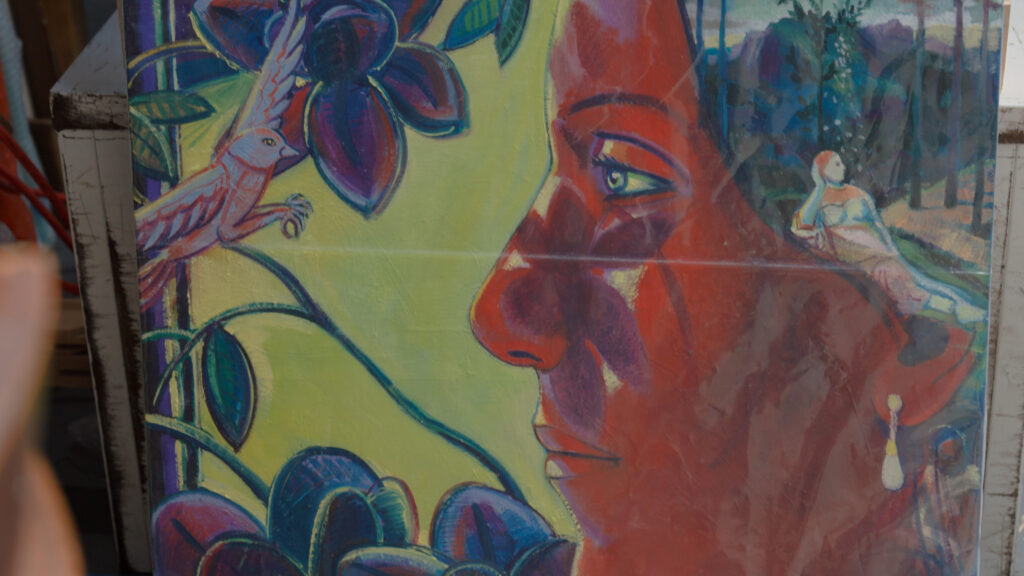
His discipline is built around simply not stopping. He tries to get to the studio every day, admitting he isn’t perfect about it, the longest he’s gone without painting was a two-month trip through Europe, and even then he kept drawing constantly, so he doesn’t really count it as a break. He estimates that showing up counts for roughly ninety percent of the work itself, regardless of whether anything good comes out of a given day, because he’s watched too many artists get genuinely stuck, unsure what to make next, and understands that the only real remedy is tricking yourself into staying in motion. One method he relies on is keeping eight or ten paintings going simultaneously; when he hits a wall on one, he sets it aside and starts another, and often the breakthrough on an early, stalled painting doesn’t arrive through direct effort but resurfaces later, almost unconsciously, while he’s absorbed in a completely different canvas further down the line. He describes this as a dreamlike part of the process, something that isn’t fully under conscious control, where the solution to an old problem simply surfaces once the mind has had enough unrelated time to work on it sideways.
Looking back at thirteen years of painting, D’Anselmi hopes that the gap between making something and understanding why it works, or doesn’t, continues to shrink with time. He’s had paintings he was certain were strong that, months later, revealed themselves as mistaken ideas, and others made almost carelessly that turned out, in retrospect, to be the strongest work of an entire year. That unpredictability doesn’t discourage him. It’s closer to the whole point: a practice built less on certainty than on the willingness to keep believing, fully, in the world a painting proposes, and to trust that something real can live inside it, even when you can’t yet explain exactly how it got there.
About the author
Sam Burke is an American artist, filmmaker and writer based in New York City. Working across film, performance, and writing exploring storytelling, identity, and place. As founder of Timestamp, Burke interviews artists, shares insights, and highlights conversations shaping art world today.
Stéphane Koyama-Meyer
French visual artist and designer based near Basel, Stéphane Koyama-Meyer grew up surrounded by art,…
Yuval Bezalel
For Yuval Bezalel, painting begins with the hands, before there is a narrative, before there…
Adèle Aproh
For Adèle Aproh, drawing began long before she knew it could become a career. Her…
Félix Deschamps Mak
Félix Deschamps Mak is a French painter based in Paris, working in large scale figurative…
Katya Quel
Katya Quel is an artist and multidisciplinary creator, born and raised in Moscow, who now…
Why Dia Beacon Deserves a Full Day of Your Attention
There are museums you visit to check a box. And there are museums that quietly…