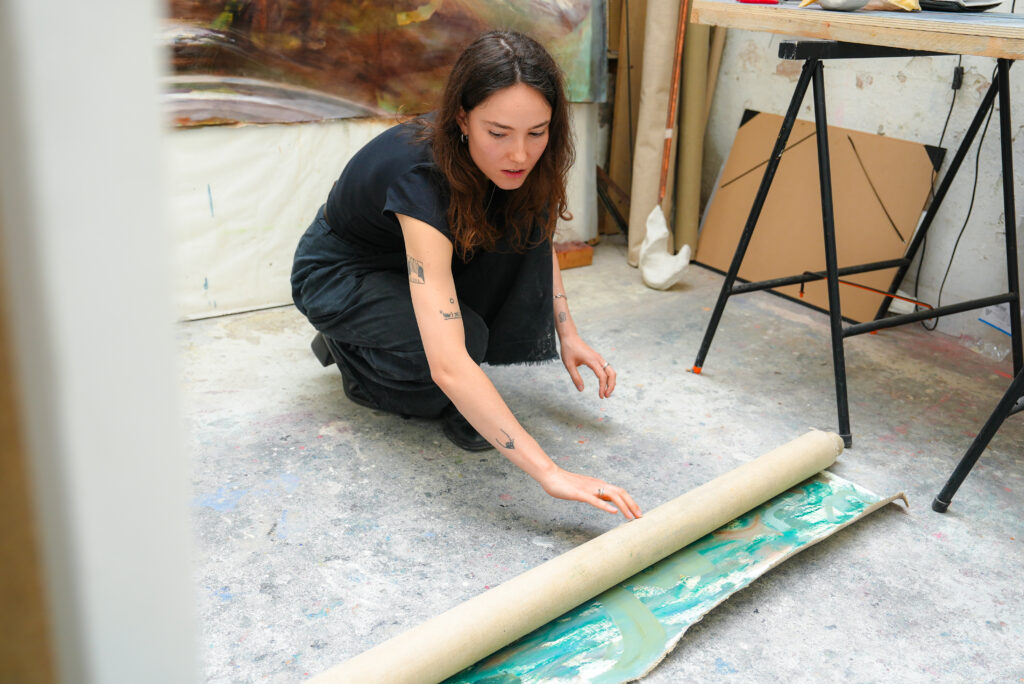
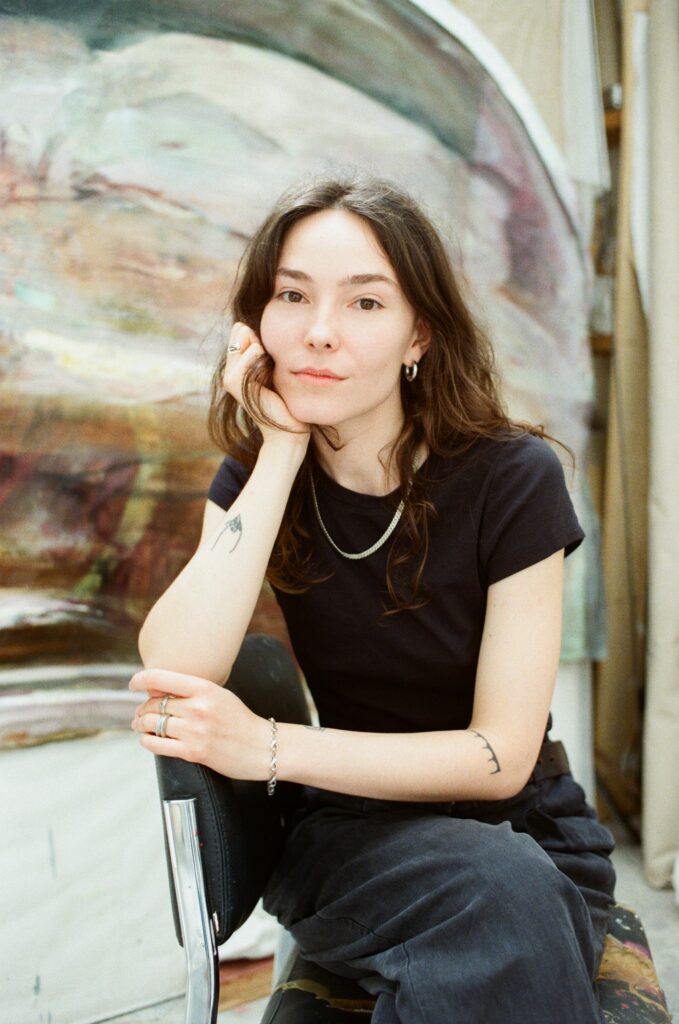
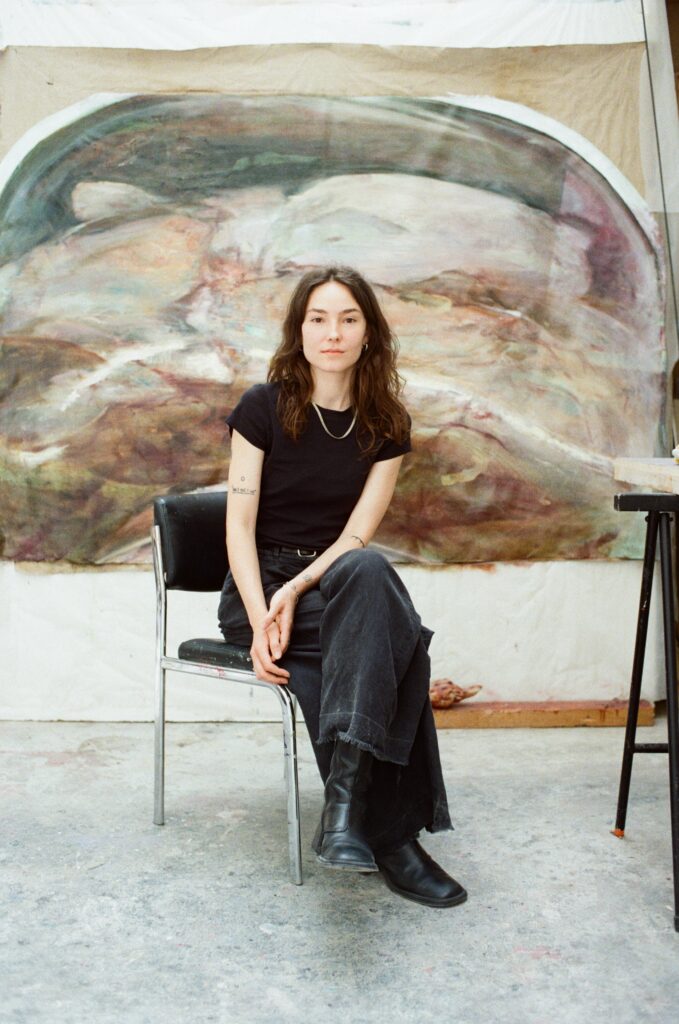
Valeria Vertii is a Ukrainian-born artist based in Paris who works across painting, drawing, metalwork, ceramics, and glass, moving so fluidly between mediums that she has trouble listing them all without leaving something out. She trained first as a painter and has spent the last several years pulling that foundation toward sculpture and installation, driven by questions about vulnerability, impermanence, and the fragile border between a living body and the world around it. Her work does not settle into a single material or format because, as she describes it, no single material can hold everything she is trying to understand about how fragile and temporary life actually is.
She grew up in a rented house in the forest, spending long stretches of time alone with paper, crayons, and whatever she could gather outside, branches, sticks, small found things she’d bring back and turn into something. That early instinct to touch and reshape material rather than simply look at it has never really left her. Her mother eventually enrolled her in art classes, though Vertii describes the decision as barely a decision at all, more of a natural continuation of something she was already doing. She started attending structured classes around the age of eight, but the education that mattered most came later, at a specialized art school for teenagers that ran six days a week and organized itself almost entirely around drawing.
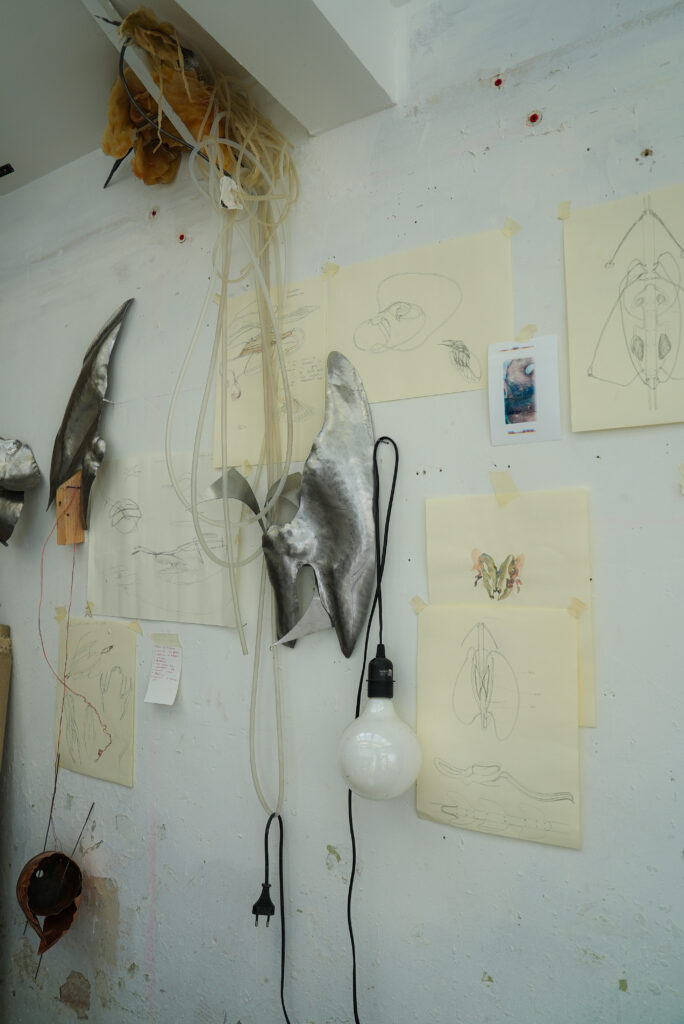
Students were expected to produce twenty to fifty sketches a week, not as finished works but as a way of training attention. Vertii credits that period with giving her a specific kind of discipline, the sense that constant looking and constant making were simply normal, that it was fine, even expected, to draw everywhere, all the time. It also gave her an enormous personal archive of drawings, made from years of hiking and travel, that still function as raw material for later work.
From there she went on to university in Ukraine before continuing her studies in France, where she is now in her fourth year at the École des Beaux-Arts de Paris, preparing to begin her fifth and final year in the fall. She describes the school with unusual warmth, crediting it specifically with introducing her to sculpture. She’d had an interest before, she says, but had never found a studio equipped for the kind of work she wanted to make. That changed in her second year, when she began learning metalwork and discovered, in her words, that she wasn’t attached to any single material, that she could expand into anything. What she values most about the school isn’t a particular technique but the fact that her professors are working artists themselves, people who can genuinely talk through a student’s practice rather than simply instruct. She’s also candid about the limits of institutional education more broadly, describing it as something that can be “slightly violent” toward a person’s individual way of making sense of the world, and arguing that what matters more than any curriculum is a kind of deep trust in oneself, a willingness to commit fully to a way of working without any guarantee of where it leads. “It’s like the blind leap that you have to perform,” she says, and there is no way around it.
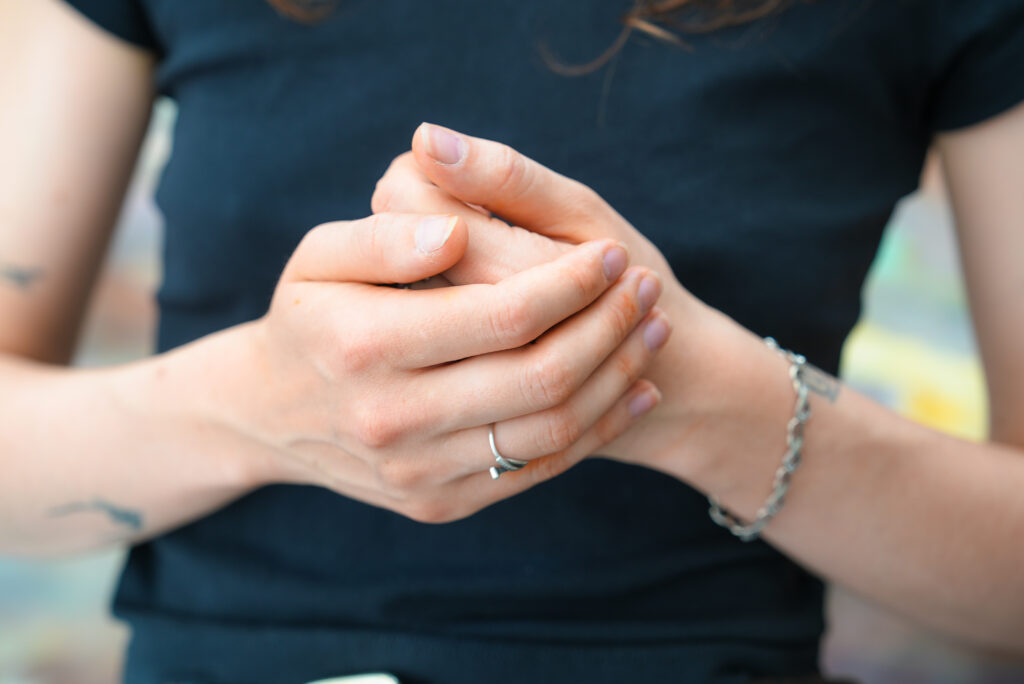
That philosophy runs through everything she says about why she continues to make work at all. When asked directly, she admits she doesn’t always have a clean answer, it isn’t really a question she interrogates, because making things has simply been present for so long that it no longer feels optional. She describes it as the thread that connects her to the world, to her own routine, to a basic sense of being alive; when she isn’t able to make anything, she says, she starts to wonder what she’s doing here at all. She resists the idea of a fixed goal, associating “goal” with an endpoint, a closing-off of possibility. What she wants instead is simply to keep building the conditions that let her keep working, exploring, and seeing where things go.
Drawing sits underneath everything else in her practice, functioning less as a finished medium than as a way of thinking. She describes it as a low-pressure space, a pen, a scrap of paper, no expectation of quality, where she can note things down, collect impressions, and figure out where a shape wants to go before committing to anything larger. Photography feeds into this collecting process as well; she often builds digital collages from photographs before a painting begins, cutting and recombining fragments until an image starts to take shape.
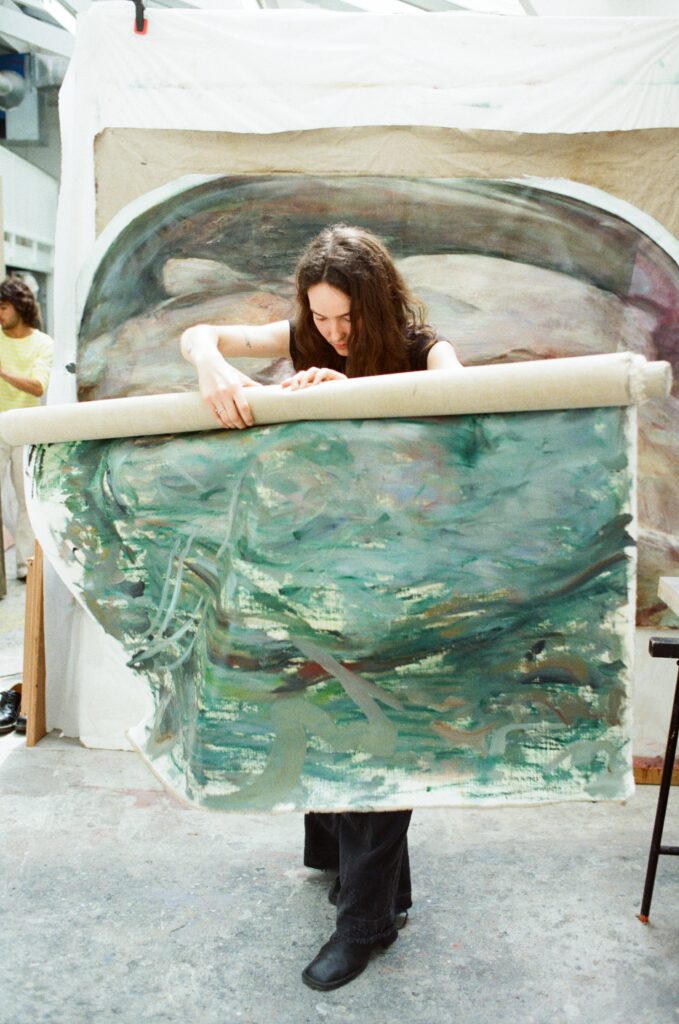
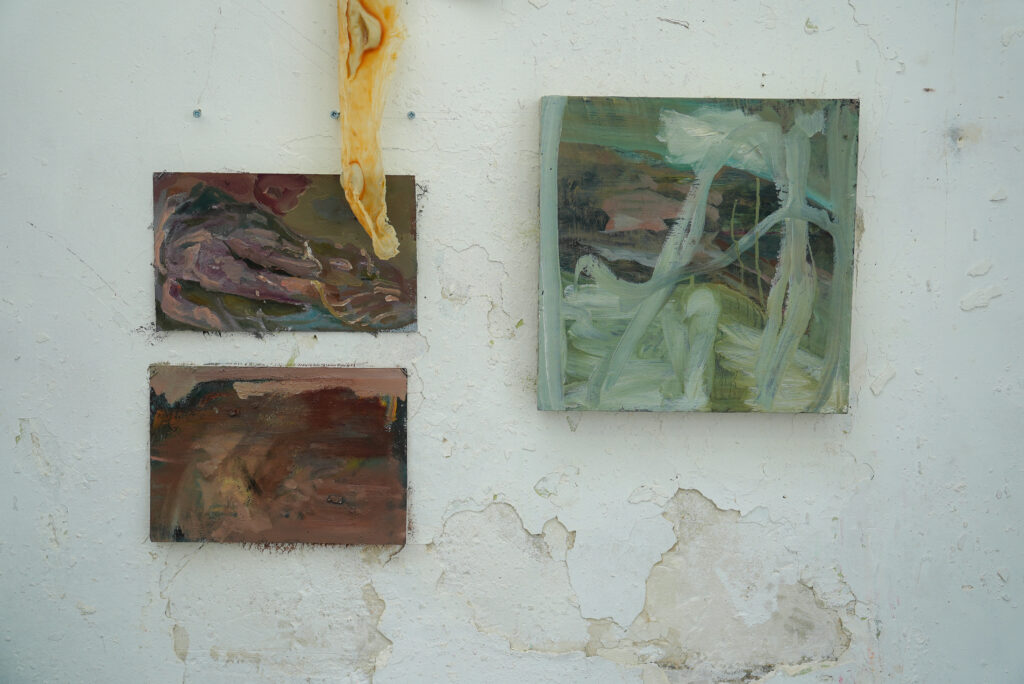
But she is wary of ever locking a composition down too early. If she were to plan an image fully and then simply reproduce it in paint, she reasons, she might as well just print it. The value of painting, for her, lives in what happens during the process itself, which is why she often builds ten or more paintings underneath the one that finally gets shown, scraping back, layering again, letting earlier decisions bleed faintly through later ones. She loves oil paint specifically for the transparency this allows, a quality she doesn’t find in any other material. She compares the resulting surface to a palimpsest, something that carries traces of everything it used to be. “There is a story before and there will be story after,” she says of these accumulated layers, extending the idea outward to her own life, that there were people before her, and there will be others after she’s gone.
That same interest in what a painting reveals depending on distance shows up in her approach to composition, which she traces back to her study of mural painting and monumental composition. Up close, her canvases can look genuinely chaotic, fragmented shapes, unresolved passages, colors that don’t obviously cohere. It’s only from a distance that the image gathers itself into something legible. She’s fascinated by how conditioned viewers are to look at paintings from a fixed, expected distance, rarely testing what a composition does from the side of a room or up close, and she plays deliberately with that habit, building canvases where a painted figure appears to keep looking at you no matter where you stand.
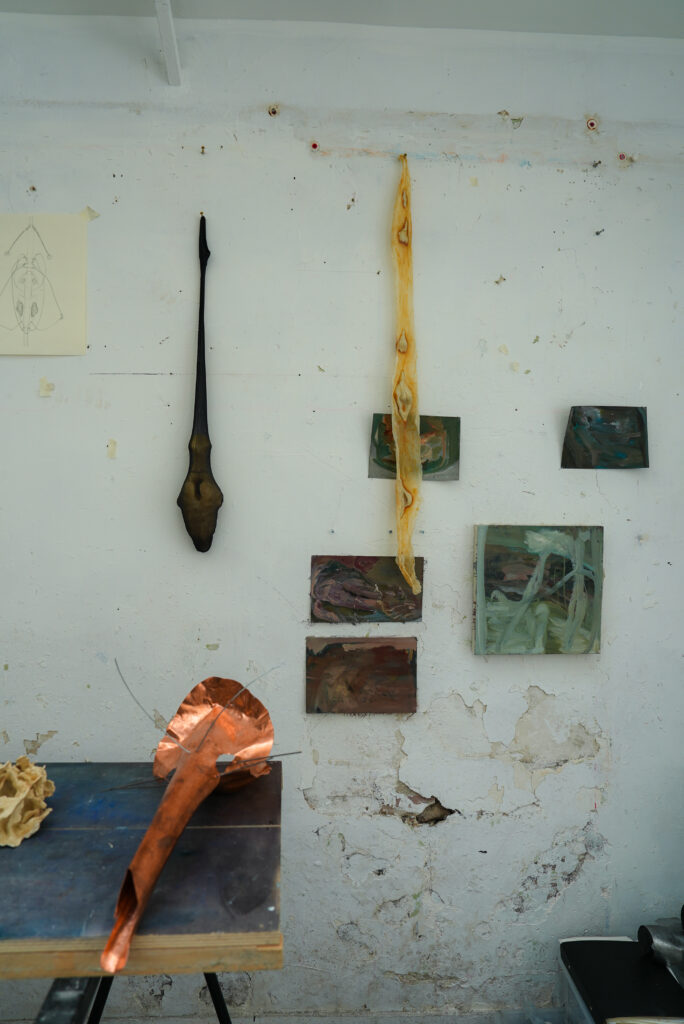
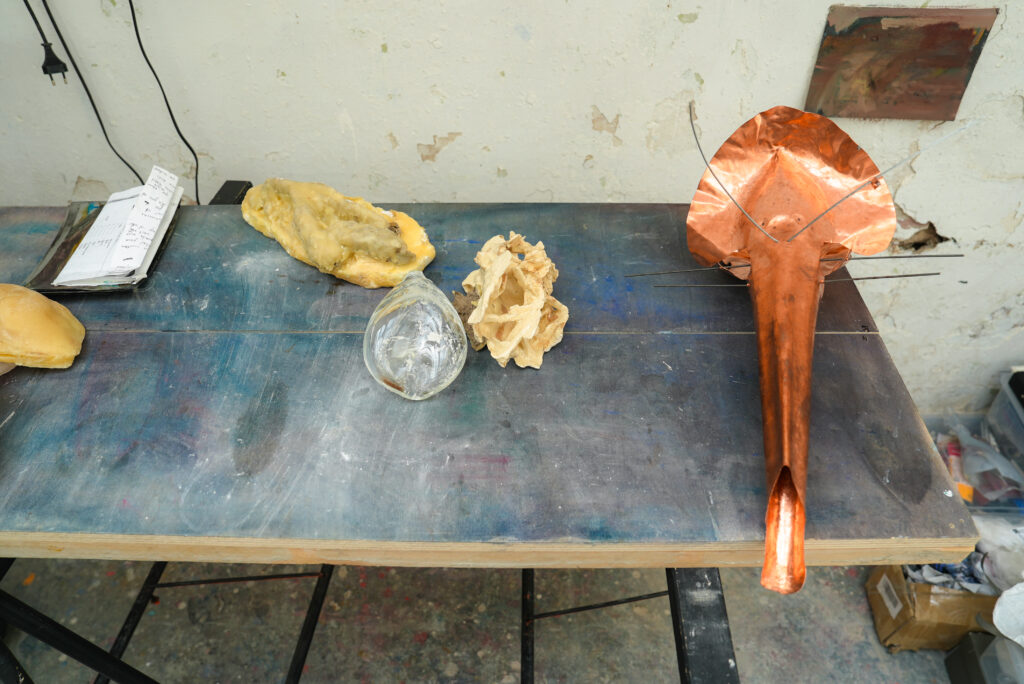
Her materials outside of painting tend to resist the categories people expect them to fit. Metal, when hammered rather than cast, turns out to be surprisingly soft and responsive, something she has to negotiate with rather than force. Wax, first used defensively to protect metal sculptures, became a material she wanted to explore in its own right once she realized how differently it behaved compared to painting or ceramic. Glass, which she learned to blow in Seoul in 2025, taught her a different kind of attention entirely, she describes moments of literally holding her breath while working, aware that a single wrong movement could break weeks of effort.
Rather than pursuing the kind of flawless perfection some glass masters insist on, she’s drawn to keeping pieces that carry visible instability, bubbles, breaks, the marks of an imperfect process, because those imperfections are, to her, simply part of the work’s honesty. Hammering metal serves an additional, more personal function: she describes it as a way to take the surplus energy and emotion in her body and direct it somewhere productive, admitting that if she doesn’t channel that energy properly she feels overwhelmed. A good day of physical work, by contrast, leaves her feeling clean.
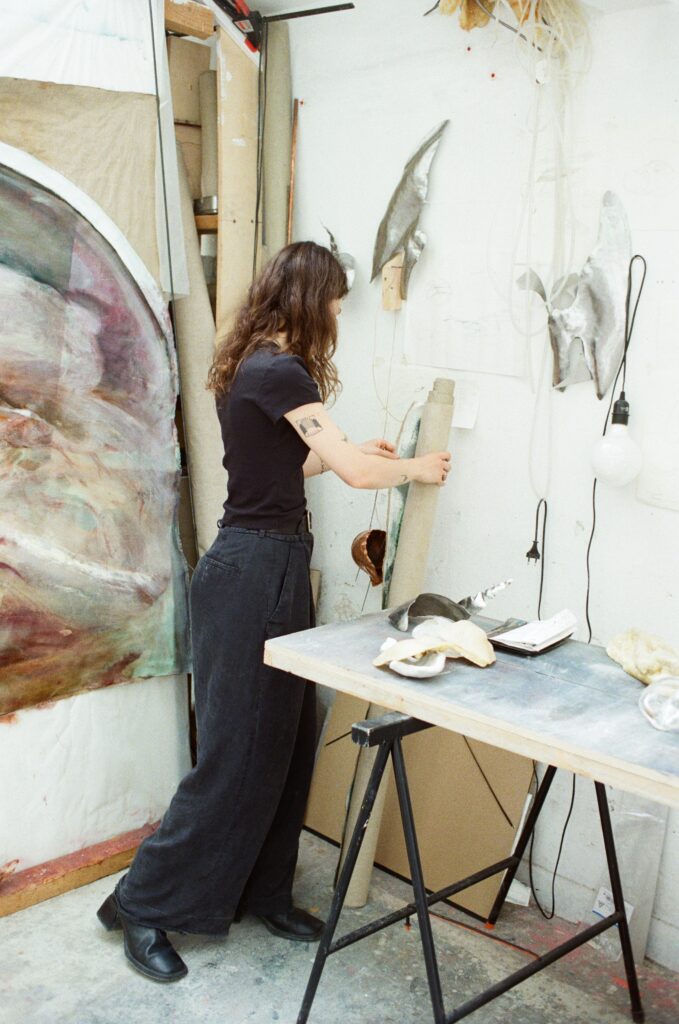
Much of this material philosophy was reshaped by a specific rupture in her life. While still working in Ukraine, Vertii built large wooden panels, spending months painting on a single surface. When she had to leave suddenly, with what she describes as no time to think, she had to store her large finished works at a friend’s place, and because the door to the storage space wasn’t wide enough, some of the panels had to be physically cut down to fit through it. She recalls the moment as genuinely brutal: watching a piece she’d spent two months building being cut apart simply so it could pass through a doorway. Over time she came to see the intrusion differently, as something that added to the work’s story rather than only damaging it, evidence that a piece’s history doesn’t stop once it leaves the studio. That displacement changed her practice more broadly. Not knowing where she would end up next, she shifted toward much smaller, more portable pieces, works on paper or small wood panels that could fit in a backpack and travel with her.
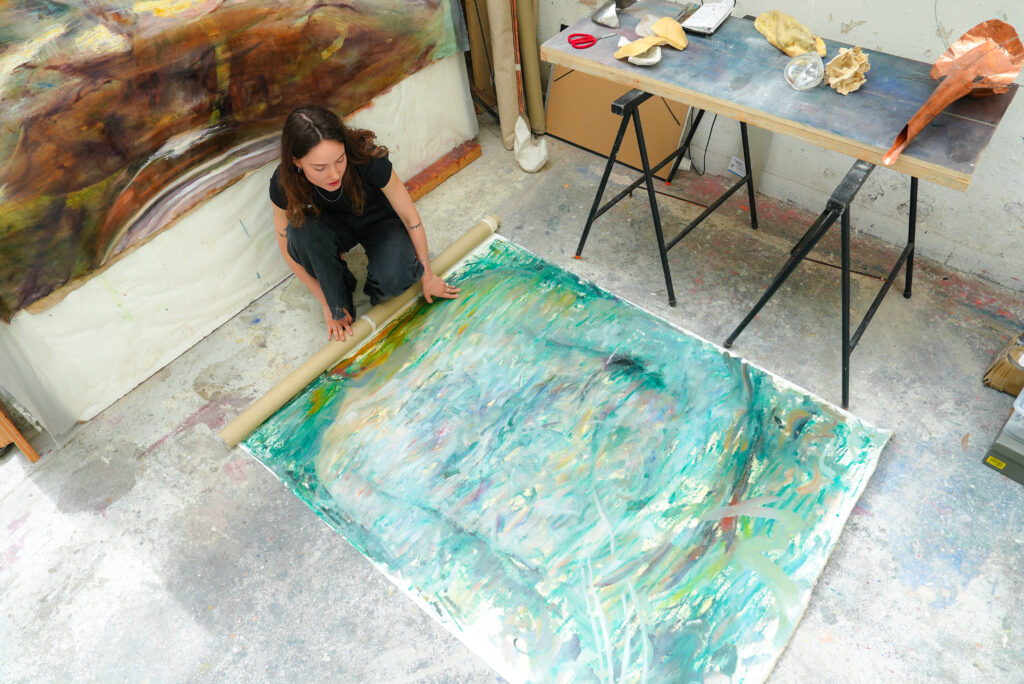
She compares the experience of leaving so much behind to the way people, facing death, eventually let go of everything they own, because none of it is needed anymore. A quiet awareness of fragility and impermanence entered her work at that point and has stayed there since, feeding directly into the themes of vulnerability and survival she now says drive her current thinking. Once she found a stable studio again, though, the pull toward scale returned, her compositions, she noticed, still wanted to be large even when she painted them small, and she has since gone back to working on big canvases, valuing the physical exhaustion of the process, the sense of her whole body being involved, in a way that smaller, seated work never gave her.
That physical, almost bodily engagement with materials connects to one of the more personal bodies of work she discusses: a series of torso paintings, all drawn from the same person, made in an attempt to hold onto a specific feeling of love, and the tangle of emotion that comes with loving someone or something you understand you cannot fully protect or preserve. She describes the difficulty of accepting that the people closest to us are just as temporary and vulnerable as anything else, and how that realization pushed her thinking further outward, toward broader questions about how living beings perceive themselves within an environment that is always shifting, always temporary, whether we choose to notice it or not.
Traveling and hiking remain steady sources of material for her, partly for the drawings they generate and partly for a specific psychological state she associates with being somewhere unfamiliar. She remembers arriving in Paris without speaking any French and finding the experience strangely liberating, surrounded by language she couldn’t parse, conversation became closer to music, stripped of the weight that comes from understanding every word around you. She thinks travel repeats that particular sensation of being slightly lost, and that the disorientation itself produces a kind of freedom, a return to something more basic about simply existing in a place without the usual overlay of meaning and judgment.
Asked whether she could ever imagine stopping, Vertii doesn’t hesitate. She has already kept making work through circumstances that would have given most people reason to stop, and she can’t picture a version of her life without it. Her practice today spans painting, drawing, metal, ceramic, glass, and wax, not because she’s restless or unable to commit, but because each material seems to answer a different part of the same ongoing question, about fragility, about time, about what it means to hold on to something you know, eventually, you will have to let go.
About the Author
Sam Burke is an American artist, filmmaker and writer based in New York City. Working across film, performance, and writing exploring storytelling, identity, and place. As founder of Timestamp, Burke interviews artists, shares insights, and highlights conversations shaping art world today.
Stéphane Koyama-Meyer
French visual artist and designer based near Basel, Stéphane Koyama-Meyer grew up surrounded by art,…
Yuval Bezalel
For Yuval Bezalel, painting begins with the hands, before there is a narrative, before there…
Adèle Aproh
For Adèle Aproh, drawing began long before she knew it could become a career. Her…
Félix Deschamps Mak
Félix Deschamps Mak is a French painter based in Paris, working in large scale figurative…
Katya Quel
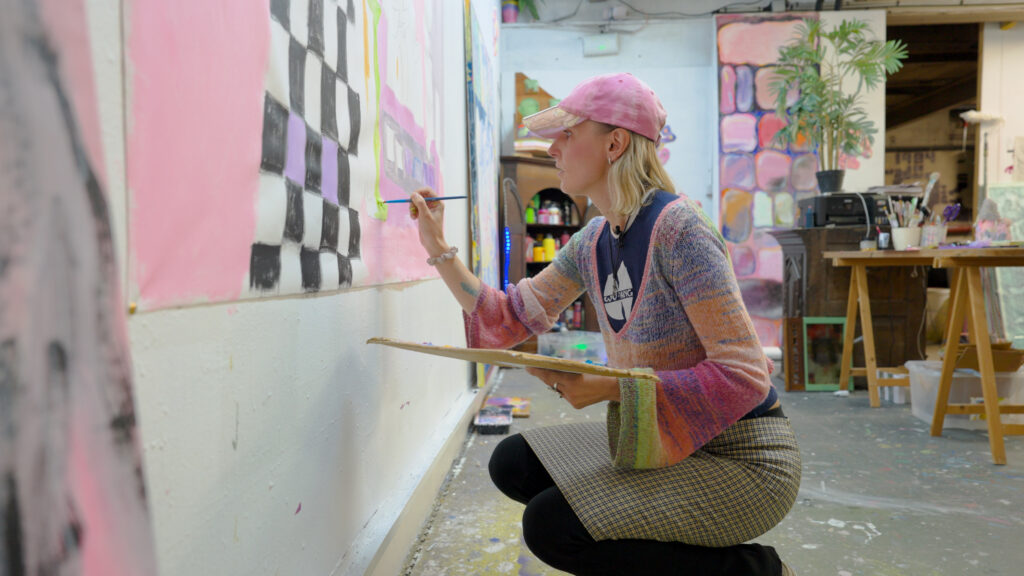
Katya Quel is an artist and multidisciplinary creator, born and raised in Moscow, who now…
Why Dia Beacon Deserves a Full Day of Your Attention
There are museums you visit to check a box. And there are museums that quietly…