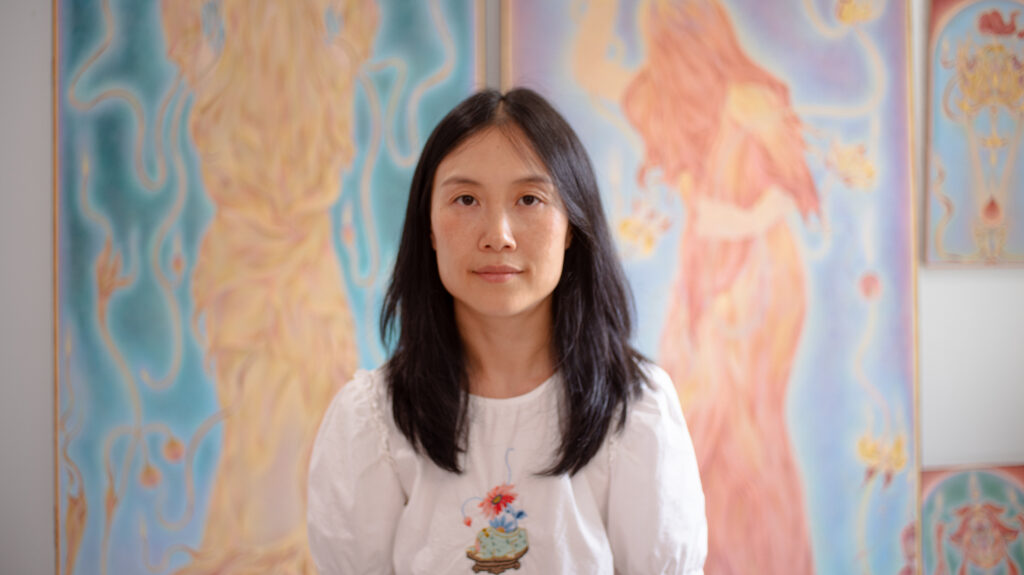
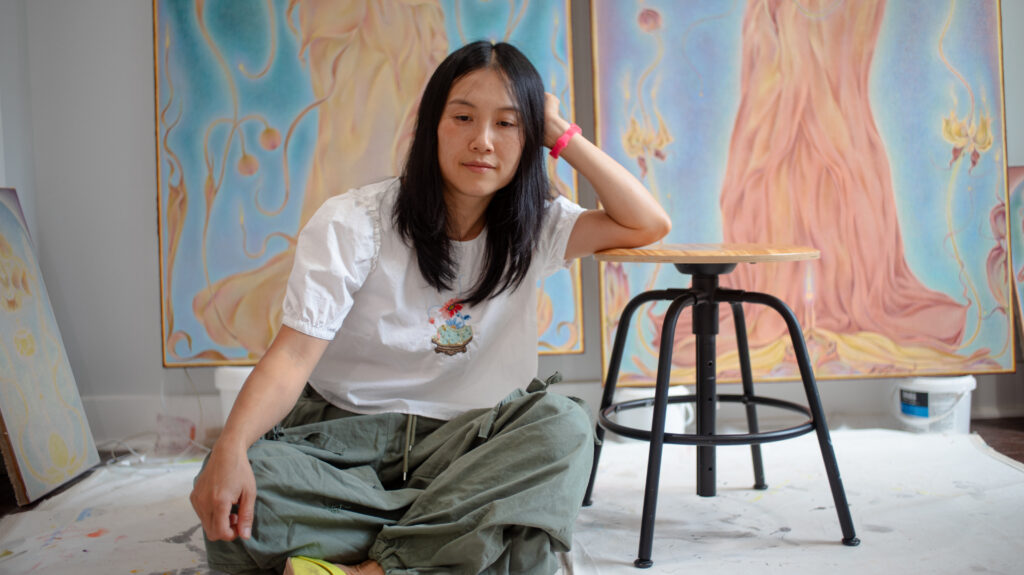
For painter Shuling Guo, making art is inseparable from the experience of living. Based in Philadelphia, Guo creates figurative paintings that draw from family history, motherhood, and the traditions of the small town in southern China where she grew up. Her work brings together images of the natural world, religious ceremonies, and the human body, exploring the connections between birth, death, and transformation. Working with raw linen, wood panels, and colored pencil, she has developed a distinctive visual language that feels at once delicate and grounded, allowing personal experiences to take shape through carefully considered materials and imagery.
Guo’s relationship with painting began when she was very young. She remembers growing up in a house with a large blackboard covering an entire wall. When she was five or six, after spending an afternoon playing in the rice fields and seeing butterflies everywhere, she returned home and began drawing them across the blackboard. Her grandmother was so excited by the drawings that she told the rest of the family, giving Guo an early understanding of the joy that making something could bring to another person. Her father, a carpenter, also influenced the way she thinks about making. Watching him transform raw pieces of wood into furniture gave her an appreciation for the process of turning simple materials into something meaningful, as well as the confidence to believe she could create things herself.
Although much of her early interest in art was self-directed, Guo eventually pursued formal training at the Central Academy of Fine Arts in Beijing. The technical education gave her the skills to translate ideas onto canvas, something she considers essential to developing a lasting practice. At the same time, she believes that technical ability is only one part of becoming an artist. What matters just as much is finding a personal way of working, developing an approach that allows an artist’s own experiences and ideas to come through. For Guo, a successful painting should feel authentic, communicate something personal, and create a connection with the person looking at it.
The place where she grew up continues to inform the subjects and imagery in her work. Guo describes her hometown as a traditional community shaped by religious ceremonies, local crafts, and a deeply patriarchal social structure. As a child, she regularly accompanied her mother and grandmother to the temple, helping prepare offerings and participating in ceremonies that took place throughout the lunar calendar. These experiences introduced her to the gardens within the temples and the important role women played in maintaining and caring for their communities. In her paintings, women and gardens become connected through ideas of protection, nurturing, and continuity.
Her understanding of these traditions has also changed through the experience of leaving home. Guo recalls feeling that the expectations placed on women in her hometown offered little room for the kind of life she wanted to pursue. Girls were often encouraged to prioritize domestic responsibilities, marriage, and family over education or independence. Her grandmother was an important exception, consistently encouraging her to continue painting. As a young person, Guo imagined a different future for herself, eventually leaving for Guangzhou to attend high school before moving to Beijing for college. After graduation, she continued working toward an artistic career while supporting herself through illustration and teaching. She describes those years as difficult, particularly as a woman trying to establish herself as an artist in an environment where she did not always feel supported.
Moving to the United States opened another chapter in that process. Since relocating to Philadelphia, Guo has found new space to understand her identity and the kind of artist she wants to become. Reading women writers and encountering feminist ideas helped her reconsider the expectations she had grown up with, giving her greater confidence in telling her own story. Rather than separating her cultural background from her present life, she has become increasingly interested in bringing those histories together. Her work now draws from traditional imagery and the experiences of becoming a woman and a mother, allowing different stages of life to exist within the same visual world.
A particularly significant shift came through two events that occurred within a few years of one another: the death of her grandmother and the birth of her child. Together, they brought questions of life and death, family, and the passage of time into sharper focus. Guo began to see painting as another form of creation, one that could develop from the body and from the accumulation of lived experience. Becoming a mother was physically and emotionally demanding, but it also changed her relationship to making art. She found herself thinking less about forcing an idea into existence and more about allowing images to emerge naturally from everything she had experienced.
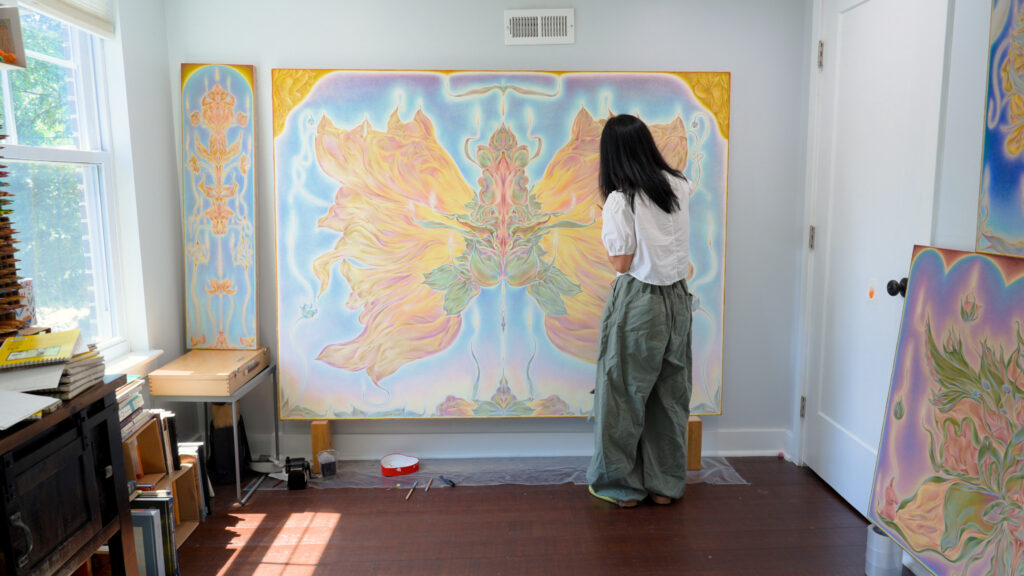
This sense of continuity appears in one of her larger paintings, The Pivot. The work brings together the pelvis, which Guo sees as the origin of birth, and the shape of a butterfly, an image associated with the soul in both Chinese and Greek mythology. She places her children within the composition, creating a visual connection between the beginning of life and the experiences that follow. The painting reflects her interest in the cycles that connect generations and bodies. Rather than illustrating one specific person or event, it gathers different personal and cultural references into a single image, allowing them to speak to one another.
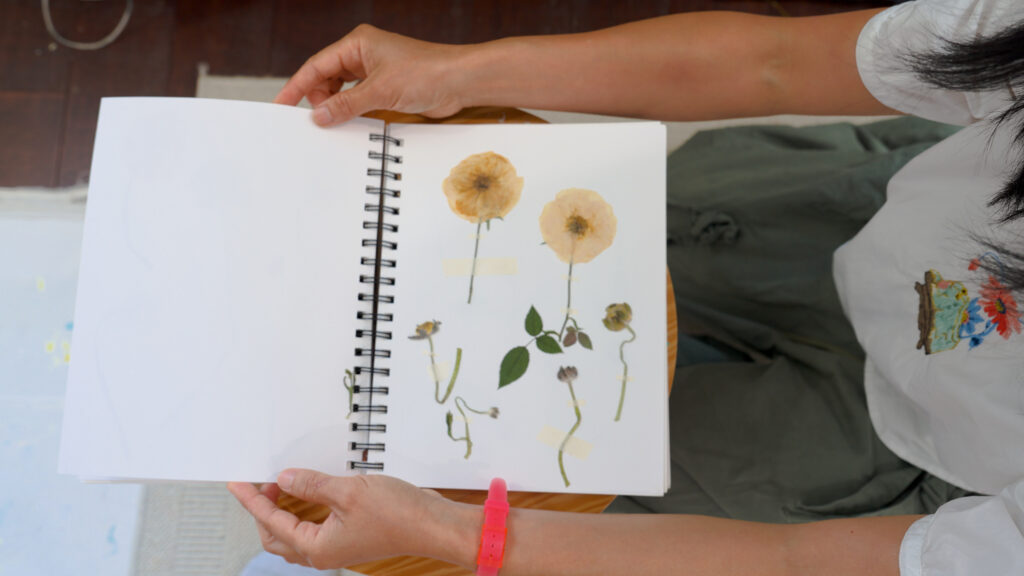
Nature has become another important source of imagery and inspiration, particularly through Guo’s interest in dried flowers. She collects them while traveling, from bouquets, and even from sidewalks, sometimes making note of where each specimen was found. As she has gotten older, she has become increasingly drawn to flowers that have dried, faded, and begun to change. Their colors feel more complex to her than those of fresh flowers, carrying evidence of time and transformation. She compares the aging of a flower to the aging of the human body, noticing how wrinkles, spots, and changes in color appear in both. These observations inform the muted, earthy palette of her paintings, where color is developed through close attention to the subtle variations found in the natural world.
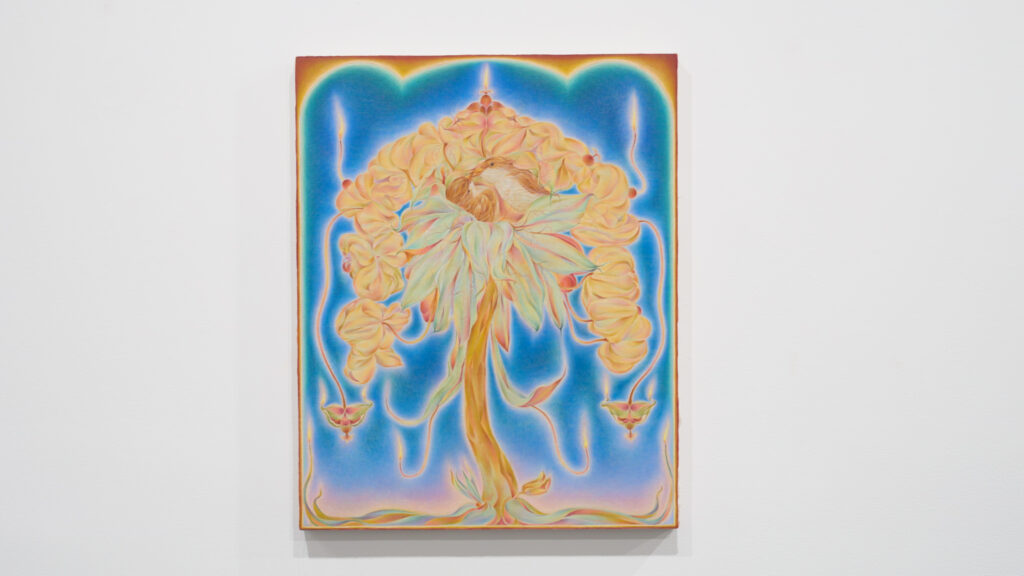
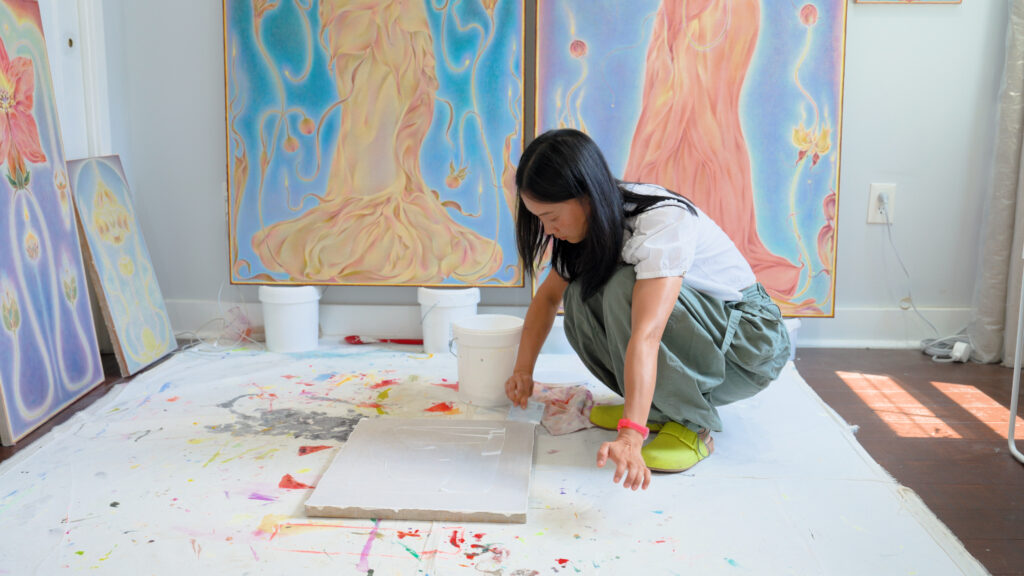
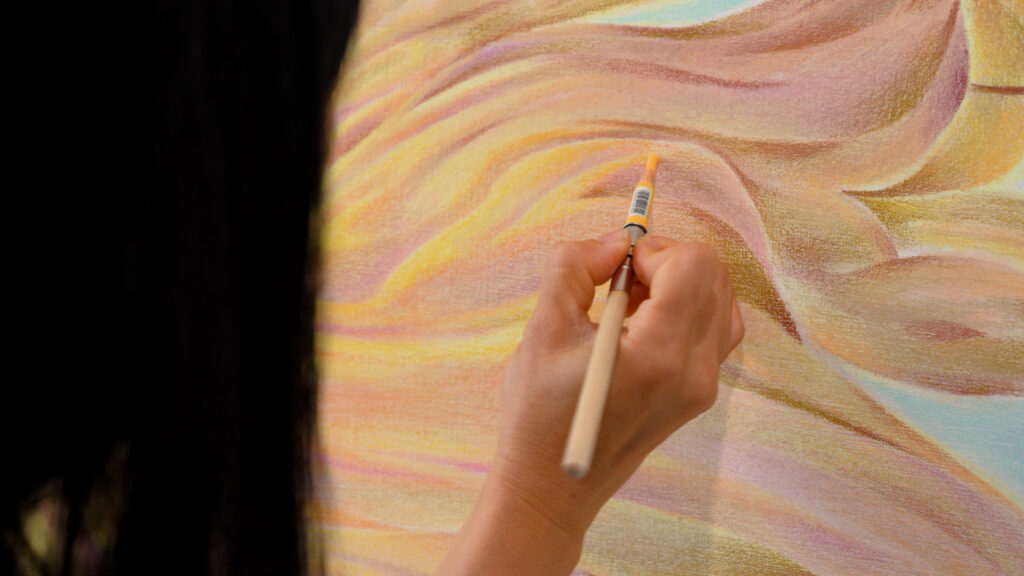
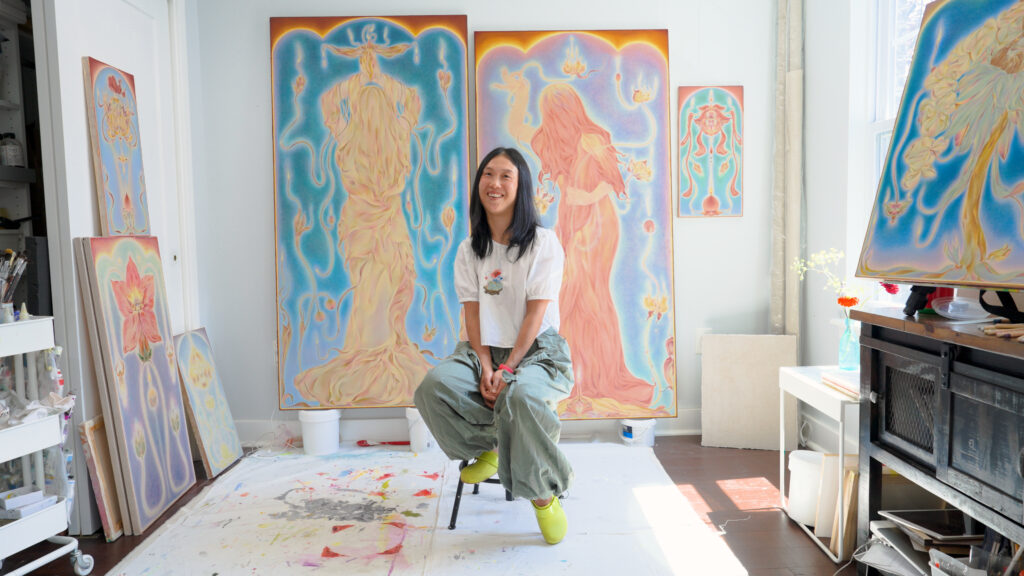
The materials she uses are central to this process. Guo glues raw linen directly onto wood panels, then tears the edges to expose the fabric and allow it to remain visible as part of the finished work. The linen provides a rigid surface while introducing a natural texture and color that connects to the dried flowers she studies. She then establishes the initial tone of a painting with pencil before building up details with colored pencil. The wax-based material creates a soft, almost mineral quality across the surface, giving the paintings an earthy finish that supports their imagery. This combination developed gradually through years of experimentation. After working on canvas, she began looking for a harder surface and eventually arrived at a method that brought together the qualities she wanted from wood, linen, and pencil.
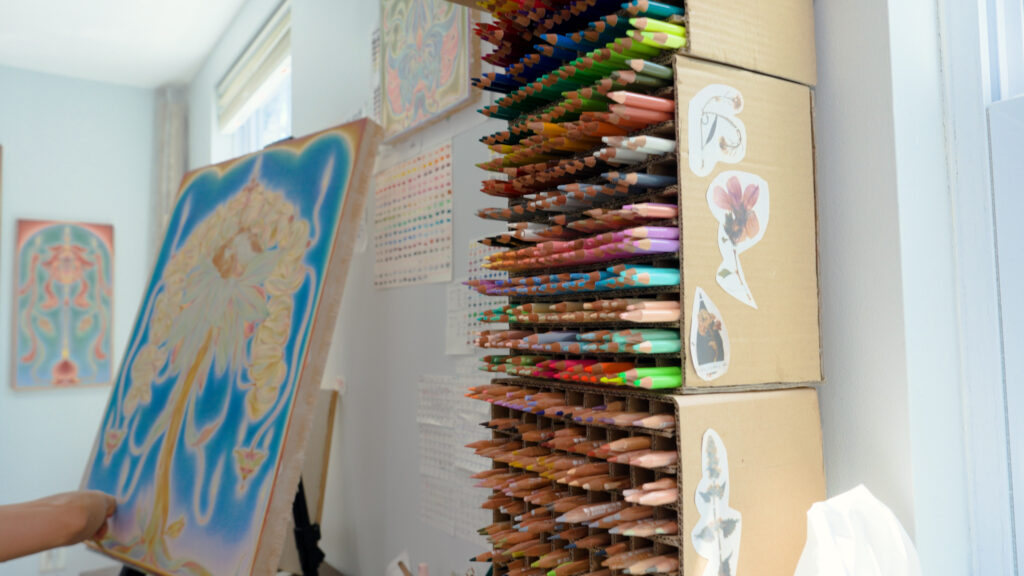
Her approach to color is equally deliberate. Guo keeps her pencils organized and maintains color charts so she can understand how particular shades work together, especially when creating subtle gradients. Unlike mixing oil paint, where colors can shift slightly each time, colored pencils provide a consistent palette that allows her to return to specific combinations. She is interested in the emotional precision of color, believing that a particular shade can communicate a particular feeling. The result is a palette that often appears aged or weathered, reflecting the colors of dried flowers and other natural specimens rather than the brightness of something newly formed.
Despite the careful preparation behind her work, Guo does not try to control every part of a painting. She usually begins with a sketch and some consideration of color, but once the process is underway, she allows the image to develop on its own. She describes the experience as similar to writing a story, when characters begin to take on their own direction and guide what happens next. A painting can begin with one idea and gradually reveal something different, asking her to respond to its changing details rather than follow a fixed plan. She often works on several paintings at once, allowing a piece to sit when she feels stuck before returning to it later. For Guo, the painting has its own personality and life, and part of her role is learning how to listen to it.
This openness is also reflected in the way she thinks about the relationship between reality and imagination. Traditional imagery, childhood stories, embroidery, birds, and the natural world all offer ways of moving between the familiar and the mysterious. She remembers the handcrafted objects and embroidered textiles of her hometown, which continue to inform the visual language of her work. Birds have also become an increasingly important subject, connected to the fairy tales she read as a child and their role as messengers between different worlds. These images allow her to build a world where the everyday and the imagined can exist together.
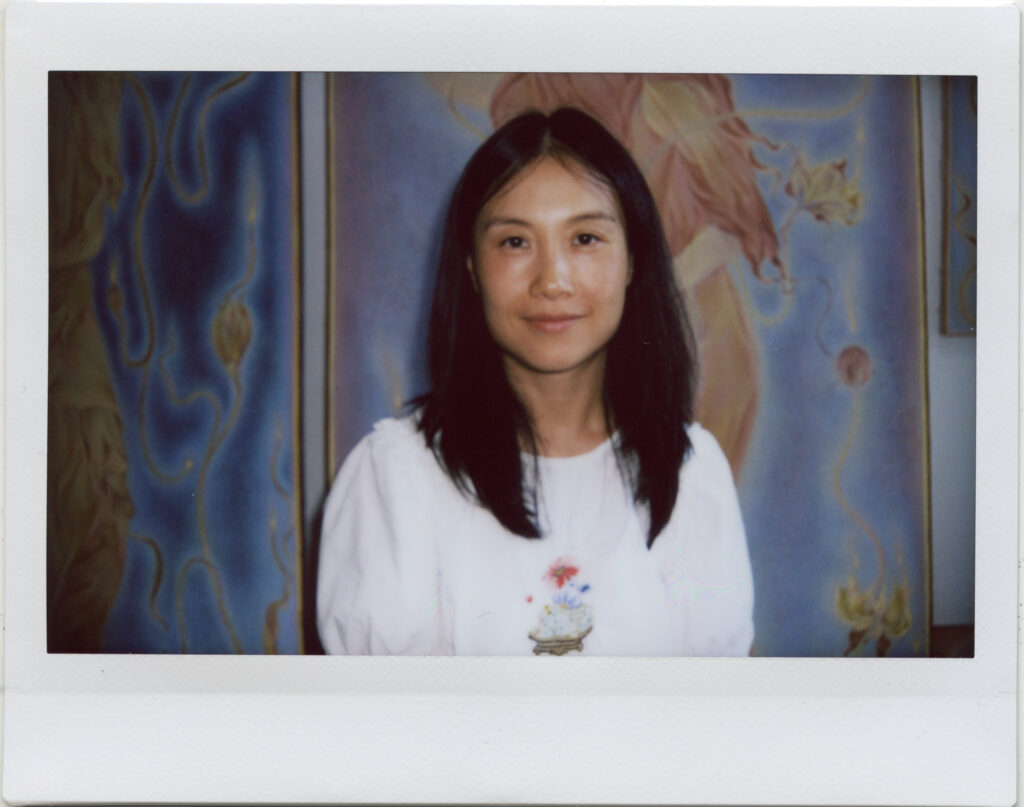
Guo has often returned to the question of whether pursuing an artistic career is worth the uncertainty that comes with it. She describes being an artist as a gamble, one that requires accepting the possibility that things may not work out as expected. For years, she asked herself whether she would regret continuing if the career never became financially or professionally stable. Her answer remained no. That certainty helped her continue making paintings even while working other jobs and navigating long periods of solitude. She has also found encouragement in women artists whose careers developed later in life, including Louise Bourgeois, whose recognition grew significantly in her later years. Their examples have helped her understand that an artistic life does not need to follow a fixed timeline.
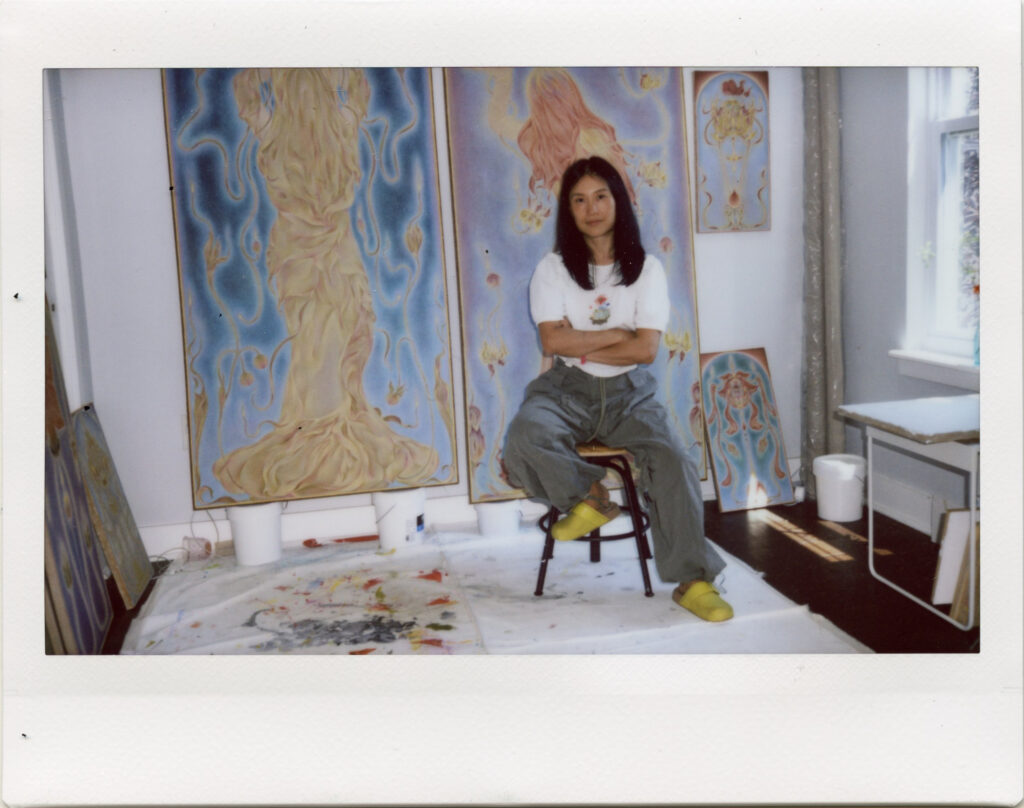
Today, Guo approaches painting with a sense of gratitude for the experiences that have shaped her. Through the textures of raw linen, the colors of dried flowers, and images that move between the body and the natural world, she creates paintings that hold different stages of life in conversation. Though rooted in her own experiences, their subjects reach beyond autobiography, reflecting the shared realities of aging, nurturing, loss, and renewal. For Guo, painting is a way of understanding the life she has lived and giving form to ideas that continue to evolve.
About the Author
Sam Burke is an American artist, filmmaker and writer based in New York City. As founder of Timestamp, Burke interviews artists, shares insights, and highlights conversations shaping art world today.
Shuling Guo
For painter Shuling Guo, making art is inseparable from the experience of living. Based in…
Gonçalo Preto
For Portuguese painter Gonçalo Preto, a painting is never simply a representation of something seen….
The Armory Show 2026: Highlights from New York’s Contemporary Art Fair
From experimental painting to immersive installations, a look at the artists, booths, and ideas that…
Mia Goldstien
Born in Los Angeles and now working in New York City, Mia Goldstein has built…
Michael Alexander Campbell
Michael Campbell once tried to give up making art. The idea, as he explains it,…
Andrew LaFarge Hamill
Andrew LaFarge Hamill describes himself as an artist and garden designer, but he is interested…