
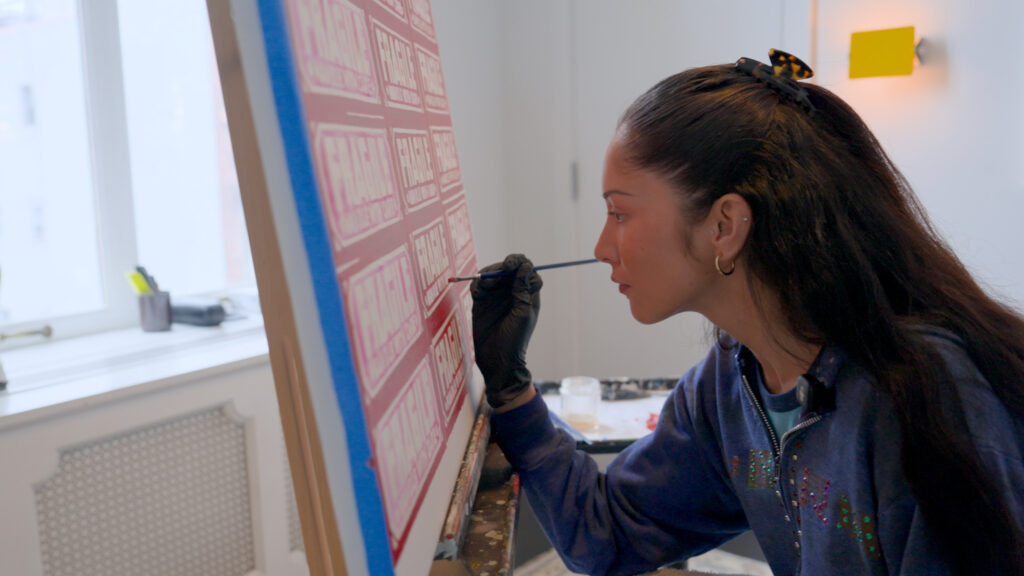
Born in Los Angeles and now working in New York City, Mia Goldstein has built a practice around looking closely at the ways people live with art, the environments they create around it, and the often overlooked moments that shape its relationship with the world. Her paintings begin with observation, but they rarely end there, using familiar scenes as a starting point for exploring how images acquire meaning and how even the most ordinary encounters can reveal something about the people involved.
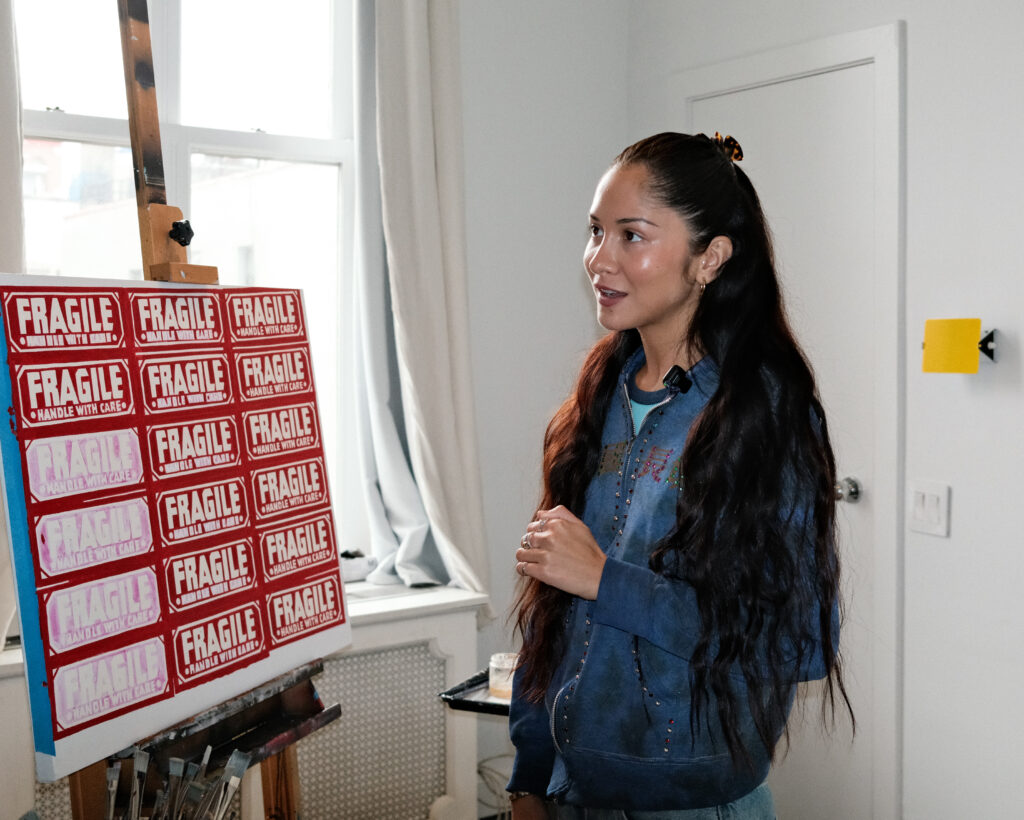
Art was part of Goldstein’s life long before she began to think seriously about becoming an artist. Her father took her to galleries and museums from an early age, and family trips often revolved around seeing art. Both of her parents worked in creative industries, and art became something she naturally gravitated toward, as well as a subject in which she felt confident at school. Drawing was her first way of making things, and for a long time she preferred it to painting. Holding a pencil offered a sense of control, while paint felt messy and difficult to manage, making it harder to translate an idea into something precise. That relationship began to change in college, when she discovered that the qualities she had initially resisted were exactly what made painting interesting. Paint could be pushed around, corrected, layered, and reworked, allowing her to loosen her approach and explore color in ways that drawing had not.
Goldstein studied art history at Gallatin School of Individualized Study at New York University, where students have the freedom to shape their own academic paths. She entered college intending to combine art history with studio classes, drawn to the knowledge that comes from studying how art has been made and understood over time. As she worked through the available art history courses, however, she realized that she wanted to devote more of her attention to painting itself. Rather than following a conventional studio art degree, she began building her practice through independent work, a handful of painting classes, and time spent learning from other artists. She describes herself as largely self taught, though her education has continued through gallery work and her role as a studio assistant for a more established artist.
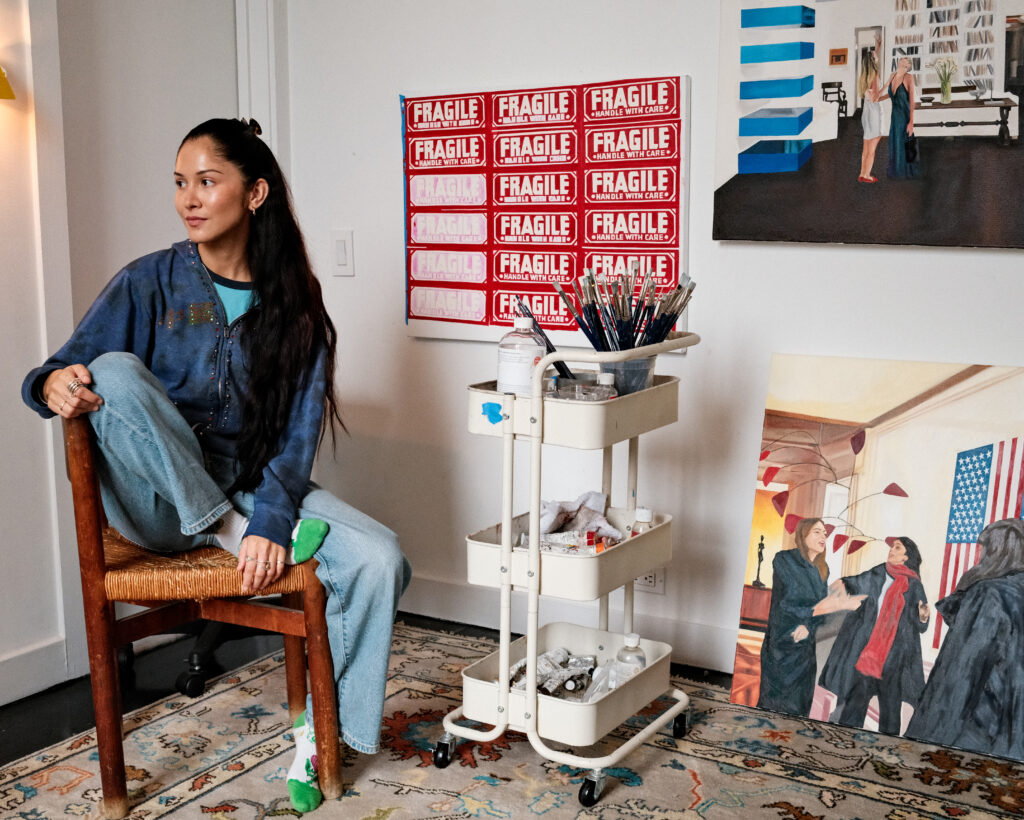
That experience has influenced not only how Goldstein works, but how she thinks about the demands of making art. She approaches the studio with the discipline of a regular job, usually arriving around ten in the morning and working through the afternoon. The structure gives her practice a consistency that can be difficult to maintain when the work is entirely self directed. Painting alone requires a continuous series of decisions, from how to apply color to what a composition needs and when a work should be left alone. Working in someone else’s studio offers a different kind of concentration. When she is following another artist’s instructions, she can focus on the physical act of painting without carrying the same responsibility for every creative decision. She has described the experience as almost therapeutic, a chance to keep developing her technical abilities while stepping outside her own head.
The distance also helps her return to her paintings with a clearer perspective. Spending too much time with a work can make it difficult to see what is actually there, and Goldstein knows how easy it is to keep adding or adjusting simply because she has not stepped away long enough to recognize that a painting is finished. Her work as an assistant creates that separation naturally. When she comes back to her own studio, she can often see what needs to change with a freshness that would have been difficult to find if she had remained in front of the canvas. In a practice that depends on judgment and revision, learning when not to make another decision can be just as important as knowing what to do next.
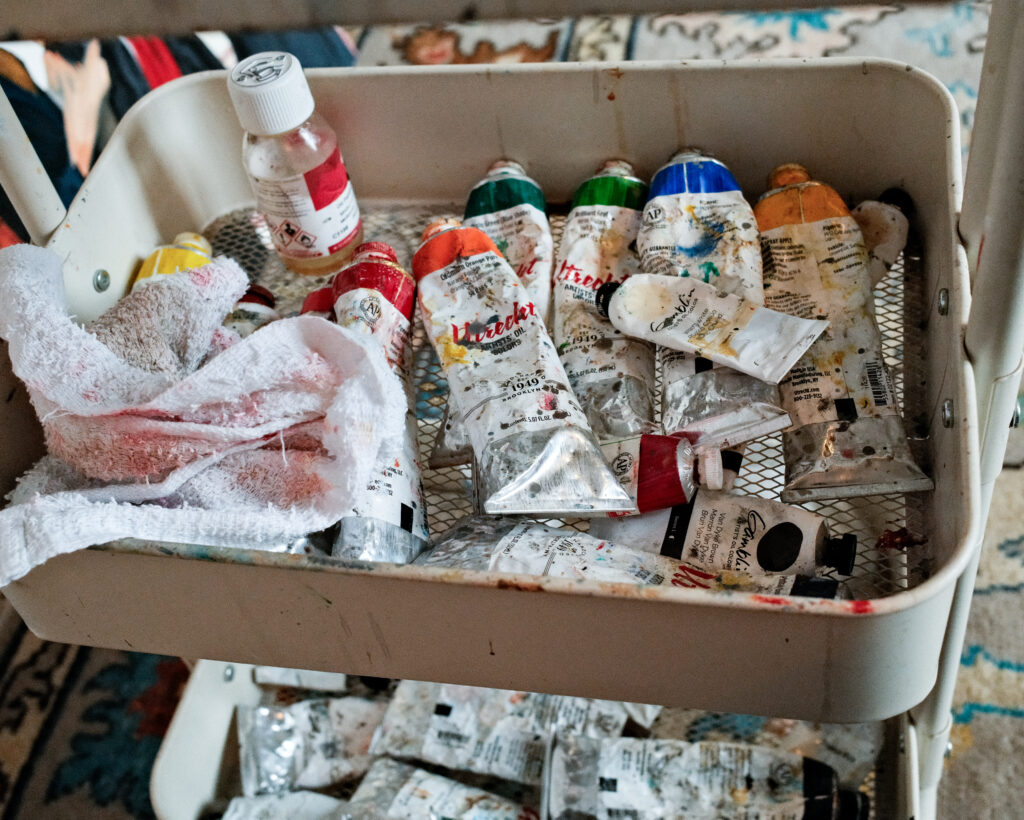
Her studio reflects that preference for order. Rather than embracing the romantic image of an artist surrounded by scattered paint tubes and dirty brushes, Goldstein likes to keep her space clean, organized, and ready for the next session. She cleans her brushes carefully, puts away paintings she is no longer working on, and wants to return to a space that feels like a fresh start. She also uses masking tape as a practical way to slow herself down. Goldstein considers herself a fast painter, and the tape creates a kind of guardrail, helping her focus on one area before moving to another instead of rushing to see as much as possible appear on the canvas. The system is not about making every part of a painting perfect before continuing, but about giving herself enough time to make considered choices.
The subjects of her paintings have developed through a similar process of observation and revision. Initially, Goldstein was interested in interiors, particularly homes and collector spaces with a strong sense of personal taste. Having grown up around art and spent time in galleries and museums, she was curious about the way people arrange their surroundings and what those decisions reveal. The paintings considered how furniture, objects, and artworks become expressions of identity, status, and personal preference. A room could communicate something about the person who lived in it without requiring a portrait or a direct explanation. Yet as she continued working, Goldstein became less interested in simply reproducing spaces that already existed and more interested in deciding what those spaces could become. She began replacing paintings, changing furniture, and rearranging details according to her own preferences, taking on the role of a curator within the image.
This interest in art and its surroundings eventually led her toward another subject that had been quietly accumulating in her own photographs. Whenever Goldstein visits a gallery or museum, she notices not only the paintings on the walls but also the people looking at them. She photographs visitors whose clothing echoes the colors of a painting, or whose presence creates an unexpected relationship with the work in front of them. The act of looking becomes part of what she is looking at, producing a kind of visual exchange between the viewer, the artwork, and the person observing both. These moments complicate the idea of a painting as an isolated object. Art is always encountered somewhere, by someone, and in relation to everything else occupying that space.
For her exhibition Handle with Care at The Journal Gallery, Goldstein took this interest in context and gave it movement. Instead of concentrating on the stillness of an interior, she began painting artworks in transit, depicting the process through which paintings and sculptures are packed, carried, lifted, installed, and moved from one place to another. The idea grew partly from her daily experience working as a studio assistant in Chelsea, where she regularly passes artworks being transported and galleries being prepared for exhibitions. She also moves her own paintings around, and began to pay attention to the choreography involved in getting an artwork from one destination to the next. The process is practical and often awkward, requiring logistics, coordination, and physical effort that are easy to overlook once a work is installed and presented to an audience.
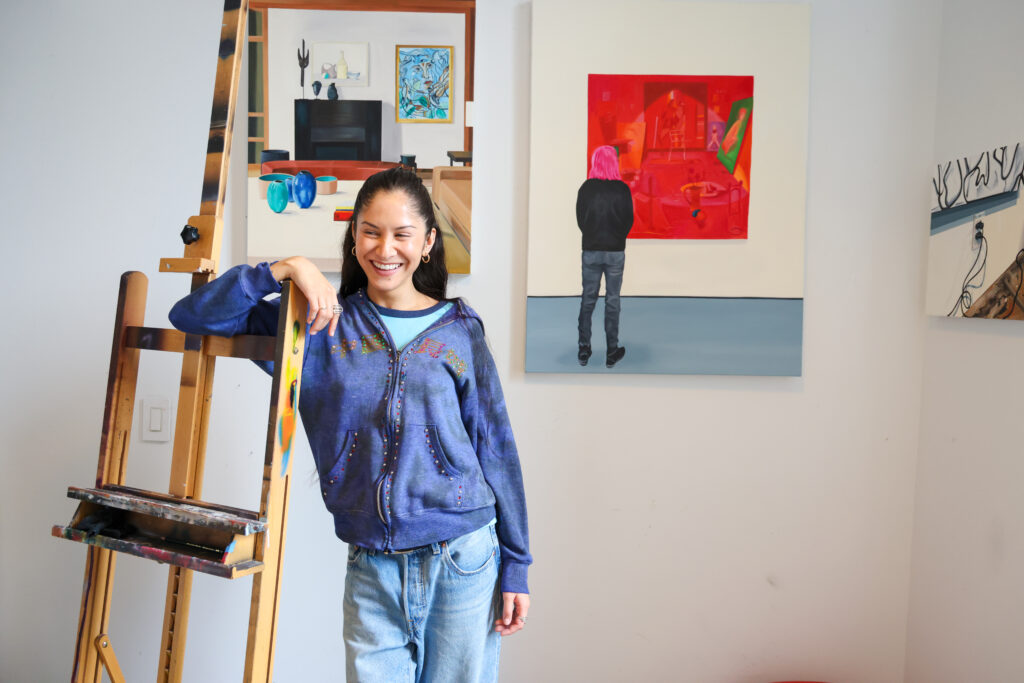
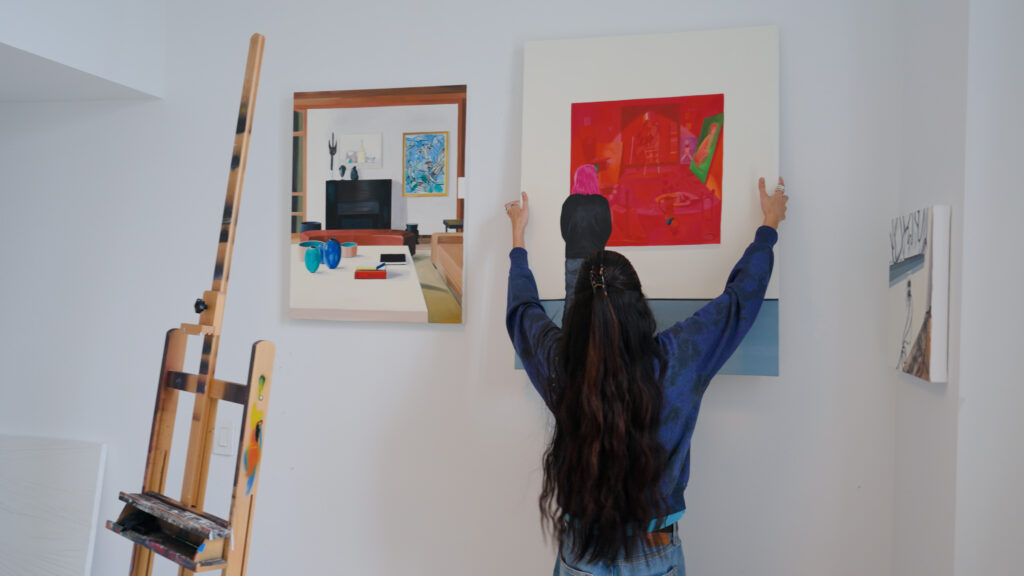
Goldstein is interested in what happens when the authority of an artwork gives way to the reality of its physical presence. A painting that might appear imposing or precious on a gallery wall can look surprisingly cumbersome when wrapped for transport or carried through a doorway. The contrast introduces an understated humor into the work, particularly when the object being moved is unusually large or valuable. There is something inherently absurd about the sight of an enormous sculpture being hoisted into the air or a highly prized painting reduced to a carefully wrapped package. These scenes do not diminish the importance of art so much as reveal another part of its existence, one defined by labor, vulnerability, and the ordinary practicalities that make its public presentation possible.
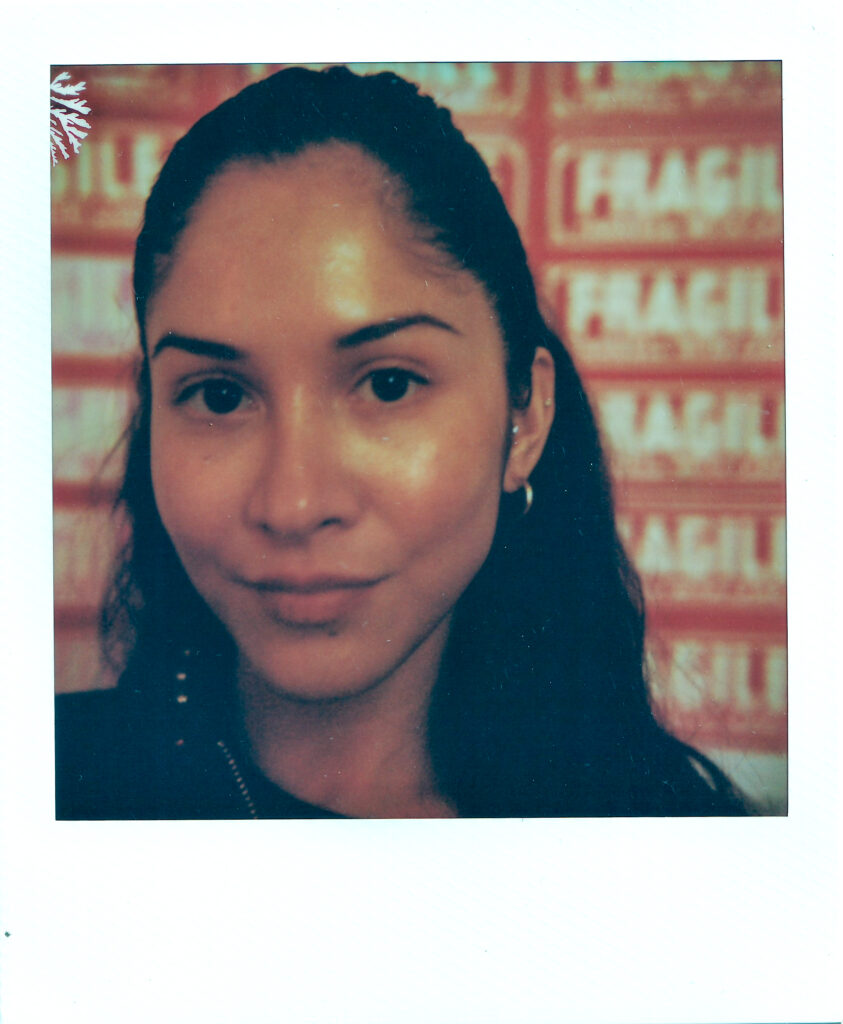
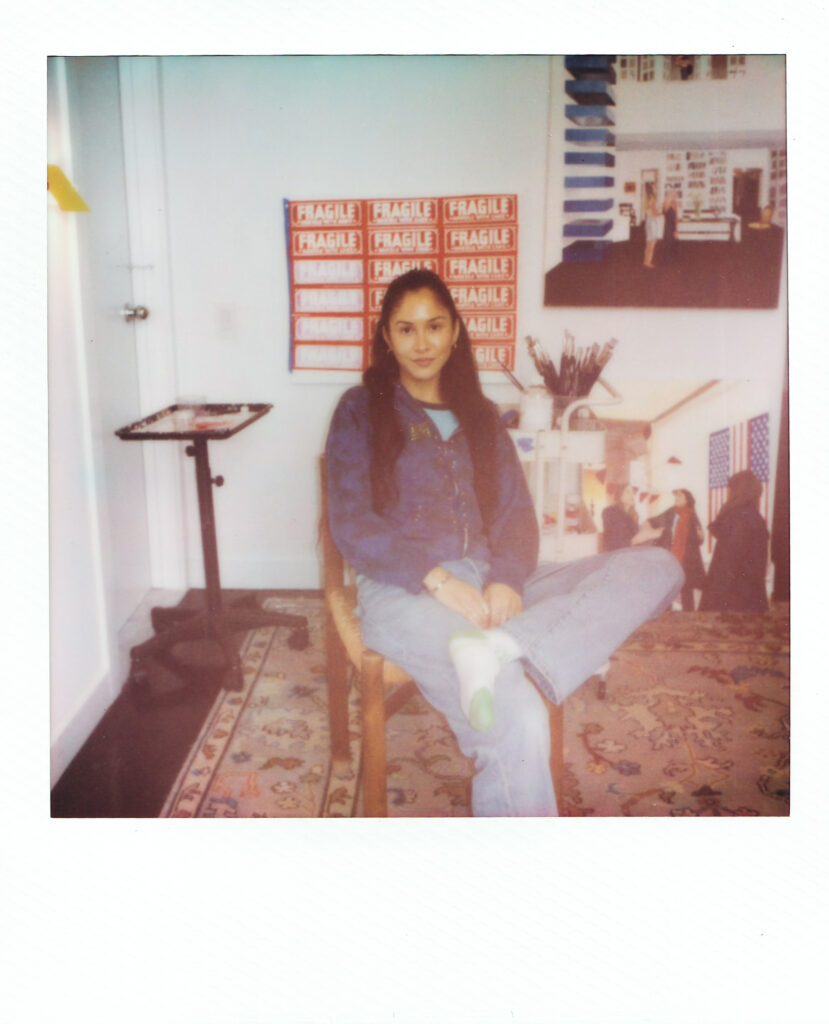
The title Handle with Care came from Andy Warhol’s Shipping Labels series, including a work bearing the repeated phrase “Fragile, handled with care.” The reference connects the language of shipping and preservation with the physical treatment of artworks, while also suggesting how objects move between different kinds of value. An artwork can be a cultural object, a financial asset, a personal possession, or a fragile thing that needs to be protected. Goldstein’s paintings bring these identities together without needing to settle on one interpretation. By focusing on the journey rather than only the finished destination, she opens up a story that usually remains outside the frame.
Her approach to painting is closely tied to the way she gathers information. Rather than developing every idea through preliminary drawings, she collects photographs and assembles references for individual works, treating that archive as a kind of sketchbook. She has found drawing increasingly difficult because the precision of a pencil can make every mark feel permanent, despite the fact that it can be erased. Paint offers a different relationship to uncertainty. She can begin directly on the canvas, discover something through the process, and revise the image as it develops. Moving from acrylic to oil has further supported that approach, giving her more time to shift paint around, adjust a composition, and build up layers.
For Goldstein, the ability to change direction is central to keeping the work alive. She wants to remain excited by what she is painting and to discover something new about herself or the world along the way. That does not mean trying to produce something that has never existed before. She recognizes that art history is full of ideas that may feel entirely new to an individual artist but have already been explored in other forms. Instead, she believes there is value in pursuing an idea because it genuinely interests you, allowing the work to contribute to a much longer conversation rather than becoming preoccupied with originality for its own sake.
That perspective also helps explain why Goldstein has sometimes found it difficult to claim the title of artist. Although she has felt drawn to making art for most of her life, she has been conscious of the assumptions that can accompany the word and the pressure to justify it. Her father encouraged her creativity while warning her against making art a career, concerned that turning a passion into a livelihood could place unnecessary demands on it. Yet Goldstein came to understand that if she wanted to spend her time painting, she needed to make room for it as work rather than treat it only as a hobby. Having her first exhibition in New York helped her feel more comfortable identifying herself as an artist, even as she continues to question what, exactly, qualifies someone to claim that identity.
Ultimately, Goldstein sees painting as a way to make an internal idea visible and share it with other people. She is interested in the possibility that a body of work can become a visual diary, recording the questions, interests, and changing perspectives that shape a life. Long after its maker is gone, a painting can offer another person access to something that might be difficult to communicate through photographs or writing alone. Her work begins with the simple act of paying attention, whether to the arrangement of a room, the way a visitor stands before a painting, or the awkward movement of an artwork through a city. By turning these observations into images, Goldstein gives them another life, inviting viewers to look again at the objects and situations they might otherwise pass without noticing.
About the Author
Sam Burke is an American artist, filmmaker and writer based in New York City. Working across film, performance, and writing exploring storytelling, identity, and place. As founder of Timestamp, Burke interviews artists, shares insights, and highlights conversations shaping art world today.
Gonçalo Preto
For Portuguese painter Gonçalo Preto, a painting is never simply a representation of something seen….
The Armory Show 2026: Highlights from New York’s Contemporary Art Fair
From experimental painting to immersive installations, a look at the artists, booths, and ideas that…
Mia Goldstien
Born in Los Angeles and now working in New York City, Mia Goldstein has built…
Michael Alexander Campbell
Michael Campbell once tried to give up making art. The idea, as he explains it,…
Andrew LaFarge Hamill
Andrew LaFarge Hamill describes himself as an artist and garden designer, but he is interested…
Felix Benton
Felix Benton grew up surrounded by people who made things. His grandmother was a glass…