
Michael Campbell once tried to give up making art. The idea, as he explains it, was that creativity might become more powerful if it were directed toward a single pursuit, like a river whose smaller streams are blocked off so that all its force can move in one direction. He stopped painting, writing, and doing the other things that occupied his attention, hoping to concentrate his energy and make something of it. Instead, he became miserable. The experiment taught him something that has since become central to his life as an artist: creativity does not necessarily become stronger through restriction, and the instinct to make things is not always something to be disciplined into submission. Sometimes it needs room to move.
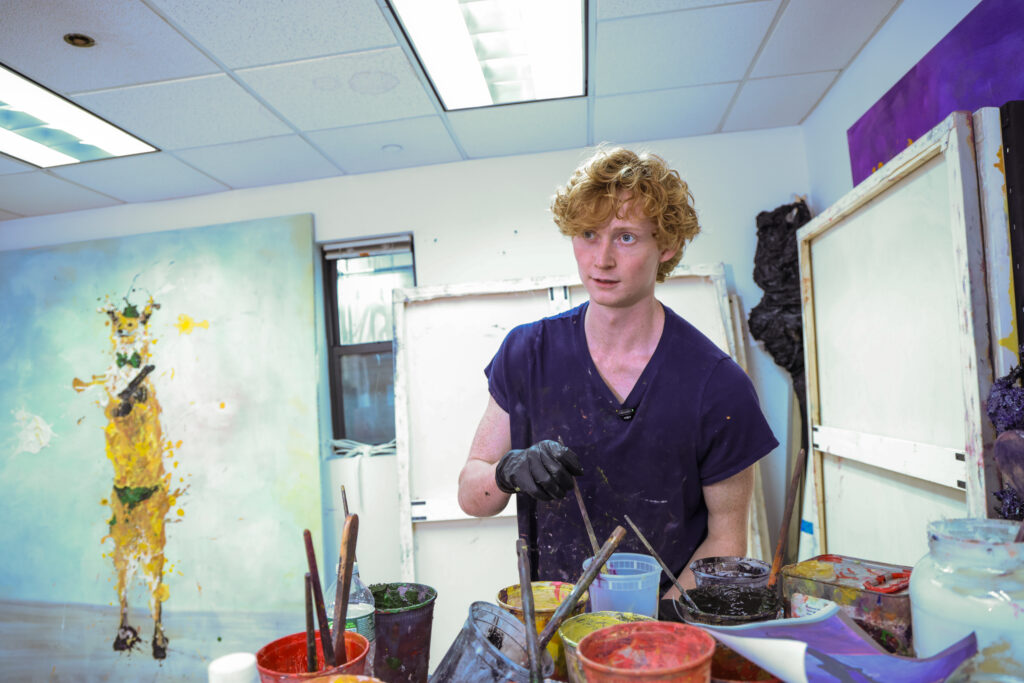
Campbell is a British and Swiss artist who grew up in a small village in Switzerland, surrounded by mountains, trees, snow, and the particular atmosphere of a place that feels almost like a fairy tale. He has been making things for as long as he can remember, although he is reluctant to explain too neatly why. His parents were not artists, but his grandmother painted, and he remembers being encouraged by teachers who understood the value of letting a young person follow an idea. At school, creative education was treated as a regular part of life, with time devoted to textiles, carpentry, drawing, and design. By the age of five or six, he was working with hammers and nails, making objects with the freedom to experiment and occasionally hurt himself in the process. The lessons were practical, but they also established an early relationship with making that was physical, curious, and largely self directed.
One teacher in particular, Nikki DeMarco, left a lasting impression. She would leave the art room open on weekends so that Campbell and his friends could spend time there without the usual supervision of a classroom. What mattered was not only that he had access to materials, but that he was trusted to use them. She treated her students like adults, giving them a space in which they could work on their own terms. Campbell remembers these experiences as a kind of freedom, one that allowed art to become more than a school subject or a skill to be assessed. It could be a place to spend time, to experiment, and to discover what interested him without needing to justify the result.
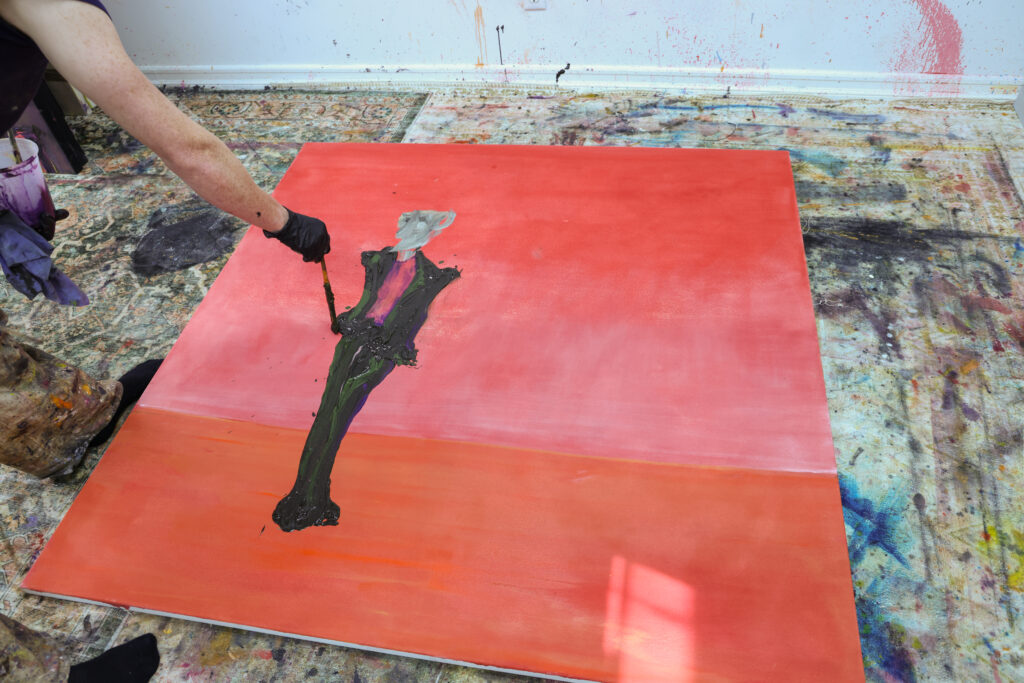
That freedom has not always come easily. After leaving school, Campbell became involved in a group whose ideas about creativity encouraged him to channel his energy into a single direction. He was around eighteen or nineteen when he began pursuing bioenergetics, a practice he describes as something like yoga mixed with psychoanalysis, and eventually found himself teaching it in Thailand and Indonesia despite having little formal qualification beyond what he had read. The experience was formative, though not in the way he had expected. When he stopped painting and writing in order to concentrate on this other pursuit, he lost something that he had not anticipated losing. After running out of money, he returned to his family’s village and began working at a local ski shop, painting again alongside the job.
Looking back, Campbell recognizes the mistake in trying to separate his interests. The things he does are not necessarily competing for the same limited supply of creative energy. Instead, they can inform one another in unexpected ways. Making more things can lead to more ideas, and an interest that seems unrelated to painting can eventually find its way into a composition, a material choice, or a subject. He describes the realization as a need to live a more expansive life, to stop suppressing his instincts and trust that they might lead somewhere worthwhile. Painting returned not because he had found a perfect reason to do it, but because not doing it had made him miserable.
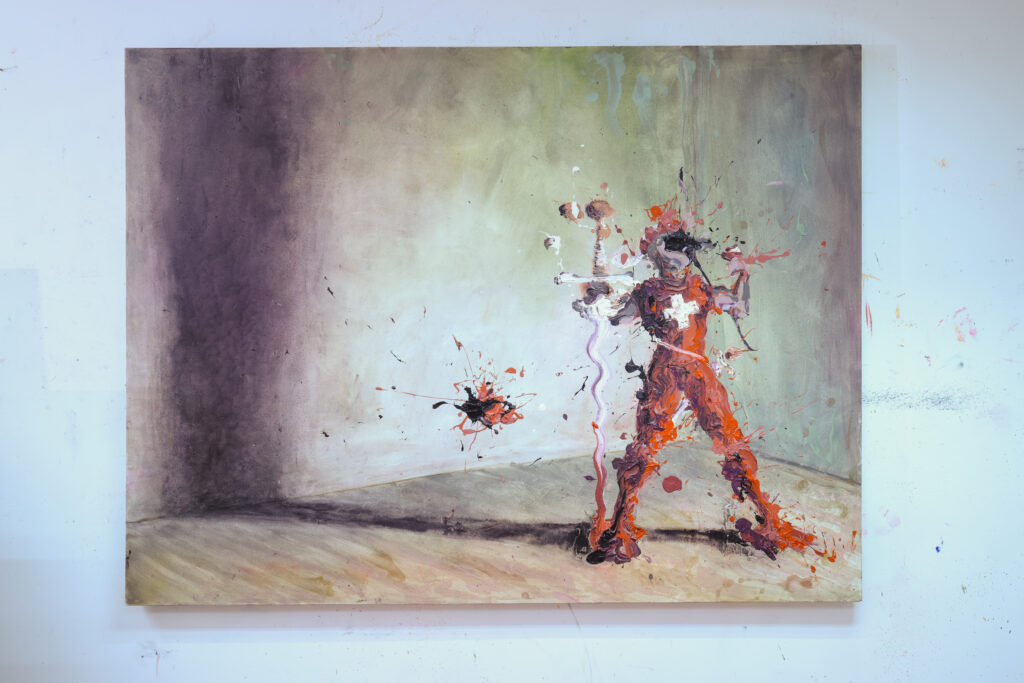
Painting remains the foundation of Campbell’s practice, in part because he sees it as an unusually versatile medium. He is also interested in sculpture, though he often approaches it as painting in three dimensions. Rather than treating the two as separate disciplines, he looks for ways to move between them, allowing an image or an object to exist somewhere between a painted surface and a physical form. Some of his sculptural works emerge directly from paintings, extending their shapes and material qualities into space. The distinction between the two becomes less important than the possibility of carrying an idea from one form into another.
This movement between forms reflects the way Campbell thinks about making more broadly. He is interested in the process of following an idea before he fully understands what it might mean, and he does not always begin with a clear interpretation of the image he wants to create. In fact, he is wary of explaining a painting too soon. He often recognizes its larger implications only after it has been made, when he can look back at the decisions that brought it into existence and begin to understand why certain images held his attention. The work itself is guided by intuition, composition, and craft, while the language that surrounds it tends to arrive later.
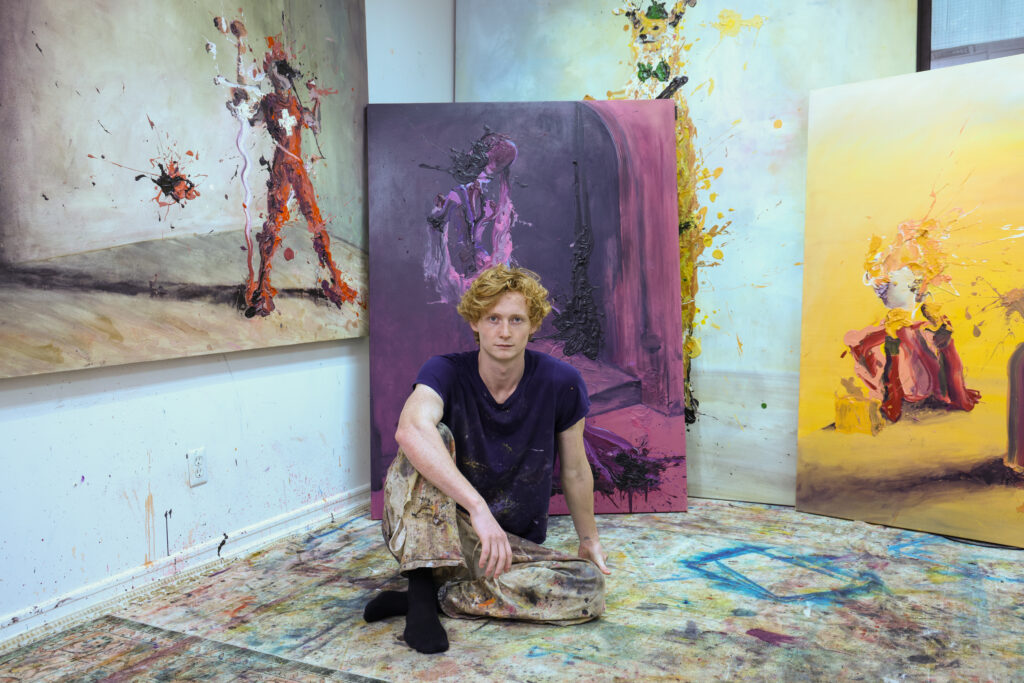
Recently, Campbell has been looking through old British magazines, including issues of Punch dating from 1917 and publications that reach back into the nineteenth century. Their illustrations offer a particular kind of visual material, filled with historical figures, dramatic encounters, strange characters, and scenes that seem to belong to another time. He is drawn to images that feel both culturally specific and strangely familiar, the kind of imagery one might associate with a Charles Dickens novel or an illustrated fairy tale. What interests him is not necessarily the historical event depicted, but the way an image can carry a story beyond its original context.
One painting began with an image of Wilhelm II, the last German emperor, shortly before the collapse of the Prussian Empire. Campbell chose the scene because he found it visually compelling, while also sensing that its political and cultural implications might resonate with the present. He does not insist on resolving those connections in advance. The image can be historically situated without being limited to its historical moment, and its significance can remain open as the painting develops. He is interested in the composition as a kind of narrative or myth that might survive even when the people, countries, and names associated with it have changed.
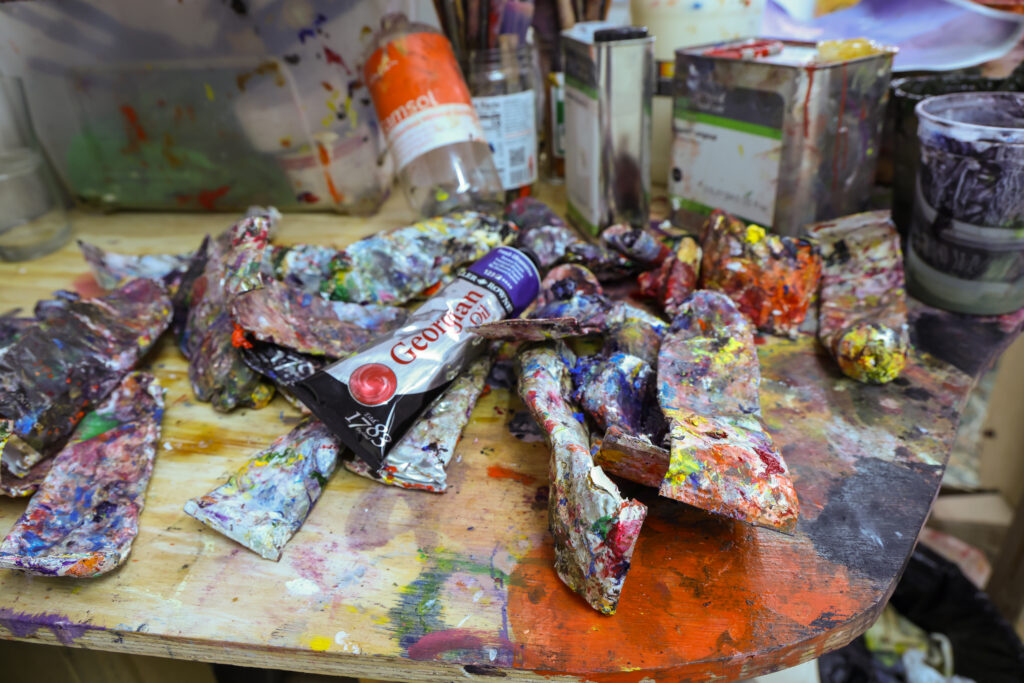
This idea extends to figures that have remained with him since childhood. On his way home from kindergarten, Campbell used to pass a wall bearing an image of a Swiss mercenary, a figure reproduced by an unknown artist and repeated over time. He remembers it as one of the first images that gave him the feeling of encountering an action figure in the world around him. Years later, he returned to that image in his own painting, drawn to something he could recognize intuitively without necessarily being able to explain it. Its meaning was not something he had consciously assigned to it. It was an image that had stayed with him, and the act of painting allowed him to discover what that persistence might mean.
Campbell’s interest in historical imagery is therefore less about reconstructing the past than finding forms that seem to endure. People change, countries change, and the names given to things change, but certain stories and relationships continue to recur. He is interested in what remains when the particular details are stripped away, in the kinds of encounters that appear across different cultures and periods. A figure facing something larger than itself, a confrontation with death, or the theatrical arrival of a powerful character can carry the structure of a fairy tale even when the original source is political history. The painting becomes a way of holding those different registers together without reducing one to the other.
His process also allows room for images to change as he works. Rather than simply copying a printed reference, he might model parts of a scene in clay and arrange them under a light to produce the shadows he wants to paint. He then uses photographs of the arrangement alongside the original image, building a new reference from the relationship between the two. At other times, he photographs a painting with his phone, draws over the image digitally, prints it, and uses the result to test possible changes. He might repeat this process several times, experimenting with different shadows or compositional decisions before returning to the painting itself. Historical images, handmade models, photography, and digital tools become parts of the same process, each offering a different way to see what the painting might become.
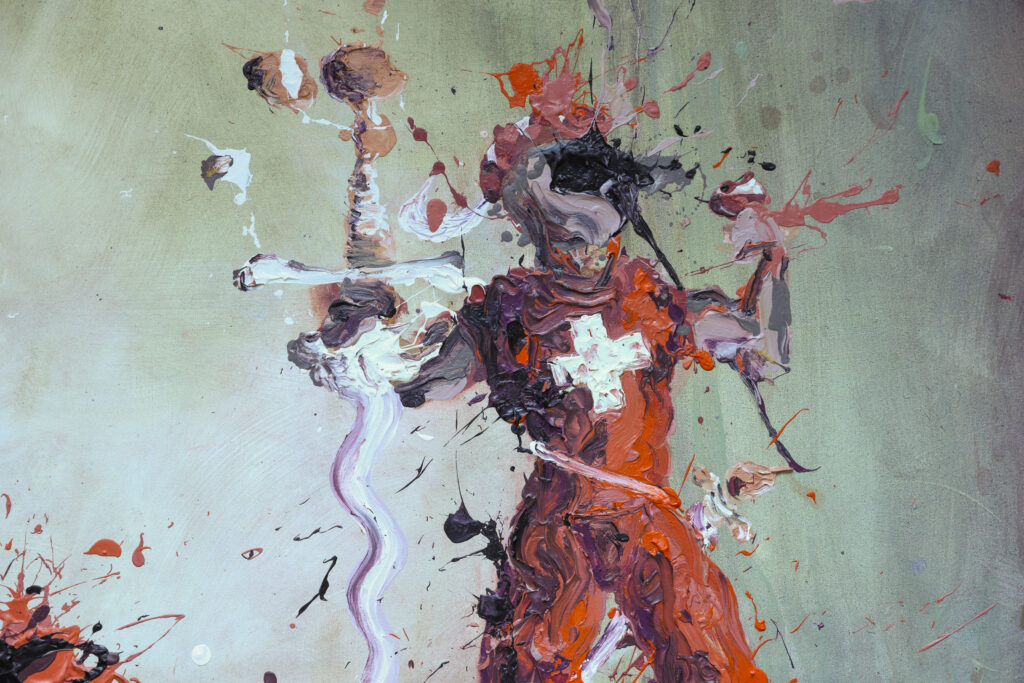
For Campbell, this kind of experimentation is not separate from the more basic work of learning to paint. The longer he makes art, the more important he finds fundamentals such as composition and color. These are simple principles, but they continue to reveal themselves at different stages of his development. He also sees learning as something that comes through trying things and discovering what happens, rather than following another person’s ideas without question. Art school, in his view, can become a test of whether you are willing to trust your own instincts, especially when those instincts lead you away from what someone else has told you to do.
Trusting those instincts does not mean that making art becomes easy. Campbell describes the beginning of a painting as something like standing at the edge of cold water before jumping in. The hesitation never entirely disappears. You learn to become the person who eventually says, essentially, to hell with it, and starts anyway. The work will often disappoint you at first, and then you have to stay with it long enough to change it. There is an emotional weight to making something that does not yet work, but that discomfort is part of the process rather than a sign that the process has failed.
The paintings retain something of this uncertainty. Their figures, shadows, and theatrical compositions can feel both carefully constructed and unresolved, as though the scene is arriving into view rather than being fully prescribed from the beginning. Campbell does not need to know everything a painting means before he can make it. In some cases, explaining too much would risk closing down the possibilities that made the image interesting in the first place. He prefers to leave room for a viewer to encounter the work without being given a definitive interpretation.
There is a quiet contradiction in Campbell’s approach. He is interested in the endurance of myths and narratives, in the possibility that some structures of human experience survive the changing circumstances of history, yet he arrives at those structures through an open ended and sometimes improvised process. He can spend time reconstructing an image through clay, light, photographs, and paint, while remaining uncertain about its final significance. The work is deliberate without being entirely predetermined. Its meaning is something he can discover alongside the viewer.
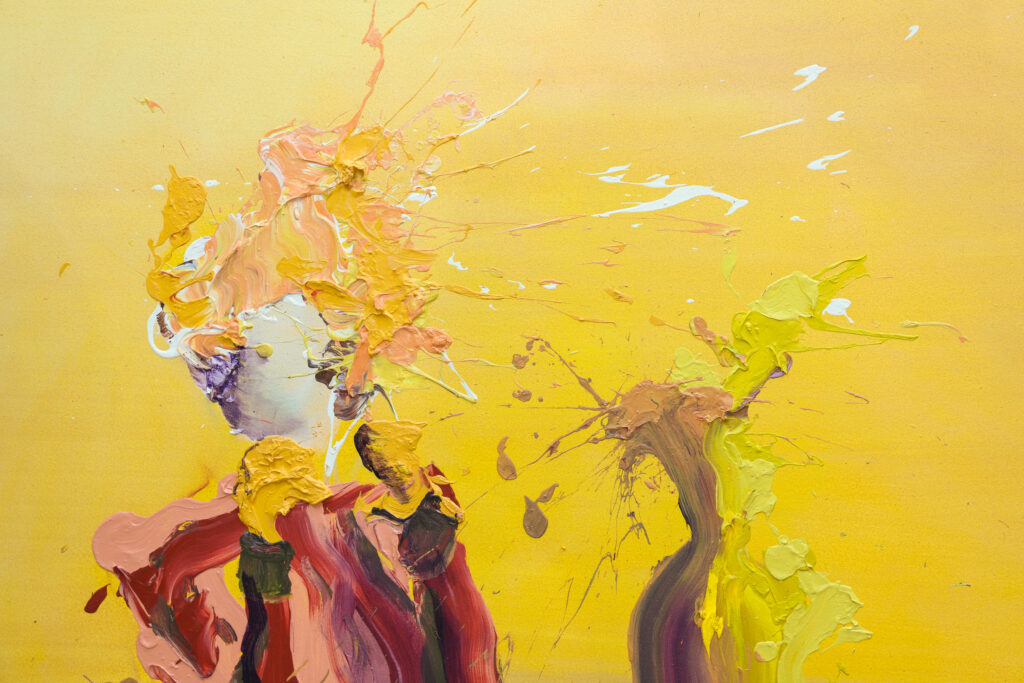
Perhaps this is why the attempt to quit art could never really hold. Campbell’s practice depends on the freedom to follow several interests at once, to let one activity lead unexpectedly into another, and to allow images to gather meaning over time. Painting offers a way to return to things that have stayed with him, whether they come from an old magazine, a childhood walk through his village, or an image whose significance he cannot yet articulate. Sculpture offers another way to inhabit those ideas, while writing and other pursuits keep his attention moving beyond the studio.
Campbell speaks openly about wanting children to like his work, and about wanting, in his own words, to cheat death. The ambitions are both simple and enormous. A painting can make an image persist beyond the moment in which it was made, allowing a story to be encountered by someone who knows nothing about its original circumstances. It cannot stop time, but it can give something a life beyond its source. For an artist drawn to the stories that endure beyond individual characters, this may be one of painting’s most compelling possibilities. The point is not to make every meaning permanent or to explain every image completely, but to create something that can continue to speak after the artist has moved on.
About the Author
Sam Burke is an American artist, filmmaker and writer based in New York City. Working across film, performance, and writing exploring storytelling, identity, and place. As founder of Timestamp, Burke interviews artists, shares insights, and highlights conversations shaping art world today.
Gonçalo Preto
For Portuguese painter Gonçalo Preto, a painting is never simply a representation of something seen….
The Armory Show 2026: Highlights from New York’s Contemporary Art Fair
From experimental painting to immersive installations, a look at the artists, booths, and ideas that…
Mia Goldstien
Born in Los Angeles and now working in New York City, Mia Goldstein has built…
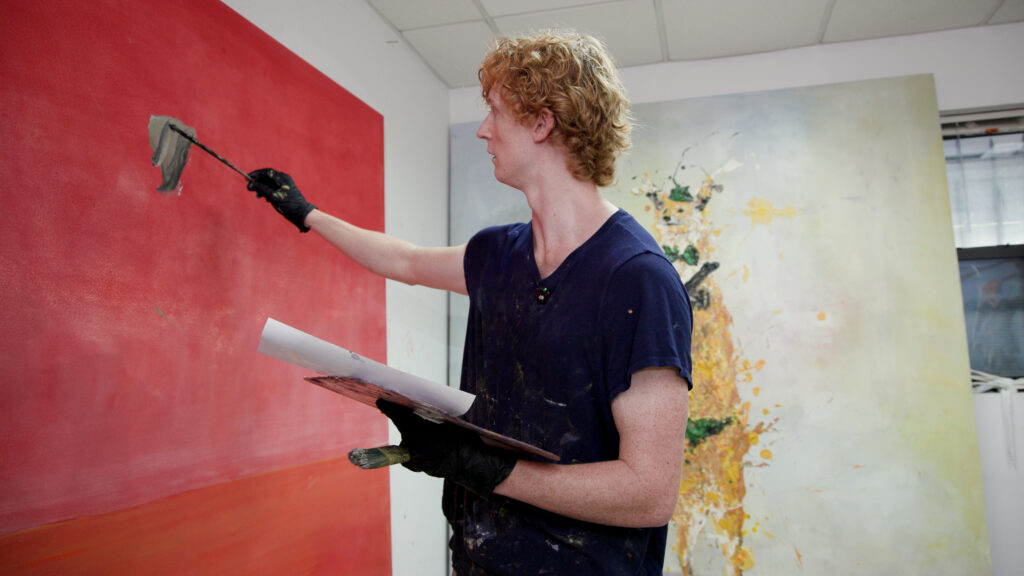
Michael Alexander Campbell
Michael Campbell once tried to give up making art. The idea, as he explains it,…
Andrew LaFarge Hamill
Andrew LaFarge Hamill describes himself as an artist and garden designer, but he is interested…
Felix Benton
Felix Benton grew up surrounded by people who made things. His grandmother was a glass…