
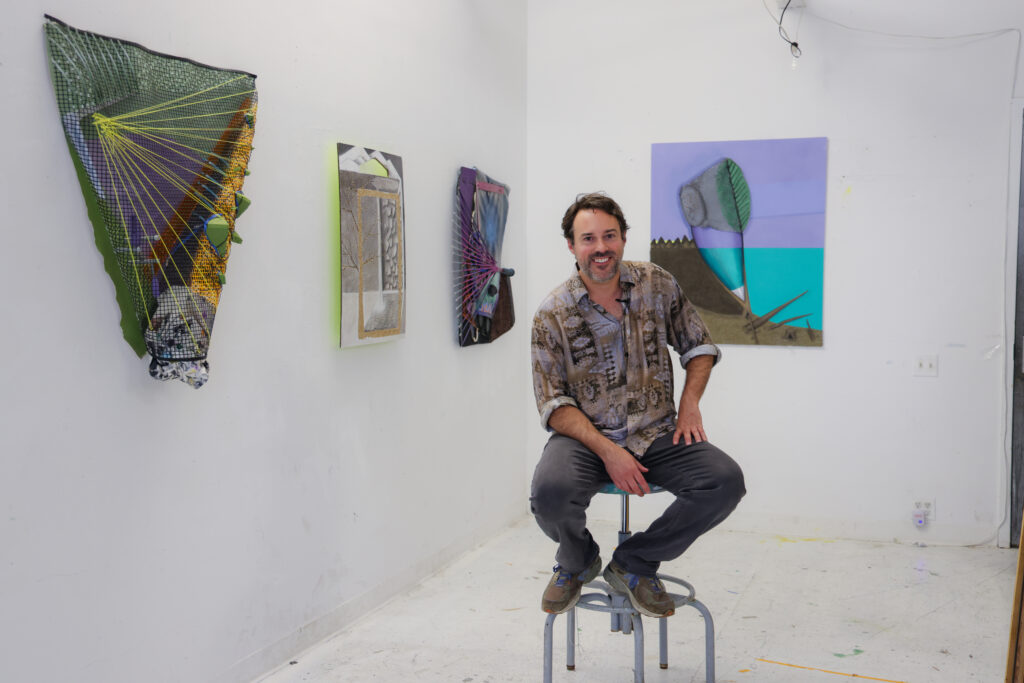
Andrew LaFarge Hamill describes himself as an artist and garden designer, but he is interested in what happens when they overlap, when sculpture begins to behave like a landscape, when a garden becomes a site for an artwork, or when a piece of discarded plastic becomes the starting point for an idea. His current practice is less about choosing one medium than about finding connections between things that are usually kept separate. “Currently I’m synthesizing the two,” he says.
That tendency toward synthesis seems to have been present long before Hamill began thinking of himself as an artist. As a child, he wanted to be an inventor, drawing imaginary objects and hybrid coffee mugs at around eight years old. He grew up between Brooklyn and Cambridge, studied anthropology as an undergraduate, and even went to business school before moving more seriously toward art. Sculpture eventually became his entry point, beginning with welding and expanding into a practice that could accommodate video, performance, woodworking, painting, collage, and almost anything else he became interested in. The attraction was partly the freedom of it. After working an office job at the Wilderness Society, he found himself thinking about the difference between making something that was distinctly his and producing work that someone else could easily reproduce. Art offered a different kind of authorship.
His relationship with nature developed alongside that search. A ten day canoe trip down the Allegheny River during college, taken with one friend with almost no contact with other people, became a formative experience, giving him a stronger appreciation for the natural world and making him think more seriously about what he wanted to do. His interest in plants also has a family history. His father was a landscape architect before eventually running the family farm, and Hamill later worked on organic farms himself. During Covid, when his ability to interact with other people was limited, he found himself becoming especially absorbed in working with plants. There was something satisfying about the physicality of it, the movement, the soil, and the possibility of working at a scale that extended beyond the walls of a studio.
That physicality is important to the way Hamill thinks about making. His education gave him technical skills, but he also learned through other artists and craftspeople, including a fellow graduate student and garden designer who was deeply hands on and taught him about building and making. Hamill later pursued traditional drawing and painting instruction as a counterpoint to his more experimental practice, spending months drawing an orb and sharpening pencils by hand. For him, the value of art comes from a combination of invention, technical skill, and meaning. Invention was something he already possessed, while education helped him develop the technical and conceptual parts around it.
Teaching has reinforced that way of thinking. Hamill has taught introductory art and sculpture, and he sees a connection between teaching and curating. When he organized Overflow, a site specific exhibition involving 21 artists and the environmental issues surrounding the Gowanus Canal’s combined sewer overflow, he found himself giving artists a framework within which to make decisions. The restrictions did not necessarily limit the work. Instead, they helped narrow the field of possibilities. Hamill sees something similar happening in his own practice, where assignments or self imposed rules can make it easier to identify what matters. There is a place for getting into a zone and making without thinking, but there is also value in stepping back and becoming analytical.
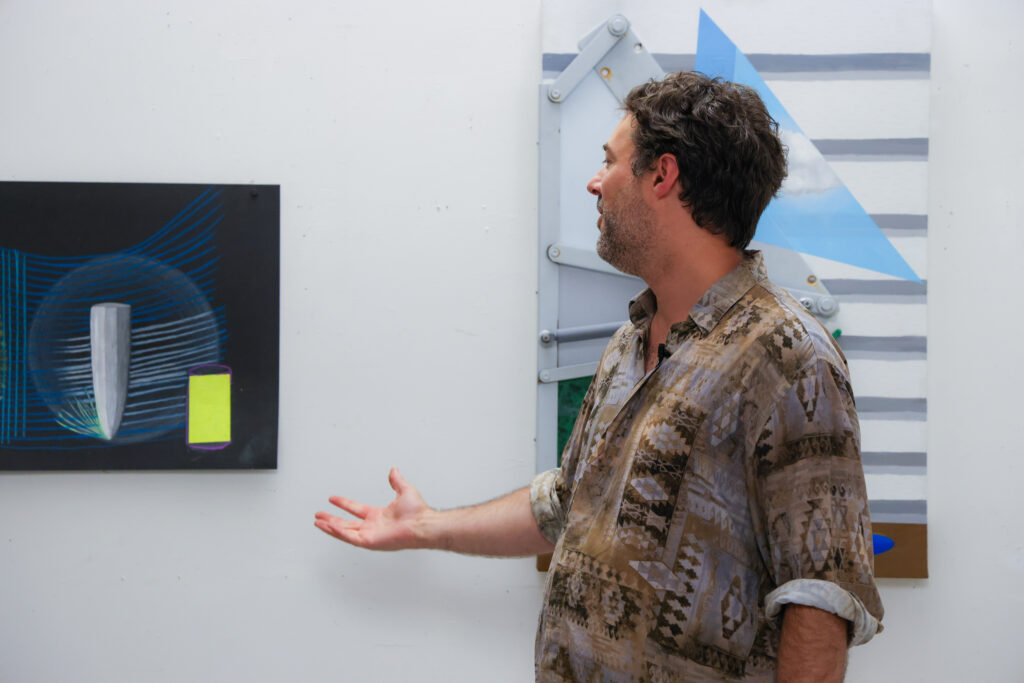
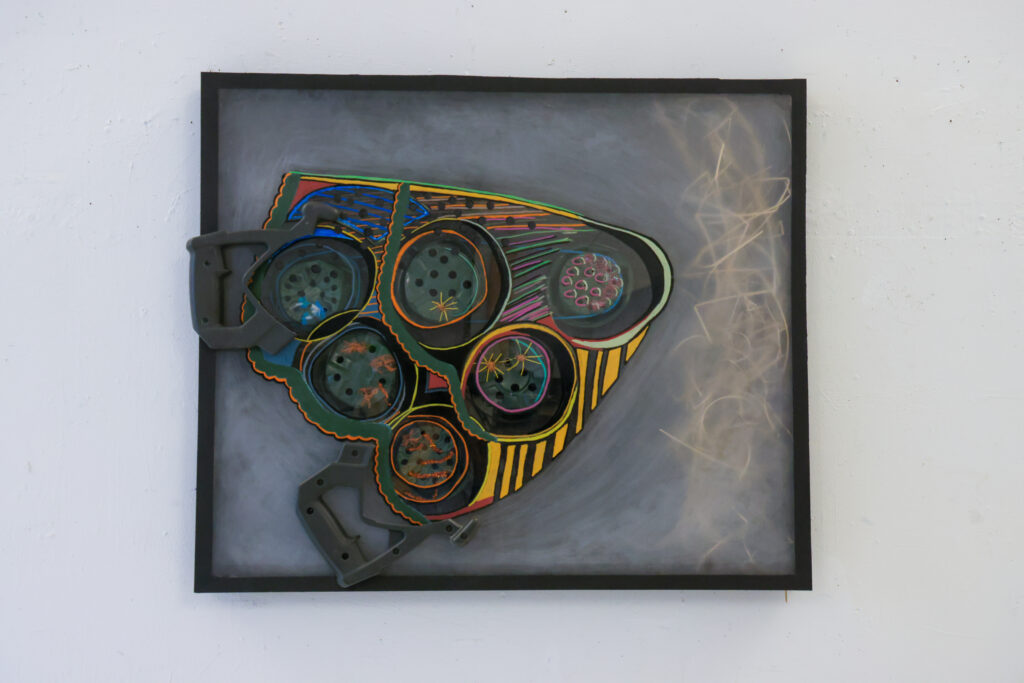
That balance between freedom and constraint appears throughout his work. Hamill often begins with an idea, but the material can redirect it. Sometimes the material comes first. He is particularly interested in the meanings carried by contemporary materials, especially plastics, plexiglass, and other synthetics, and in what happens when those materials are combined with references to the natural world. Many of the materials he works with are recycled or repurposed, including plastic originally used to protect young trees, yoga blocks, paint rags, and other objects that might otherwise be discarded. He is drawn to the strange histories these materials carry, including the discoloration and patina that develops on plastic over time.
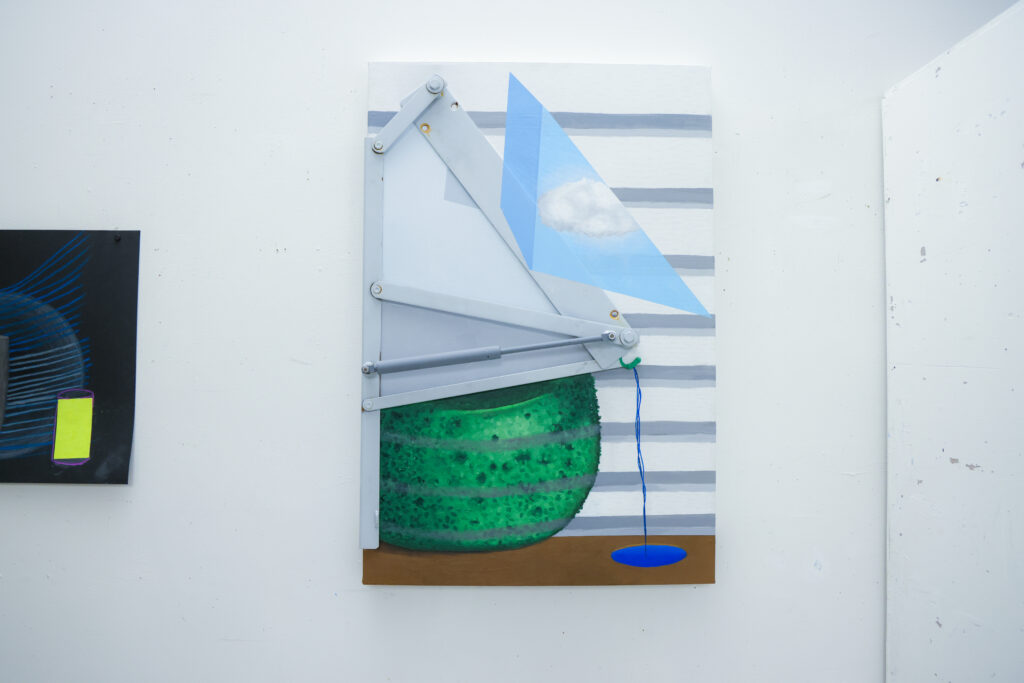
There is a quiet tension in that choice. Hamill wants to bring people closer to nature, but he is not interested in an idealized version of nature that exists outside contemporary life. His materials are often distinctly artificial, industrial, or disposable. His sculptures can suggest landscapes, islands, plants, seeds, ice, or other natural forms, while remaining visibly constructed from the objects of everyday life. He describes the process almost like poetry, where meaning can emerge from the combination of separate things rather than from one fixed image or explanation. A piece might resemble a landscape from one direction and something entirely different from another. The potential for the object to become something else is part of the work.
This interest in transformation also shapes his understanding of what art can be. Hamill is skeptical of the idea that simply moving an object into a museum makes it art. At the same time, he believes almost any material can become part of an artwork if there is invention, concept, and meaning behind it. He is especially interested in materials that have been overlooked or discarded, describing the possibility of making something beautiful from what would otherwise be considered detritus. There is even a kind of power in making an object from such materials that seems as though it made itself, allowing the discarded thing to take on a new presence without completely losing its previous identity.
That impulse toward the overlooked has become increasingly focused on the natural world around him. In Prospect Park, Hamill has been mapping groups of trees, looking at their different layers and studying the ways they occupy the landscape. The project grew out of an interest in language and the idea that the more precisely we are able to name something, the more closely we might begin to notice it. He became interested in the many words used to describe groups of trees and in how language can change the way we see the world. The project is partly an attempt to restore attention to things that have become visually ordinary.
His Prospect Park work also complicates the idea of what nature actually is. From his studio, the park can feel like an escape into the woods, but Hamill is interested in looking beyond that romantic image and examining the park’s construction and history. Its landscape was designed, its gorge and river are artificial, and many of the trees that now define the environment arrived through circumstances that were never part of the original plan. Norway maples, for example, were not intentionally planted there but eventually became part of the landscape on their own. For Hamill, that mixture of design, accident, history, human intervention, and natural growth makes the park more interesting rather than less natural.
One of his current projects takes that observation into something more imaginative. Hamill has been developing hypothetical amusement park rides based on the trees of Prospect Park, including one inspired by the Norway maple and its seeds. He maps where the tree exists and studies its biological characteristics before translating those observations into an invented experience. The project brings together research, sculpture, design, environmental history, and fantasy, while continuing his interest in the strange space between the artificial and the natural. He calls the larger project Prospect Planets, an ode of sorts to Disney World that he hopes will eventually involve other people and organizations.
For Hamill, the environmental questions are not separate from the artistic ones. He is interested in the changing boundaries between native and invasive plants, especially as climate change shifts the conditions in which different species can survive. A plant that might be considered invasive in one context can become useful in another, particularly in neglected spaces where survival and maintenance matter more than rigid categories. That complexity mirrors his broader discomfort with simple divisions between natural and artificial, useful and useless, art and design.
Ultimately, Hamill’s practice seems to be less about representing nature than about getting people to notice it. He returns repeatedly to the idea that if you pay enough attention to anything, it becomes interesting. That attention can be directed toward a tree, a piece of plastic, a neglected sidewalk, a garden, a word, or the history of a public park. His work gives those things another reason to be looked at, not by removing them from everyday life but by making their existing relationships more visible.
That may be what connects the different parts of Hamill’s practice most clearly. The child drawing inventions, the sculptor welding metal, the garden designer working with living plants, the teacher giving students specific assignments, and the artist mapping trees in Prospect Park are all doing essentially the same thing: looking closely enough for something new to emerge. His work does not require the separation of disciplines because the world itself does not seem to operate that way. A garden can be a sculpture, a discarded material can become a landscape, a tree can become an amusement park, and an ordinary patch of the city can become a place worth paying attention to.
About the Author
Sam Burke is an American artist, filmmaker and writer based in New York City. Working across film, performance, and writing exploring storytelling, identity, and place. As founder of Timestamp, Burke interviews artists, shares insights, and highlights conversations shaping art world today.
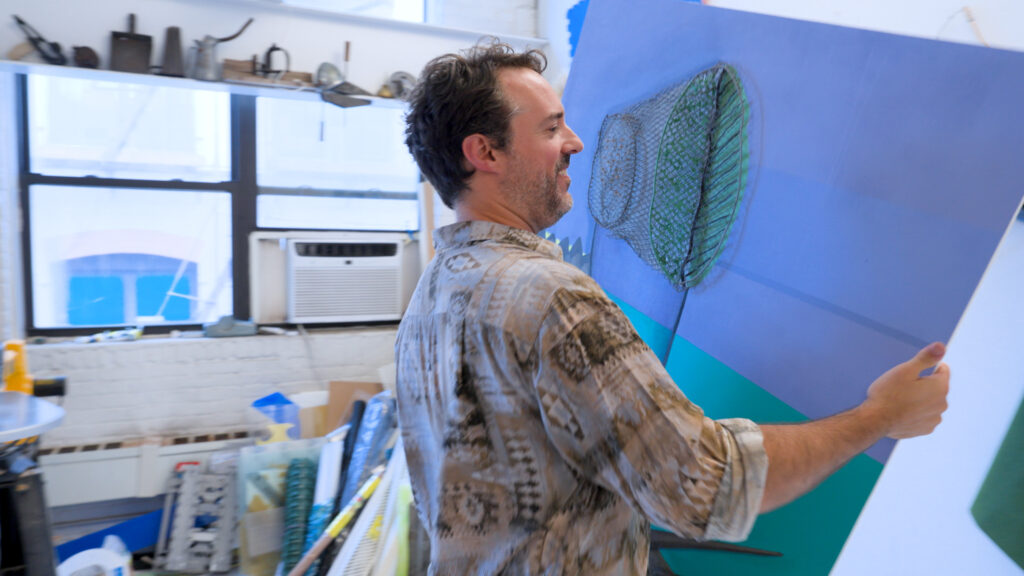
Andrew LaFarge Hamill
Andrew LaFarge Hamill describes himself as an artist and garden designer, but he is interested…
Felix Benton
Felix Benton grew up surrounded by people who made things. His grandmother was a glass…
Jackie Reeves
Jackie Reeves grew up in Montreal in a family where making things was part of…
Stéphane Koyama-Meyer
French visual artist and designer based near Basel, Stéphane Koyama-Meyer grew up surrounded by art,…
Yuval Bezalel
For Yuval Bezalel, painting begins with the hands, before there is a narrative, before there…
Adèle Aproh
For Adèle Aproh, drawing began long before she knew it could become a career. Her…