
Jackie Reeves grew up in Montreal in a family where making things was part of everyday life. Both of her parents were architects with seven children, art supplies were always within reach. Large sheets of paper covered the floor, her father drew and her mother built architectural models. Jackie learned by watching them, developing an instinct for drawing and making that has stayed with her ever since.
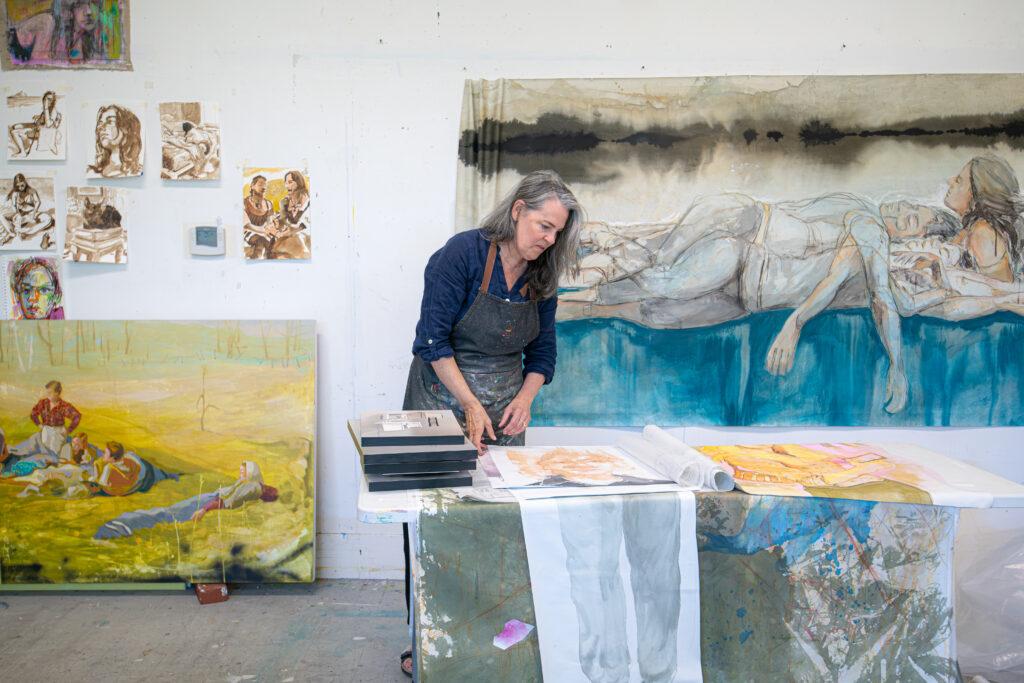
Her route into art, however, was not straightforward. She studied art and design but spent the first twenty years of her career working commercially, taking on graphic design, illustration, murals, painted furniture, set painting and other commissions. She became comfortable saying yes to projects before knowing exactly how she would complete them, trusting that she could learn what was necessary along the way. That experience gave her an unusually broad range of technical skills, but for many years she thought of herself more as a craftsperson or commercial artist than as an artist working from a personal point of view.
That changed in her forties, after the death of her older sister, who had been an artist and mentor. The loss made Jackie reconsider how she was spending her time and what she might make if nobody was giving her a brief. She stopped taking commission work for a period and, with several friends on Cape Cod, organized a show of their own work. Standing in front of a blank canvas without a client or instructions was intimidating, but it also opened up a completely different way of thinking about making. For the first time, she had to ask herself what she wanted to say and what her own voice might look like.
The experience led her back to school, where she began thinking more deeply about painting and its place in contemporary life. By then she had already spent years learning through practice, and she continued to see making as the most important form of education. “I feel like all art ends up being self taught anyway,” she says, because eventually an artist has to leave the classroom and discover what happens through their own process.
Her commercial background remains an important part of that process, but Jackie is now careful to protect her personal work from the demands of the market. She knows how to make things that people want to buy, but she does not want sales to determine what she paints. Instead, she supports herself through teaching, community work and occasional projects, leaving her studio practice open to experimentation. Her ambition is deliberately difficult to define. She wants to keep growing, try things she has not tried before and make paintings that feel genuinely her own rather than repeating a formula because it has worked before.
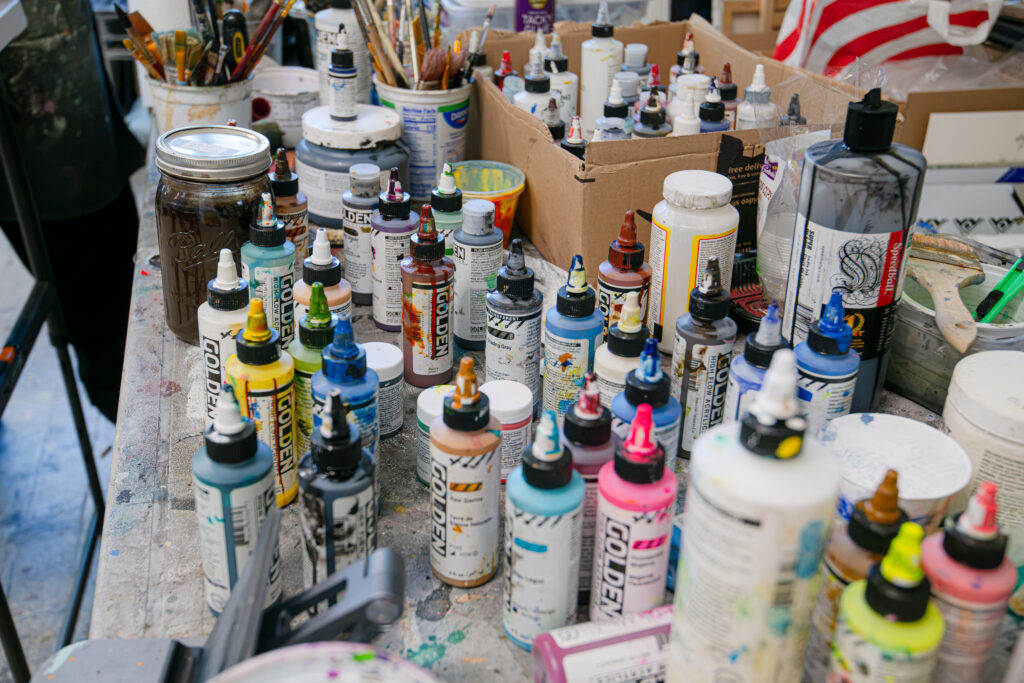
That openness is central to the way she works. Jackie often begins without a fixed idea, allowing diluted paint, water and other materials to move across a surface before deciding what she is looking at. She is particularly drawn to processes that produce results she cannot completely control. When she slows down too much, she says, her analytical mind takes over, so she tries to work quickly enough to respond intuitively. The accidents that happen along the way are not problems to be corrected but possibilities to follow.
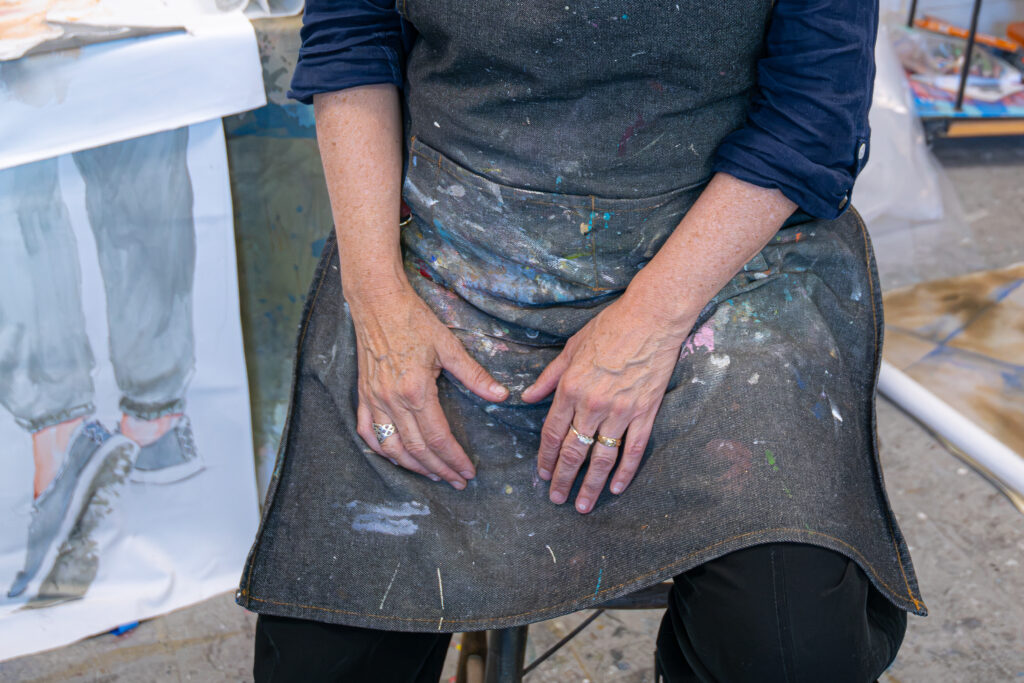
This has led her to work across a wide range of materials and surfaces, including canvas, paper, aluminum and fabric. One unexpected discovery came when she found a roll of blackout curtain liner in her studio and wondered whether it could be painted. The material absorbed the paint differently from canvas, allowing colors to bleed and spread across the surface, and what began as an experiment eventually became a substantial body of work. Some paintings remain stretched while others can be rolled, cut apart or transformed into something entirely different.
The willingness to alter or even destroy a finished work comes from the same place. Jackie does not want to become overly precious about the objects she makes. A painting can sit in her studio for years before she decides that it needs something else, and sometimes an older work becomes the material for a new one. Looking back at these paintings can also reveal another kind of value, because they become records of different periods of her life, preserving the chaos of raising children, the people around her and the things she was thinking about at the time.
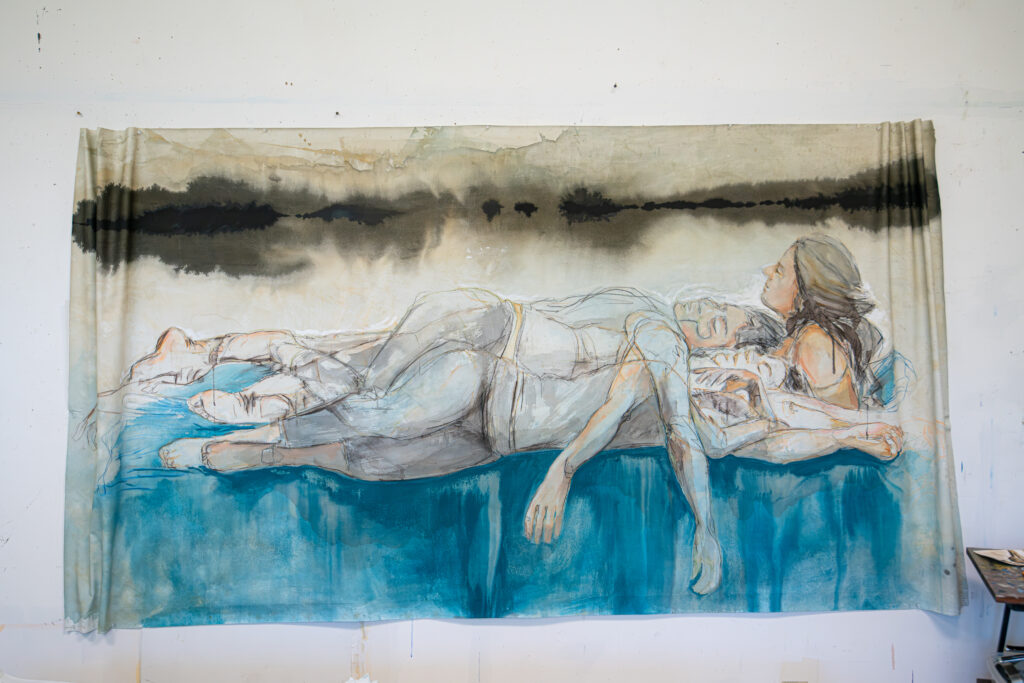
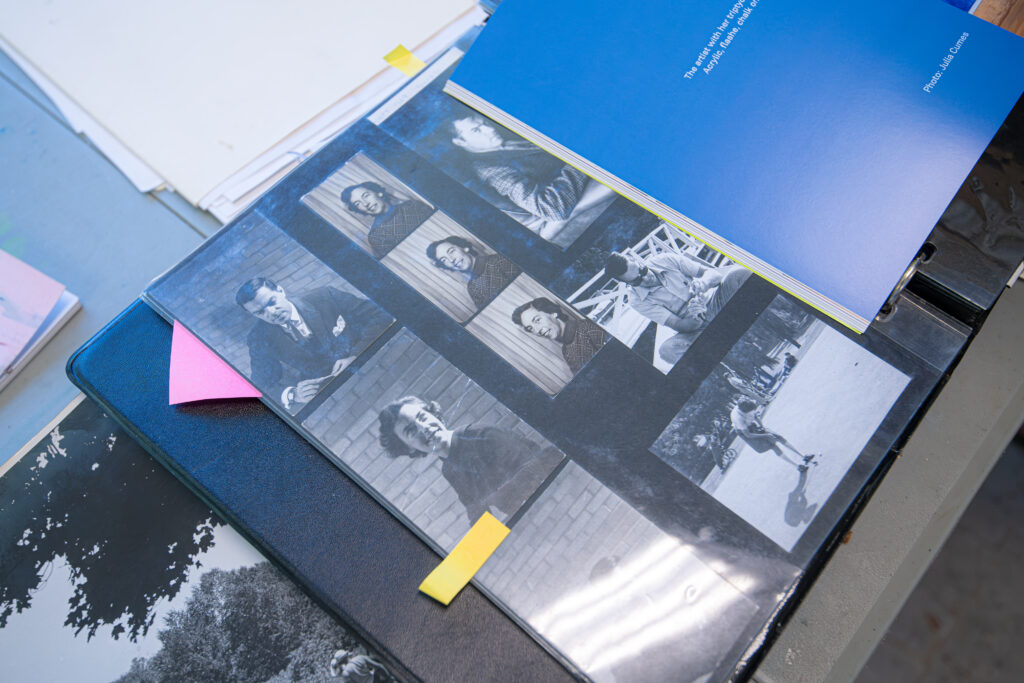
Family and memory have become increasingly important in her recent work. After her mother died, Jackie inherited boxes of family photographs, and going through them became a way of looking back at the people and places that shaped her. Her mother had been an architect and photographer, and the photographs offer fragments of family life that Jackie can now reconsider from an adult perspective. She is interested not only in what the images show but in the complicated relationship between photographs and memory, wondering how much of what we remember comes from the event itself and how much is reinforced by seeing a photograph of it later.

Those photographs often become starting points rather than images to reproduce faithfully. She might focus on a gesture, a landscape, the way several people occupy a space or an incidental detail in the background, then develop the image through drawing, watercolor or painting until the original reference becomes less obvious. The process allows the photograph to become something more personal and ambiguous, a place where memory and invention can overlap.
Figures have remained a constant throughout this process. Jackie has been drawing people since childhood and has taught life drawing for roughly two decades, finding something calming in the simple act of looking closely and responding to what is in front of her. Her piles of drawings, often made on loose sheets of paper, become a visual record of ideas and possible compositions. Some develop into paintings while others remain as fragments, but the act of drawing keeps her connected to observation.
Her interest in family history extends beyond photographs. Growing up around her father’s architectural practice gave her an early understanding of structure, space and the movement from an idea to a physical object. His old architectural drawings have since found their way into her own work, becoming material for digital compositions and other experiments. The influence is not simply aesthetic but personal, connecting her current practice to the environment in which she first learned to make things.
Motherhood has also shaped the way she thinks about creativity. Jackie raised three daughters and wanted them to experience the freedom to experiment without worrying about whether they were doing something correctly. Watching children make things has reminded her of the instinctive quality she wants to retain in her own practice, the willingness to begin without knowing the outcome and to treat the process itself as valuable.
That attitude has allowed her practice to move well beyond painting. She has explored sculpture, digital work and animation, often entering each new medium without knowing exactly how it works. A commission introduced her to concrete, while more recent collaborations have brought her paintings into animated films that have been shown at festivals. Rather than seeing these projects as departures from her practice, she approaches them as opportunities to learn something new.
The variety of her work once made her question whether she had a consistent voice. She could move from loose watercolor to tightly observed drawing, from abstraction to figuration, from painting to sculpture and animation, and wonder whether all of it belonged together. Over time, she has become more comfortable with that inconsistency. The continuity is not necessarily in the appearance of the work but in the questions behind it, particularly around family, memory, material, observation and the act of making.
There is also a strong connection between her work and the landscape around her. She grew up near lakes and now lives beside a pond on Cape Cod, so water has always been part of her environment. That familiarity may help explain her attraction to water based materials and the way they move across a surface. She is interested in the point where control gives way to something more fluid, where the artist responds to what the material is doing rather than dictating every step.
For Jackie, the studio works best when it remains a place of possibility. She does not want to know exactly what she will make next, and she is wary of becoming too comfortable with any one method. The moment a process becomes completely predictable, she starts looking for another way in. New materials, old photographs, family drawings, figures, landscapes and accidents can all become starting points.

That approach reflects the larger shift in her career. She began by making things for other people, developing the practical skills that allowed her to work across a wide range of commercial projects, and eventually reached a point where she needed to discover what she would make without being asked. The answer has not been one fixed style but a practice built around curiosity.
Jackie Reeves has spent decades learning how to make things, but the most important part of her practice may be her willingness to remain a beginner. She continues to experiment, to follow unexpected materials, to revisit old photographs and to allow paintings to change long after they appear finished. Her work is shaped by family history and memory, but it is never simply about looking backward. It is about finding out what those memories can become when they are carried into something new. For Jackie, staying open is not a strategy for making art. It is the reason she continues to make it.
About the Author
Sam Burke is an American artist, filmmaker and writer based in New York City. Working across film, performance, and writing exploring storytelling, identity, and place. As founder of Timestamp, Burke interviews artists, shares insights, and highlights conversations shaping art world today.
Felix Benton
Felix Benton grew up surrounded by people who made things. His grandmother was a glass…
Jackie Reeves
Jackie Reeves grew up in Montreal in a family where making things was part of…
Stéphane Koyama-Meyer
French visual artist and designer based near Basel, Stéphane Koyama-Meyer grew up surrounded by art,…
Yuval Bezalel
For Yuval Bezalel, painting begins with the hands, before there is a narrative, before there…
Adèle Aproh
For Adèle Aproh, drawing began long before she knew it could become a career. Her…
Félix Deschamps Mak
Félix Deschamps Mak is a French painter based in Paris, working in large scale figurative…