French visual artist and designer based near Basel, Stéphane Koyama-Meyer grew up surrounded by art, with parents who regularly took him to museums when he was young and a father who painted and taught him to draw. He remembers being exposed to the work of major twentieth century artists from an early age, seeing enormous sculptures and paintings and developing a fascination with the possibilities of making things, while at home his father encouraged him to draw small characters and experiment with images. As long as he can remember, he was drawing, and decades later that instinct remains just as strong. “I cannot imagine myself without building something,” he says, describing making art and experimenting with materials as something that has become inseparable from his identity.
His route into art was not completely straightforward, however, and graphic design became an important part of his development. He studied graphic design after deciding that he was not talented enough to go to art school, eventually working with logos, posters and typography, but rather than seeing design and art as separate disciplines, he considers them part of the same language. Graphic design taught him about composition, balance, structure and communication, while graffiti gave him a different relationship to letters and the physical act of making. Over time these influences began to overlap, producing a practice that moves between painting, sculpture, murals, typography and experimental objects without feeling the need to fit neatly into one category.
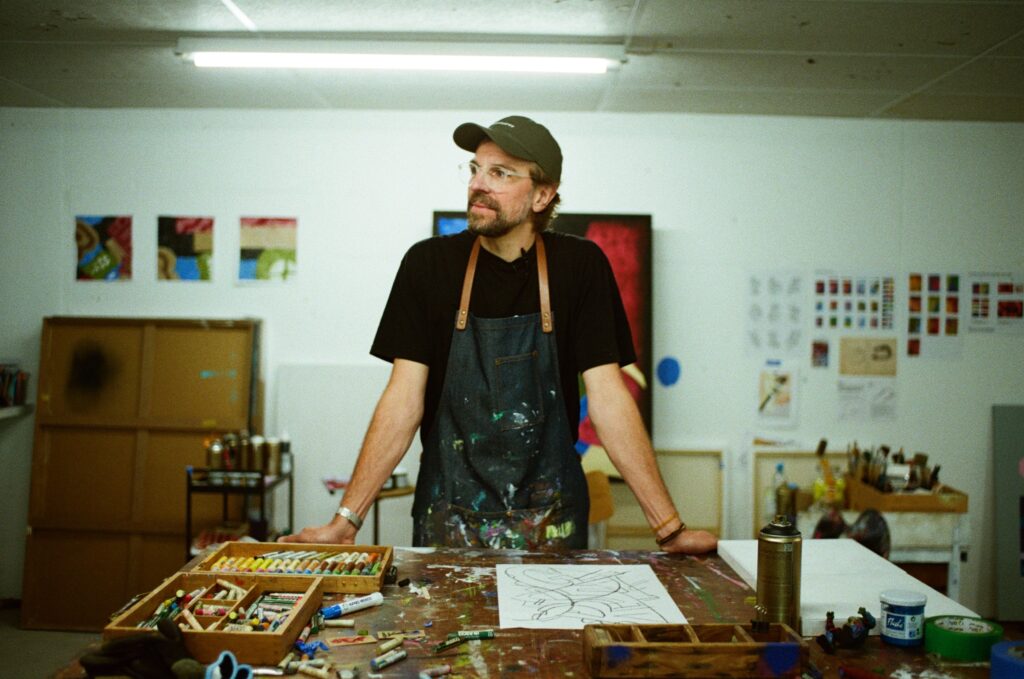
That sense of movement has remained central to the way Stéphane works. He describes his studio as a laboratory, a place where he can explore different materials and techniques without knowing exactly where they will lead. He may spend months working in one particular direction before suddenly becoming interested in something else, then return to an earlier idea six months or a year later with a new perspective. Looking back across almost twenty years of serious artistic activity, he can now see a clear evolution from one body of work to the next, but when he is inside the process he does not necessarily know what the next stage will be. That uncertainty is part of what excites him, because he prefers to have a direction rather than a predetermined outcome.
The idea of never knowing exactly where the work will lead is also connected to the way he thinks about an artistic life itself. Stéphane does not see art as something that needs to be completed within a particular period or career stage, but as a long term activity that can continue alongside everything else. Even when he became a father and had much less time to work, he continued sketching, developing ideas and making plans for projects that he knew he would return to when he had more time. He now has three children, and the relationship between family life and his practice has become part of the rhythm of his work, forcing him to think carefully about how he uses the time he has rather than simply assuming that the studio will always be available.
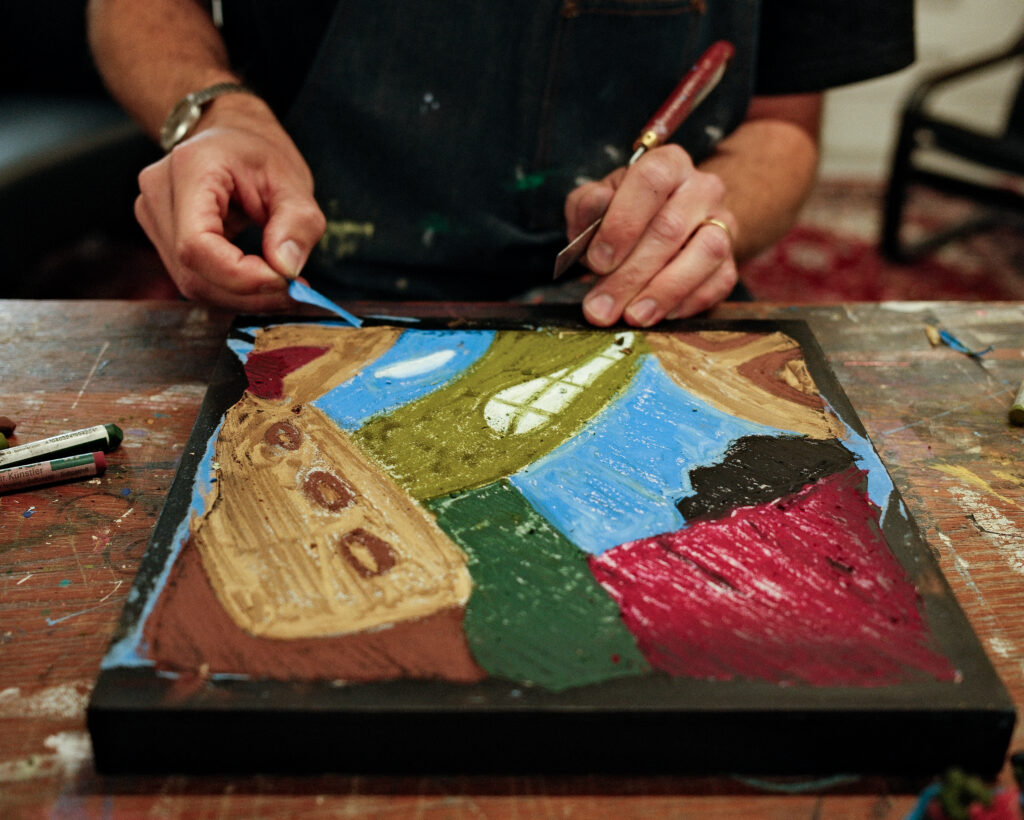
That discipline has made the time he spends there more precious. Stéphane still works as a designer, so he cannot spend every day in the studio, but he does not necessarily see that as a limitation. Sometimes the fact that he is away from the work gives him time to think about where he wants to go next, and when he finally has a day in the studio he can work with a sense of urgency and focus. “Some people go to sport, I go to my studio,” he says, describing the studio almost as a form of personal exercise, a place where he can return to himself through making.
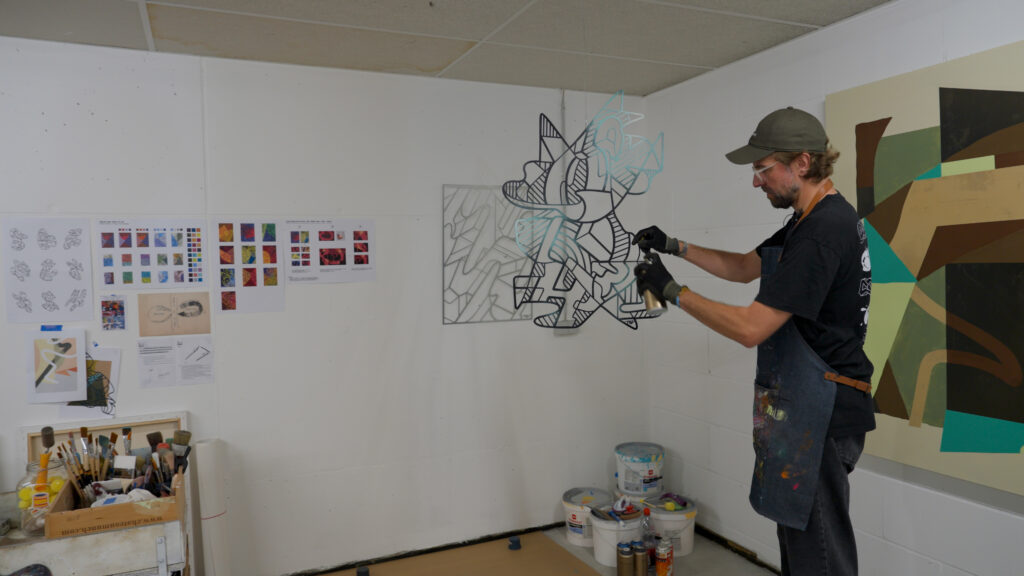
The relationship between his design background and his artistic practice is particularly visible in his fascination with letters. His interest began with graffiti when he was a teenager, when letters were not simply a means of communicating words but shapes that could be manipulated, stretched, distorted and rebuilt. He eventually developed his own approach to typography through a combination of drawing and digital tools, filling sketchbooks with variations of letterforms before translating the ones he liked into vector shapes and eventually cutting them from materials such as metal or wood. The process can begin with a single letter and gradually move so far away from its original form that it becomes almost abstract, leaving behind the geometry and rhythm of the character rather than its literal meaning.
His relationship with letters is therefore less about typography in the traditional sense and more about extracting visual possibilities from language. He is fascinated by what happens when a familiar letter becomes unfamiliar, when its structure is enlarged, distorted or repeated until the viewer begins to see it as an image rather than a symbol. The letter R, for example, appeals to him because it contains several different kinds of movement at once, a straight line, a curve and a diagonal, while the A interests him for its geometric construction. These details become starting points for compositions that can eventually move far beyond the original alphabet.
This process developed into the project he calls Typographic Chaos, in which the order of typography is deliberately pushed toward something more unpredictable. The work still contains the structure of graphic design, but it also contains the physical irregularities of drawing, cutting, painting and experimentation. Stéphane is interested in the space between the two, where something can be carefully constructed while still retaining evidence of the hand that made it.
That tension between order and chaos appears throughout his work. He describes his own life as an “organized mess”, and the phrase could just as easily describe his studio and his paintings. There are clean shapes and carefully balanced compositions alongside rougher surfaces, imperfect edges and unexpected marks, with each side becoming more interesting because of the other. He spent years trying to make everything as clean and precise as possible, partly because of his graphic design training and partly because of his early experience with graffiti, but eventually he began to feel that the perfection was taking something away from the work.
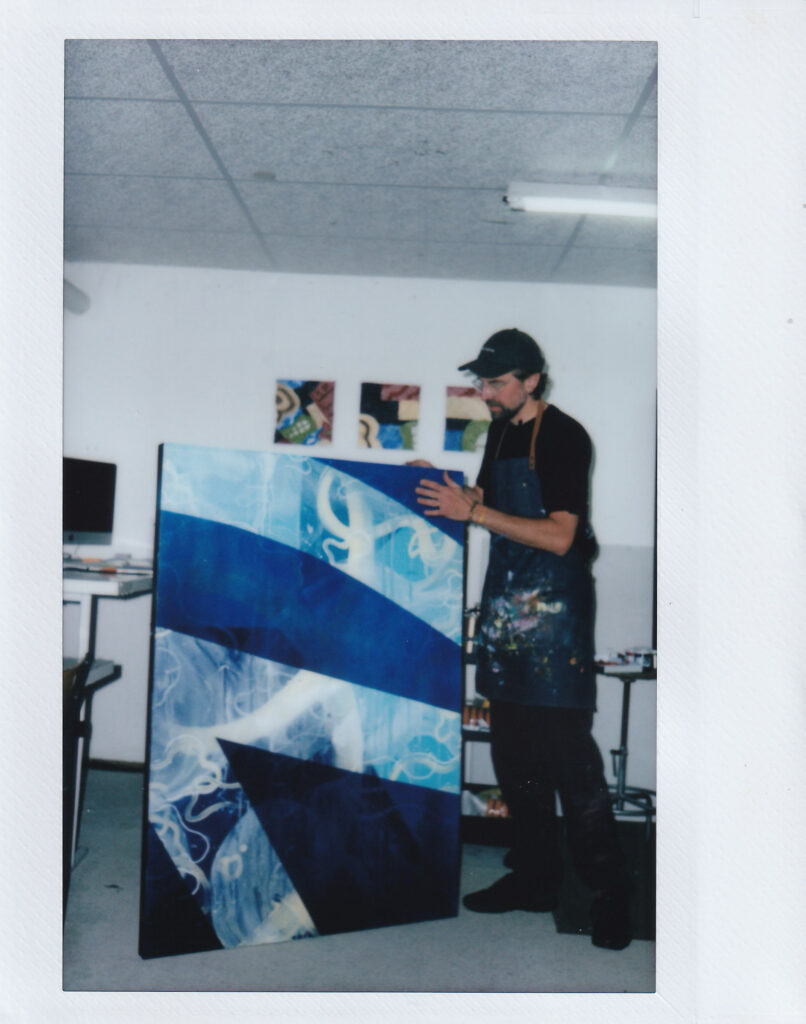
At a certain point, he realized that he was spending too much time calculating the placement of every element, preparing layers and making sure that nothing would drip or move unexpectedly. The work was becoming technically precise but less enjoyable to make, and that loss of pleasure became a signal that something needed to change. He wanted to reintroduce emotion and physicality, to stop worrying so much about the finished result and allow himself to make mistakes again. The shift has led him toward rougher textures, more organic spaces and a greater willingness to let accidents become part of the final image.
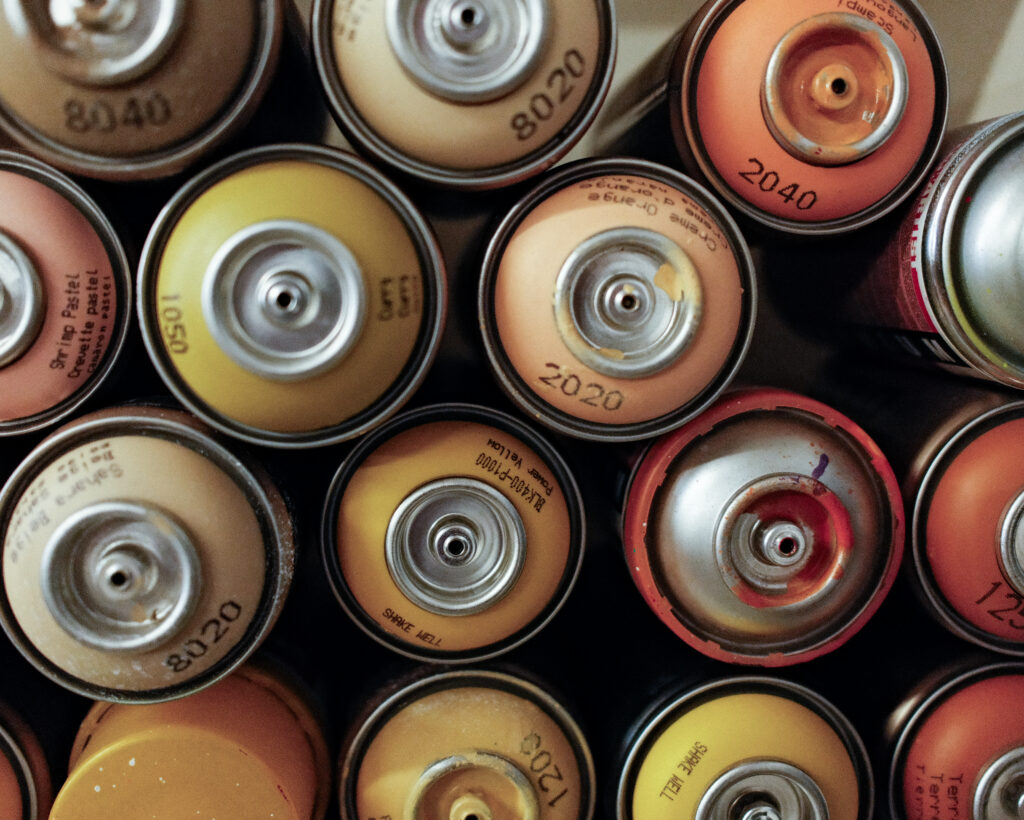
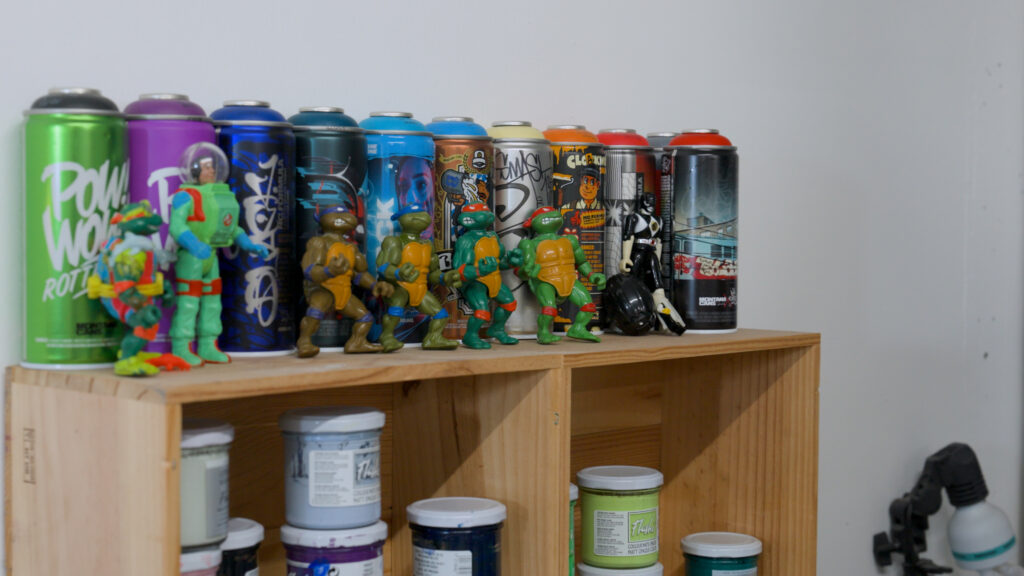
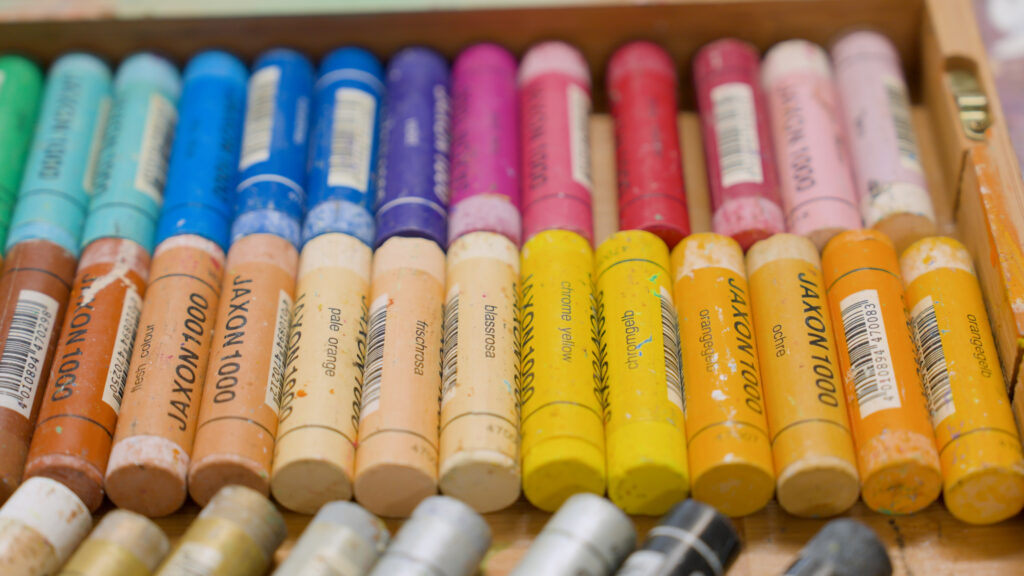
His use of materials reflects that change. He works with spray paint, acrylic, pastel and other materials, often mixing them without worrying too much about whether they are supposed to be used together. Spray paint connects directly to his graffiti background and remains an important part of his visual identity, while pastel has a more personal connection because his father used it when he painted. Stéphane talks about the smell and physical feeling of the material as something that brings back memories and motivates him to work, creating a connection between the materials in the studio and the experiences that shaped him.
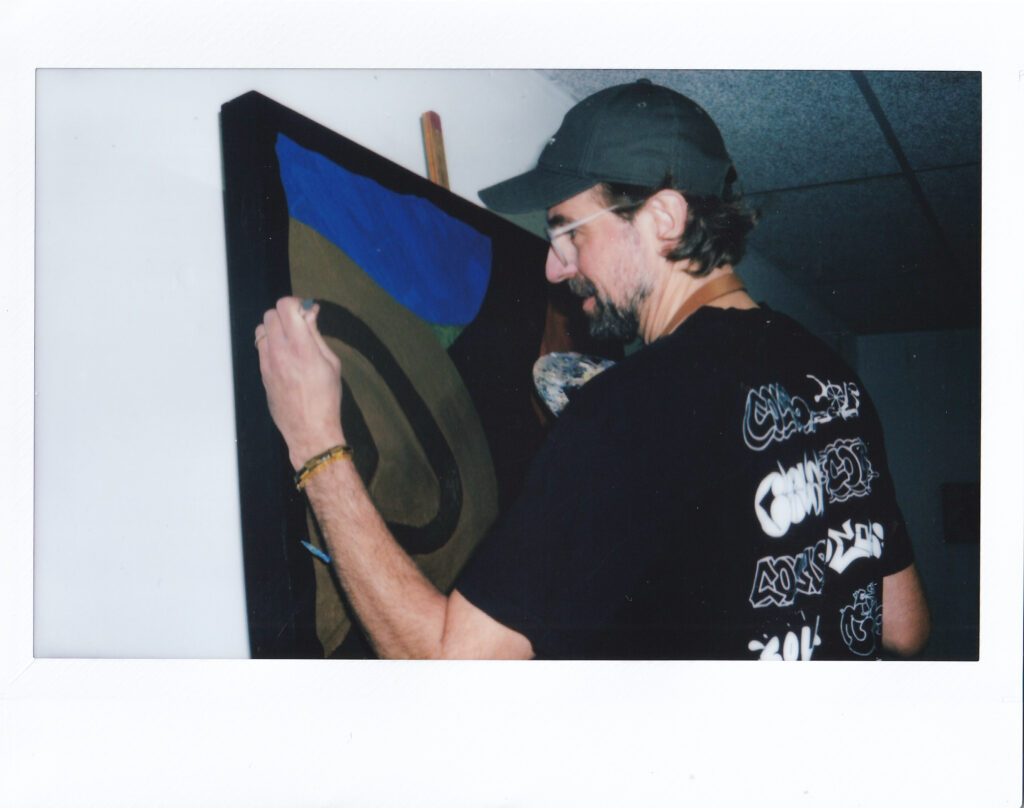
The studio itself contains traces of these different periods of his life. One table in particular has become important because it originally belonged to the collective he co-founded with other designers, Back to Type, a group formed around the desire to leave the computer behind and work with their hands. The collective focused on letters and typography, producing murals, sign paintings and experimental projects, and the old table they used became covered in paint over time. When Stéphane established his current studio, he wanted that table to remain at the center of the space because it carried the history of that period with it. It is not simply furniture but a physical reminder of where a particular part of his practice began.
His sketchbooks carry a similar history. He has kept a daily drawing practice for years, filling books with letters, ideas, quotes, observations and experiments. Some are highly developed while others are little more than quick notes or fragments, but together they create a chronology of his thinking. He describes them as a mixture of his brain rather than something carefully organized, and that quality is important because the sketchbooks allow ideas to exist before they need to become finished works.
Some of his most personal ideas have also emerged from everyday life. A series of paintings developed from old figurines that he discovered at his parents’ home, objects he had played with as a child and later found himself playing with again alongside his daughter. He became interested in the colors and shapes of the small toys, particularly the slightly strange combinations that belonged to the visual culture of the 1980s, and began taking details from them, enlarging and abstracting them until the original objects became almost unrecognizable.
The process mirrors the way he has always worked with letters and images, taking something small and familiar and changing its scale until it becomes something else. He might isolate a detail from an old poster, crop it, enlarge it and turn it into a painting, or take a small part of a figurine and rebuild it into a new composition. The original reference remains hidden somewhere inside the work, but what matters to Stéphane is the visual relationship between shapes, colors, textures and space.
His recent work has also become increasingly interested in moving away from obvious figurative references. When he sees too much of the original object in a painting, he starts pushing the image further toward abstraction, zooming into details until the source becomes difficult to recognize. He is looking for the point where something remains familiar enough to create a connection but abstract enough to become independent from its original context. That balance is never fixed, which is why he repeatedly tests different scales and compositions before deciding what works.
Experimentation is therefore not simply a stage before the finished artwork. It is the artwork’s underlying method. Stéphane will make twenty small versions of an idea rather than immediately committing to one large canvas, using the smaller works as a way to understand what the final piece might become. He may test different colors, surfaces, materials and formats before deciding which direction feels right, and sometimes a piece that seemed promising will be abandoned completely. He is comfortable with having a corner of the studio filled with work that he does not particularly like because those failures are still part of the process.
That attitude has become increasingly important to him as he tries to recover something he feels he lost through too much planning. Watching his children play has reinforced this feeling. When they draw with chalk or play with toys, they do not spend much time questioning whether what they are doing is correct, they simply begin. Stéphane sees something valuable in that freedom and has been trying to bring some of it back into his own practice, allowing himself to paint without asking too many questions beforehand and accepting that some of the results will not work.
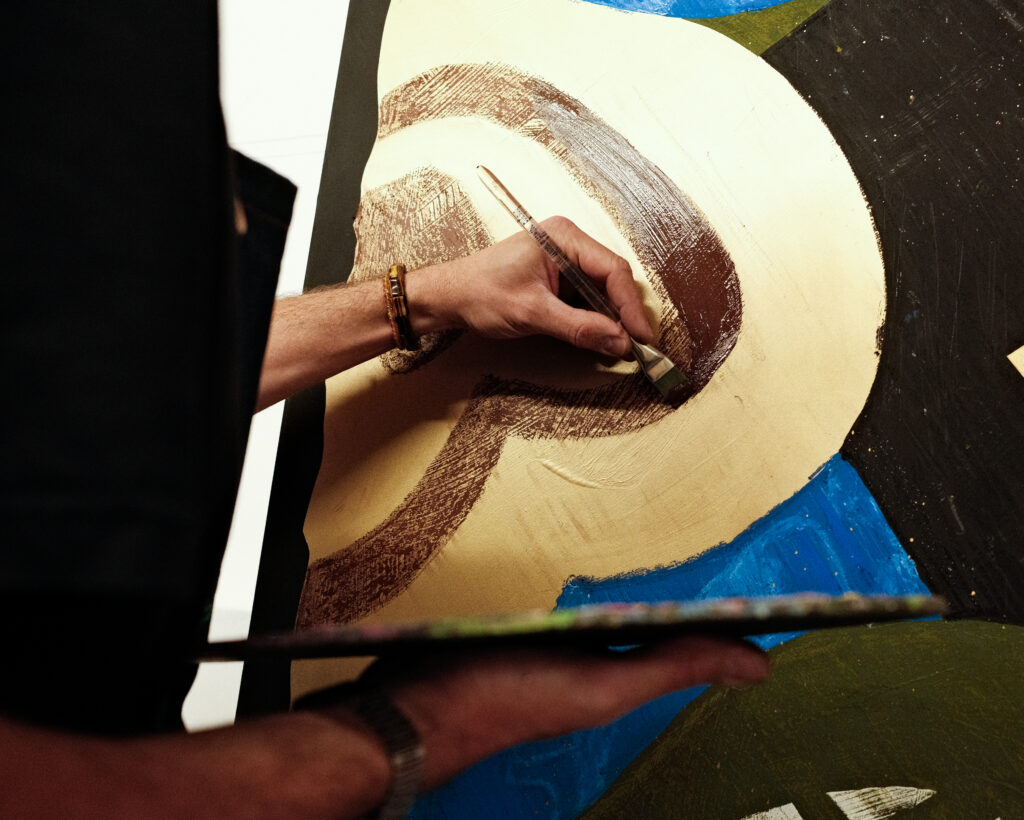
“If I like the outcome, it’s fine,” he says, and if he does not, he can put it aside and continue. The point is not that every experiment needs to become a finished artwork but that the willingness to experiment has to remain intact. For him, failure is not the opposite of progress because the failed works are often what make the next successful work possible.
This is also why he has become more comfortable leaving paintings unfinished. Sometimes he reaches a point where he does not know what the next move should be, so instead of forcing himself to continue, he leaves the work alone and returns to it weeks or even months later. A painting that began in November might still be sitting in the studio unfinished because he knows there is something missing but has not yet discovered what it is. He may eventually complete it, decide that it is already finished or paint over the whole thing and start again, and all three possibilities remain open.
There is a patience in that approach that contrasts with the precision of his earlier work. Rather than demanding an immediate solution, he allows the painting to wait until he understands what it needs. The studio becomes a place where ideas can remain unresolved without becoming failures, which is perhaps another reason he describes it as a laboratory.
Stéphane’s approach to art is also shaped by a strong sense of curiosity. He describes himself almost as an art geek, constantly reading about artists, looking at techniques, studying biographies and asking why another artist made something in one particular way rather than another. He enjoys talking with other artists about materials and processes and sees those conversations as another form of education. There is always something else to discover, and he does not see that learning process as something that ends once an artist develops a recognizable style.
If anything, he believes that developing a style should make it possible to move beyond it. He may find a direction that he loves and imagine working with it for years, only to return several months later with another idea that takes him somewhere else. Looking back, those changes now appear connected, but at the time they are simply experiments. The uncertainty is part of what keeps the practice alive.
That same attitude informs his advice to younger artists. He believes in thinking long term and not giving up simply because there is a period when work becomes difficult or life becomes busy. At the same time, he is careful not to turn persistence into pressure. If you are exhausted or emotionally somewhere else, he believes it can be better to take a break rather than force yourself to make work that does not feel right. The studio will still be there, and the work will wait.
He is equally skeptical of the pressure to constantly be visible, particularly through social media. Artists are increasingly encouraged to present themselves, build an audience and respond to what people want to see, but Stéphane believes that trying too hard to please an audience can eventually pull an artist away from themselves. The work needs to remain personal, even when it is public, and curiosity needs to be more important than visibility.
His own decision to continue working as a designer alongside his art is part of that philosophy. He sometimes wonders whether he should become a full time artist and leave graphic design behind, but he still loves design and appreciates the fact that his limited studio time forces him to step back and think carefully about where he wants to go. The two practices continue to feed each other, with graphic design providing structure and artistic experimentation providing freedom.
Ultimately, Stéphane’s work seems to exist in that space between the two. His background has taught him to appreciate precision, balance and structure, while years of experimentation have taught him to embrace accidents, texture and imperfection. His letters are carefully constructed but often pushed toward abstraction, his compositions can be highly organized while still allowing disorder to enter, and his materials move between industrial and handmade processes.
There is no single medium that defines him because the process matters more than the category. He is interested in asking how something can be made, whether an idea can be translated into a physical object and what happens when technology, craft and intuition are brought together. He might use a computer to develop a shape, a laser cutter to produce it, spray paint to transform it and then return to the surface with pastel or acrylic, allowing each stage to change what came before.
“I love to try new things, new techniques,” he says. For Stéphane, the challenge is always how to make an idea exist, which means researching materials, testing possibilities and accepting that not every attempt will succeed. What interests him most is often not even the finished object but the process of figuring out how to get there.
Once the work is finished, however, he is ready to move on. Seeing a completed piece in a clean room can give him the feeling that the idea has finally been resolved, allowing him to clear his mind and begin thinking about something else. The finished work becomes a record of the research that led to it, while the studio remains the place where the next question is already waiting.
That may be the clearest way to understand Stéphane Koyama-Meyer’s practice. It is not built around arriving at a final style or a definitive answer, but around continuing to ask questions, breaking things apart, rebuilding them, changing materials, changing scale and finding new ways to make something that did not previously exist. His work carries the precision of the designer, the energy of the graffiti artist and the curiosity of someone who never stopped being fascinated by the act of making.
For Stéphane, the goal is not to make everything perfect. It is to stay curious enough to keep experimenting, to accept the moments when something goes wrong and to understand that those mistakes may be what lead the work somewhere new. His studio may be an organized mess, but within that mess there is a clear logic, keep looking, keep testing, keep building and never stop asking what might happen next.
About the Author
Sam Burke is an American artist, filmmaker and writer based in New York City. Working across film, performance, and writing exploring storytelling, identity, and place. As founder of Timestamp, Burke interviews artists, shares insights, and highlights conversations shaping art world today.
Gonçalo Preto
For Portuguese painter Gonçalo Preto, a painting is never simply a representation of something seen….
The Armory Show 2026: Highlights from New York’s Contemporary Art Fair
From experimental painting to immersive installations, a look at the artists, booths, and ideas that…
Mia Goldstien
Born in Los Angeles and now working in New York City, Mia Goldstein has built…
Michael Alexander Campbell
Michael Campbell once tried to give up making art. The idea, as he explains it,…
Andrew LaFarge Hamill
Andrew LaFarge Hamill describes himself as an artist and garden designer, but he is interested…
Felix Benton
Felix Benton grew up surrounded by people who made things. His grandmother was a glass…