Born in China and now based in New York City, Shuyao Huang approaches painting less as a pursuit of outcomes and more as a daily necessity. What began as an ambition to study fashion design shifted after arriving in New York, where teachers encouraged her toward fine art. At Pratt Institute, Huang developed both a technical understanding of painting and a conceptual framework rooted in meditation, perception, and color theory.
Her paintings are built through repetition. Lines, stripes, layered glazes, and carefully calibrated color relationships become a way of studying movement, optical illusion, and emotional response. Drawing from Buddhist philosophy, Huang often works through meditative processes where the act of painting itself becomes inseparable from the finished work. In many pieces, repeated brushstrokes reflect cycles of breath, concentration, and interruption, allowing small imperfections and shifts in rhythm to remain visible on the canvas.
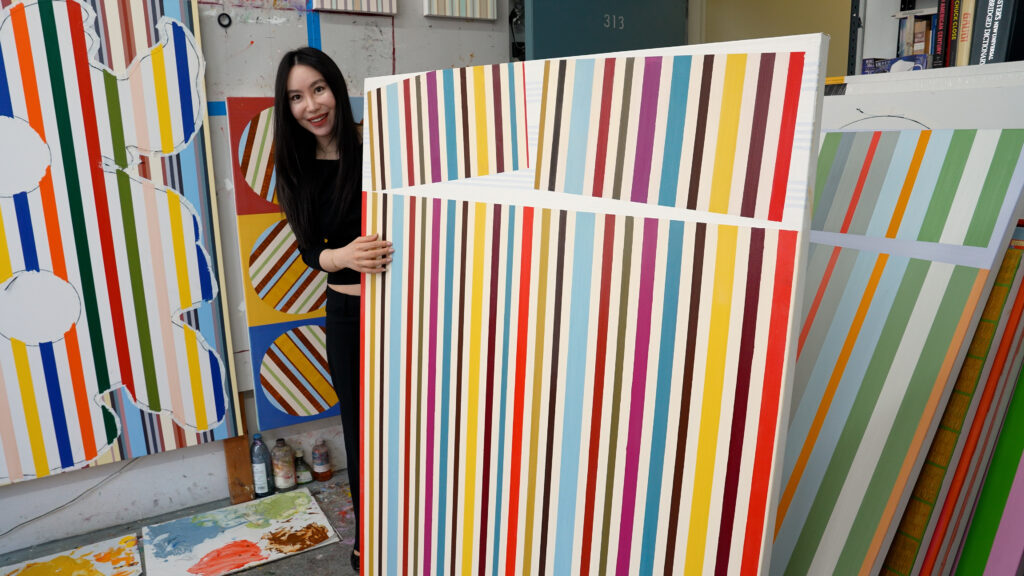
Huang’s work explores how color behaves both physically and psychologically. Warm and cool tones advance and recede, creating depth on flat surfaces through subtle shifts in wavelength and interaction. Influenced equally by fabric, design, memory, and perception, her paintings balance precise geometric structures with increasingly organic forms. Through glazing techniques and layered surfaces, she creates compositions that appear almost textile-like while remaining entirely handmade.
Rather than treating painting as a fixed style, Huang sees it as an ongoing process of learning. Each work becomes a way of understanding how color functions, how the eye processes space, and how memory shapes perception. For Huang, painting is less about arriving somewhere definitive than remaining engaged in the act itself.In her Brooklyn studio, surrounded by works built from stripes, color interactions, and layered optical effects, Shuyao Huang’s painting feels closer to breathing than career-building. “I just want to paint,” she says. “Maybe it will bring me somewhere. But if not, it’s okay as well.”
Born in China and now based in New York City, Huang originally moved to the United States to study fashion design. Growing up in a small city without museums or galleries, she didn’t encounter contemporary art in a serious way until arriving in New York. At first, drawing was tied to fashion illustration and figure studies, but conversations with professors slowly redirected her toward painting and fine art.
At Pratt Institute, Huang found herself pulled between technical discipline and conceptual thinking. Foundation courses centered on drawing from life and still life’s, while later classes introduced ideas around perception, meditation, and abstraction. A course on Buddhism and meditation became especially formative, shifting her work away from figuration and toward systems of repetition, color, and movement.
Her paintings now revolve around a small set of recurring elements: color, line, form, light, and motion. Using carefully calibrated palettes and repeated brushstrokes, Huang creates optical environments that seem to pulse and shift as viewers move through them. Warm colors advance while cooler tones recede. Patterns appear to vibrate. Shapes flatten and deepen simultaneously.
Much of the work begins with meditative repetition. In some paintings, Huang uses only one brush loaded with five premixed colors representing the cycle of seasons in Buddhist philosophy: spring, summer, autumn, winter, and spring again. She paints stripes freehand without rulers or tape, letting small drips, curves, and imperfections record interruptions in concentration. If her focus breaks completely, she stops and begins again. The empty spaces between lines become evidence of that process.
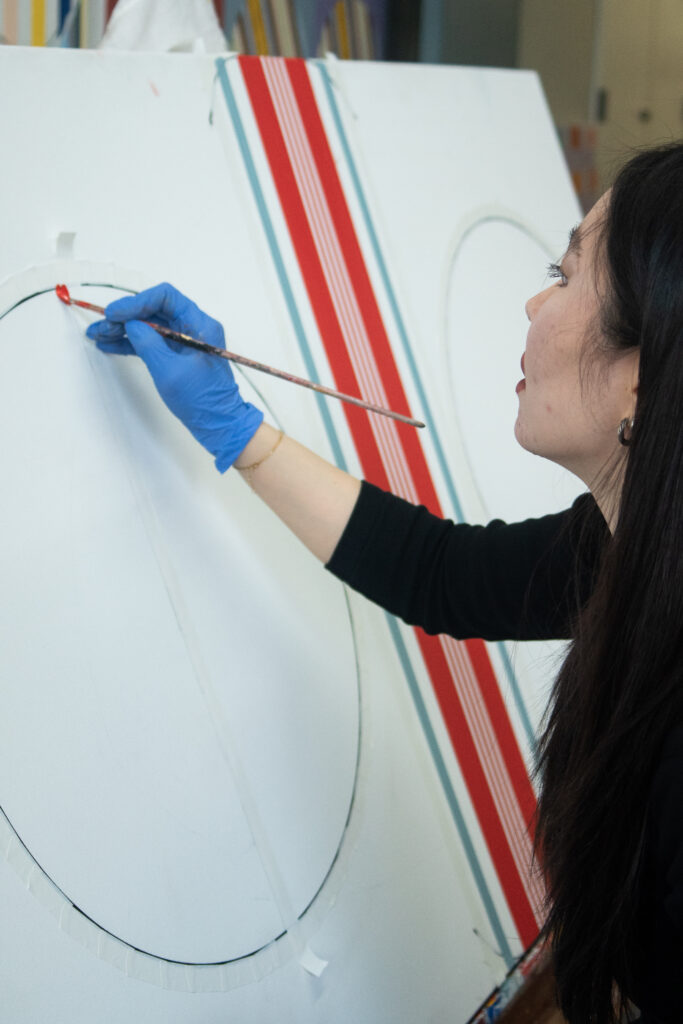
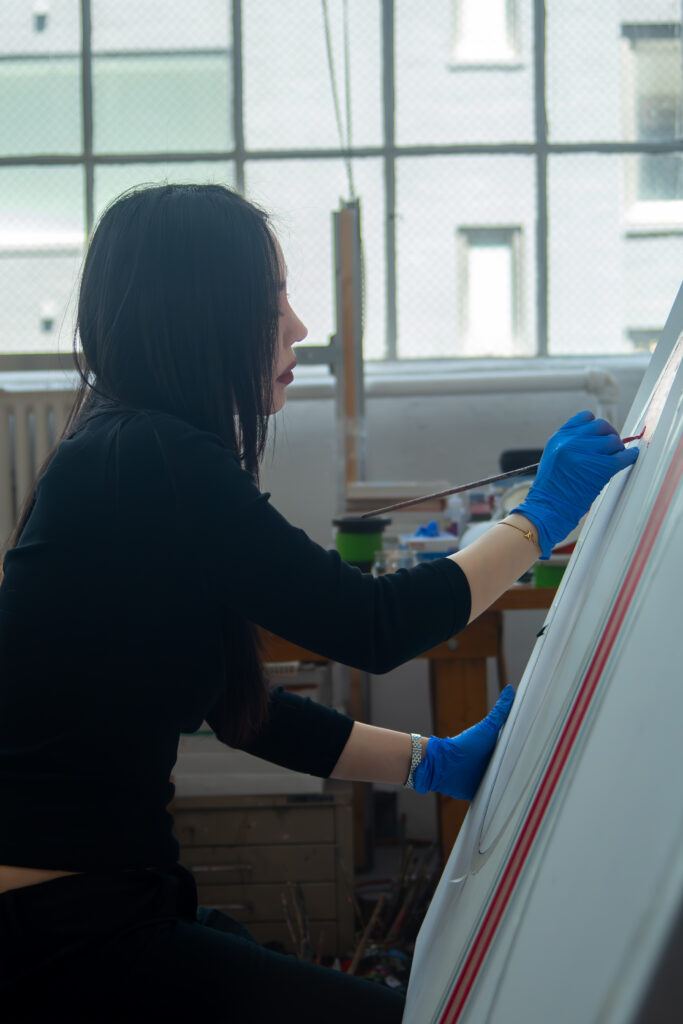
Rather than hiding labor, Huang makes it visible. Repetition is central to her practice, both formally and philosophically. Thin brushstrokes accumulate into surfaces that resemble woven fabric or printed textiles despite being entirely handmade. Acrylic glazes create matte, soft textures, while oil paint introduces reflective surfaces that shift depending on light and distance.
Her fascination with color theory borders on scientific observation. Huang speaks frequently about wavelength, depth, and the way the eye processes visual information. Adjacent colors alter one another’s temperature and spatial presence. Orange appears warmer beside blue. Cool tones retreat while warm tones move forward. Entire compositions are built around these relationships, balancing optical harmony with subtle instability.
At the same time, Huang resists becoming overly rigid. Alongside precise geometric structures, newer works introduce organic forms, plaster textures, and layered surfaces that push beyond strict systems. Some paintings are planned carefully through sketches and color studies made at home, while others evolve through intuition inside the studio.
Although her paintings often appear highly controlled, Huang describes them as emotional anchors during periods of uncertainty. “As long as I come to the studio every day, I don’t feel totally lost,” she explains. Painting becomes both a structure and a release, a way of learning through repetition while remaining present inside the act itself.
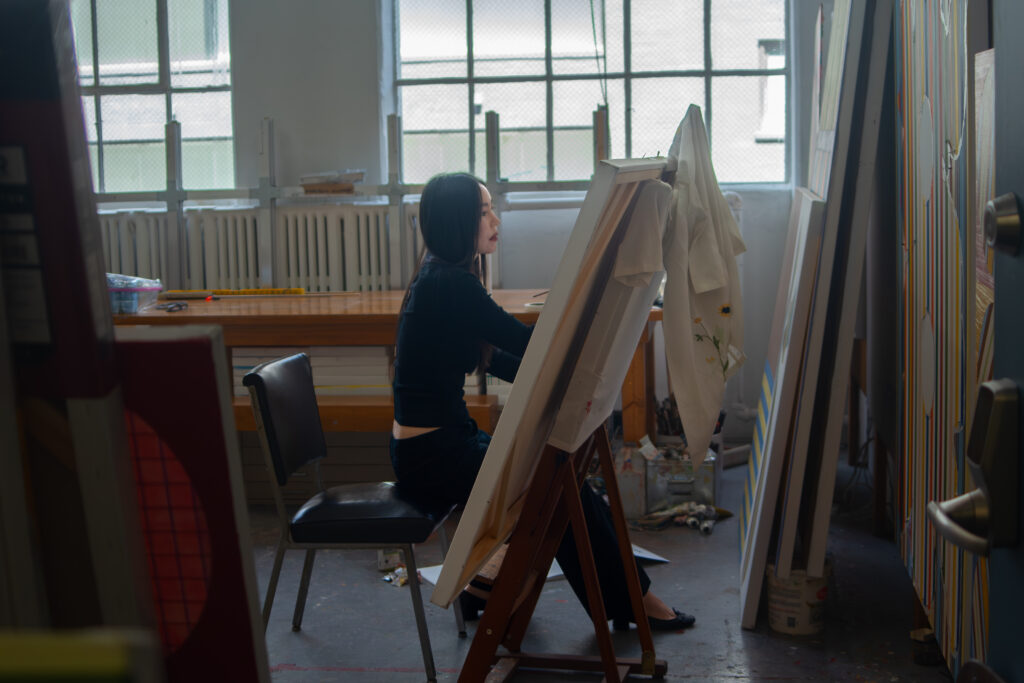
That tension between precision and openness runs throughout the work. Huang is deeply interested in how viewers project their own memories and experiences onto abstract forms. Referencing ideas of “top-down” and “bottom-up” visual processing, she describes painting as a space where objective perception and personal memory merge together. A surface might read as fabric to one person, architecture to another, or pure color to someone else entirely.
Even with increasing complexity in materials and process, Huang maintains a remarkably simple outlook toward her practice. There is no singular goal, no fixed endpoint she is chasing. The work grows slowly through routine, repetition, and attention. Each painting becomes another attempt to understand how color functions, how perception shifts, and how emotion can emerge through abstraction alone.
About the Author
Sam Burke is an American artist and writer based in New York City. Working across film, performance, and writing exploring storytelling, identity, and place. As co-founder of Timestamp, Burke interviews artists, shares insights, and highlights conversations shaping art world today.
Stéphane Koyama-Meyer
French visual artist and designer based near Basel, Stéphane Koyama-Meyer grew up surrounded by art,…
Yuval Bezalel
For Yuval Bezalel, painting begins with the hands, before there is a narrative, before there…
Adèle Aproh
For Adèle Aproh, drawing began long before she knew it could become a career. Her…
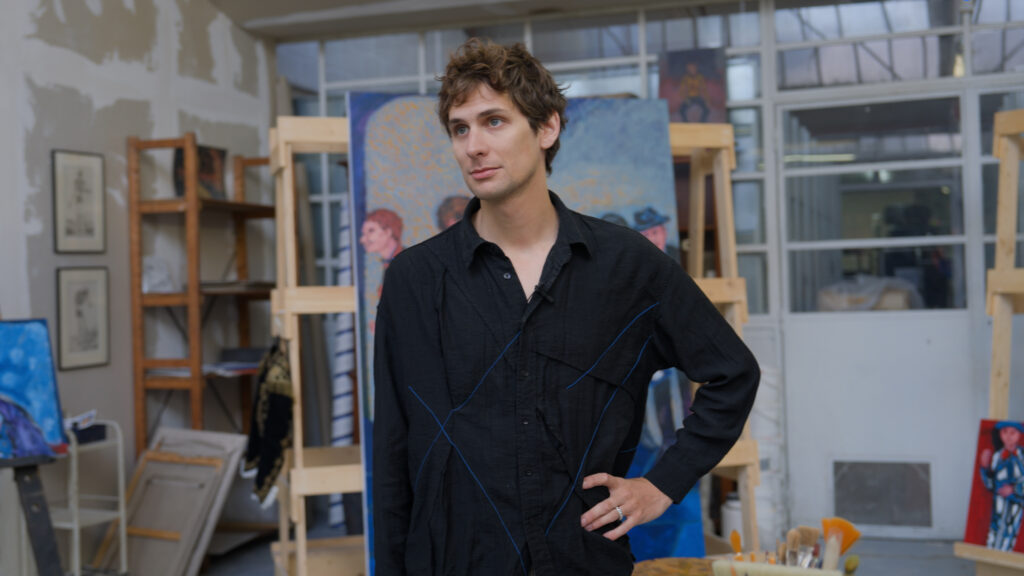
Félix Deschamps Mak
Félix Deschamps Mak is a French painter based in Paris, working in large scale figurative…
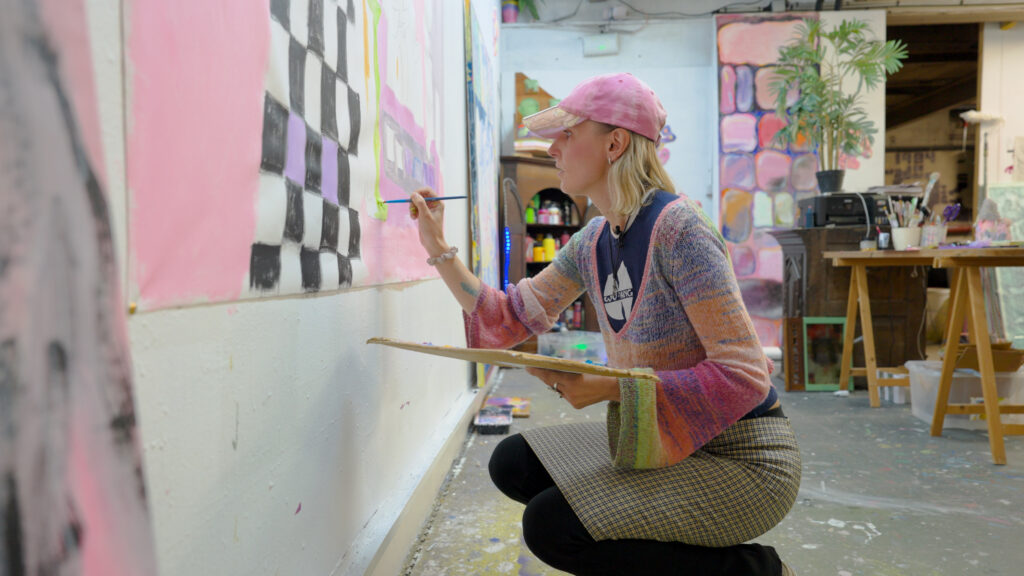
Katya Quel
Katya Quel is an artist and multidisciplinary creator, born and raised in Moscow, who now…
Why Dia Beacon Deserves a Full Day of Your Attention
There are museums you visit to check a box. And there are museums that quietly…