
There’s a belief in Madjeen Isaac’s work that the world, as it exists, is not fixed. That it can be reimagined, reassembled, and cared for differently. Her paintings don’t just depict environments; they propose them.
Born, raised, and based in Brooklyn, Isaac builds immersive, layered scenes that draw from her Haitian American identity, her upbringing in Flatbush, and her deep attention to the everyday. Her work sits at the intersection of observation and invention – where documentation meets speculation, and memory becomes material.
Isaac’s process begins long before the canvas. It starts outside on commutes, in passing moments, in the small details that might otherwise go unnoticed. A decorated porch, a cluster of plants pushing through a fence, the way light hits a building at a certain hour. These fragments accumulate into a personal archive, often captured through photography.
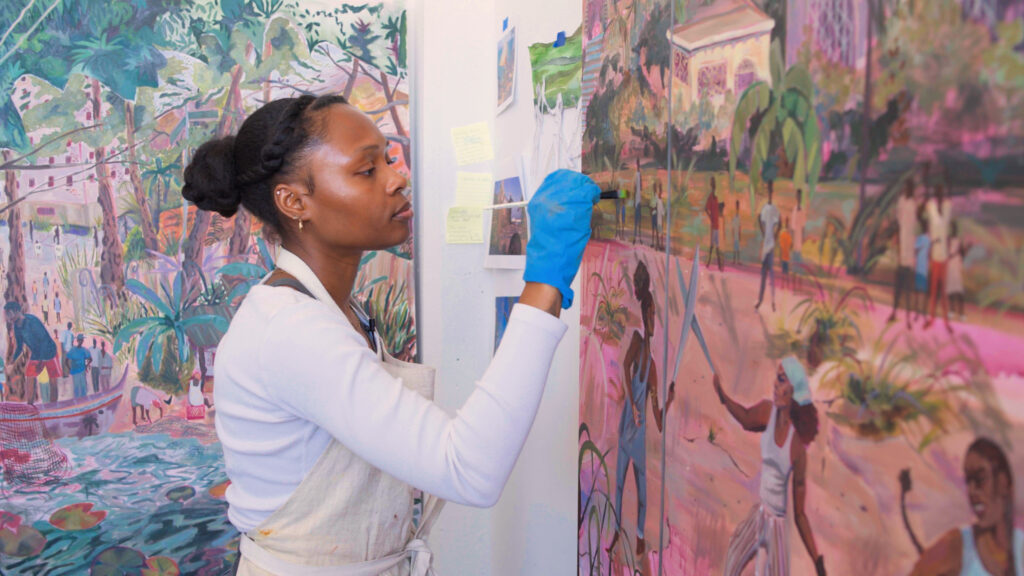
This act of looking is also an act of holding on. Brooklyn, particularly neighborhoods like Flatbush, has undergone rapid transformation. For Isaac, painting becomes a way to preserve what feels at risk of disappearing: the charm, the density, the specificity of place.
But her work is not nostalgic in a conventional sense. Rather than reconstructing the past as it was, she filters it through imagination, allowing memory to stretch, merge, and evolve.
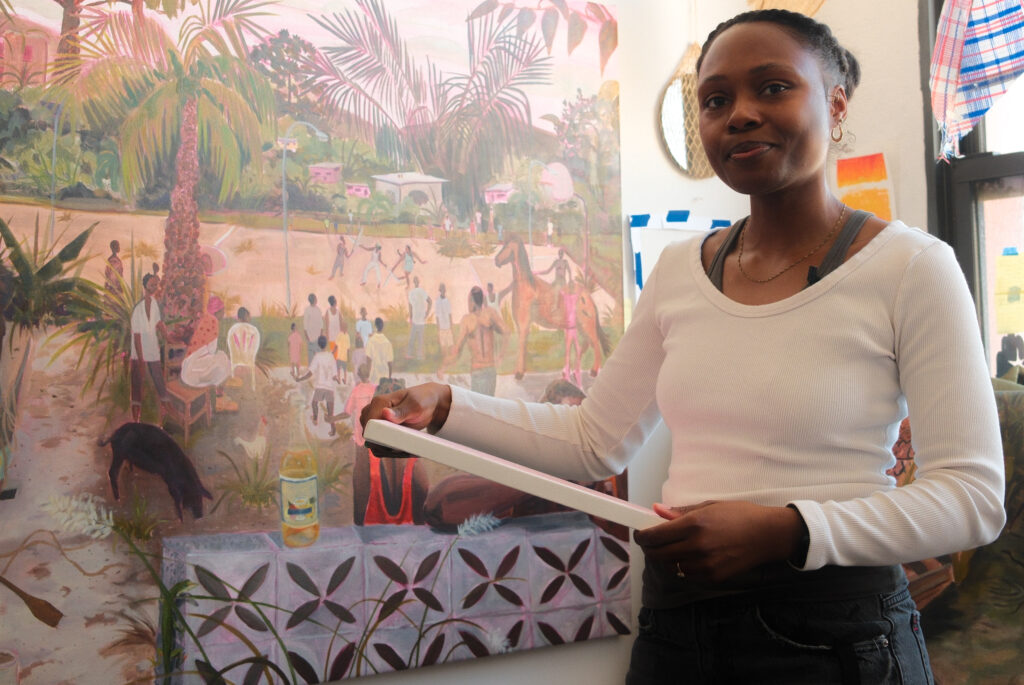
In Isaac’s paintings, geography is fluid. Flatbush and Port-au-Prince collapse into one another, connected through rhythm rather than distance. Street markets, roaming animals, dense greenery, and communal gathering spaces coexist within the same visual field.
This merging reflects a lived reality. For many within the Caribbean diaspora, home is not singular, it exists across locations, histories, and sensory experiences. Isaac captures this multiplicity by building environments that feel both specific and universal.
There is a cadence to her compositions it’s busy, layered, and full of movement. Figures gather, interact, and occupy space collectively. Nothing feels isolated. The world she paints is one where life unfolds in relation to others.
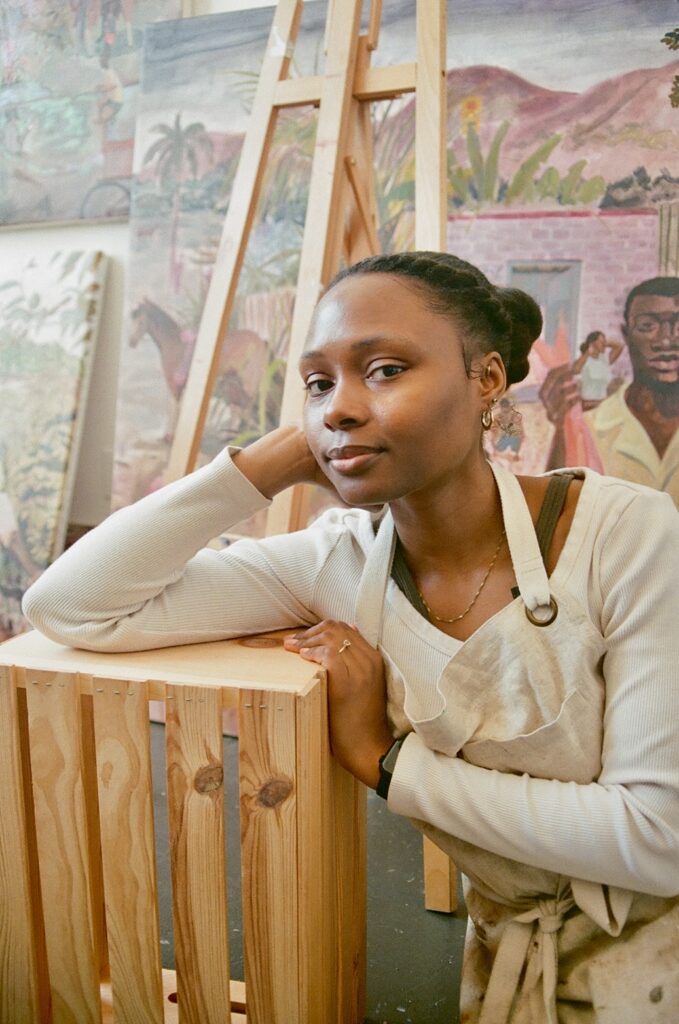
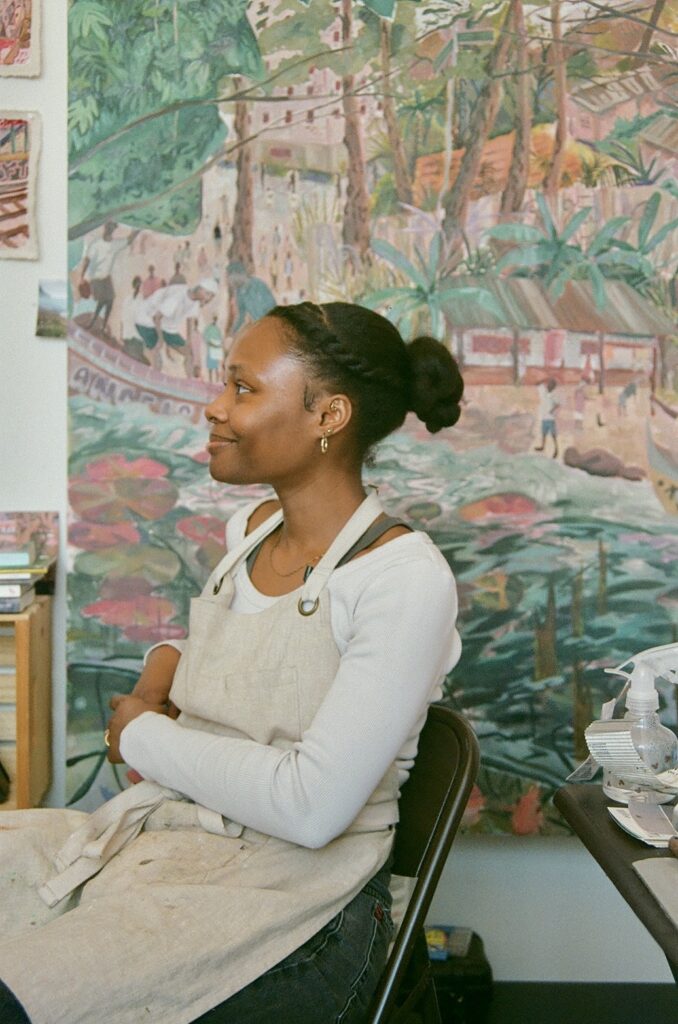
A recurring conceptual anchor in Isaac’s work is the Haitian idea of the lakou; a shared, communal living structure rooted in mutual care and collective responsibility. Emerging in the aftermath of the Haitian Revolution, the lakou represents autonomy, resilience, and the reclamation of space.
Isaac translates this framework into a contemporary context. In her paintings, community gardens, basketball courts, storefronts, and informal gathering spaces become modern iterations of the lakou. These are sites where people convene, sustain one another, and create culture in real time.
Her work asks: what would it mean to build environments around care rather than extraction? What would it look like to live in deeper relationship with both land and community?
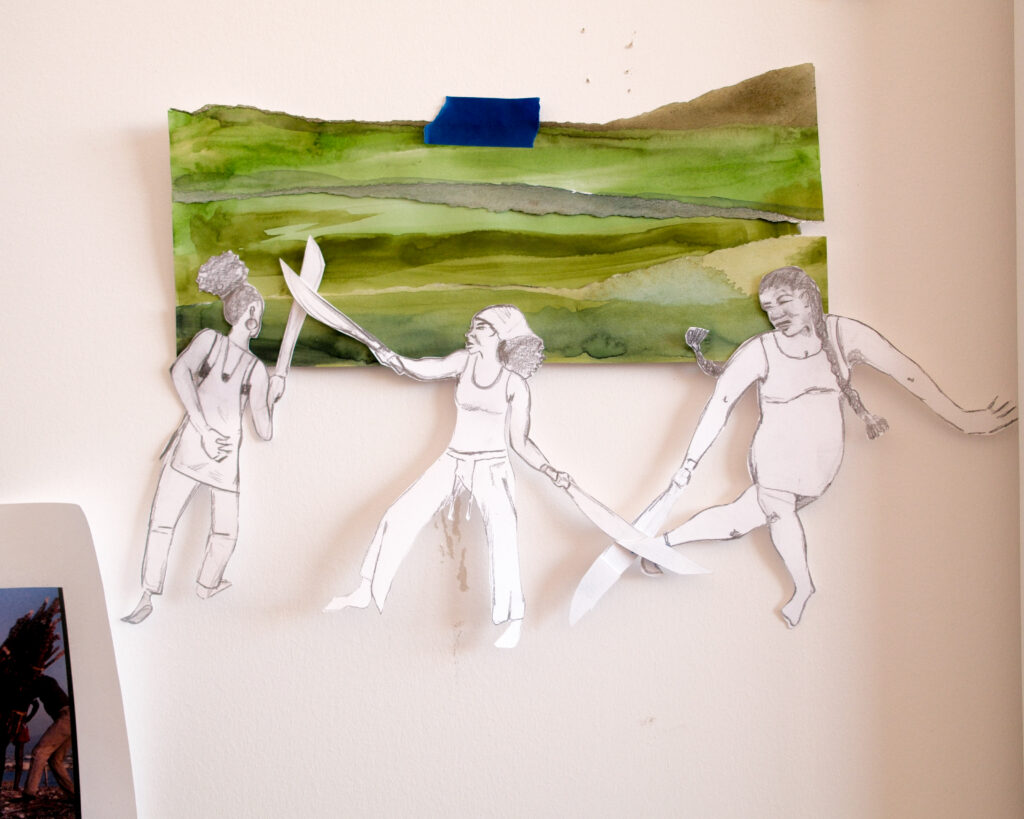
Compositionally, Isaac’s paintings are dense but deliberate. They begin as collages, assembled from photographs, sketches, and fragments of imagery. This stage allows her to construct a visual logic, mapping out how different elements might coexist.
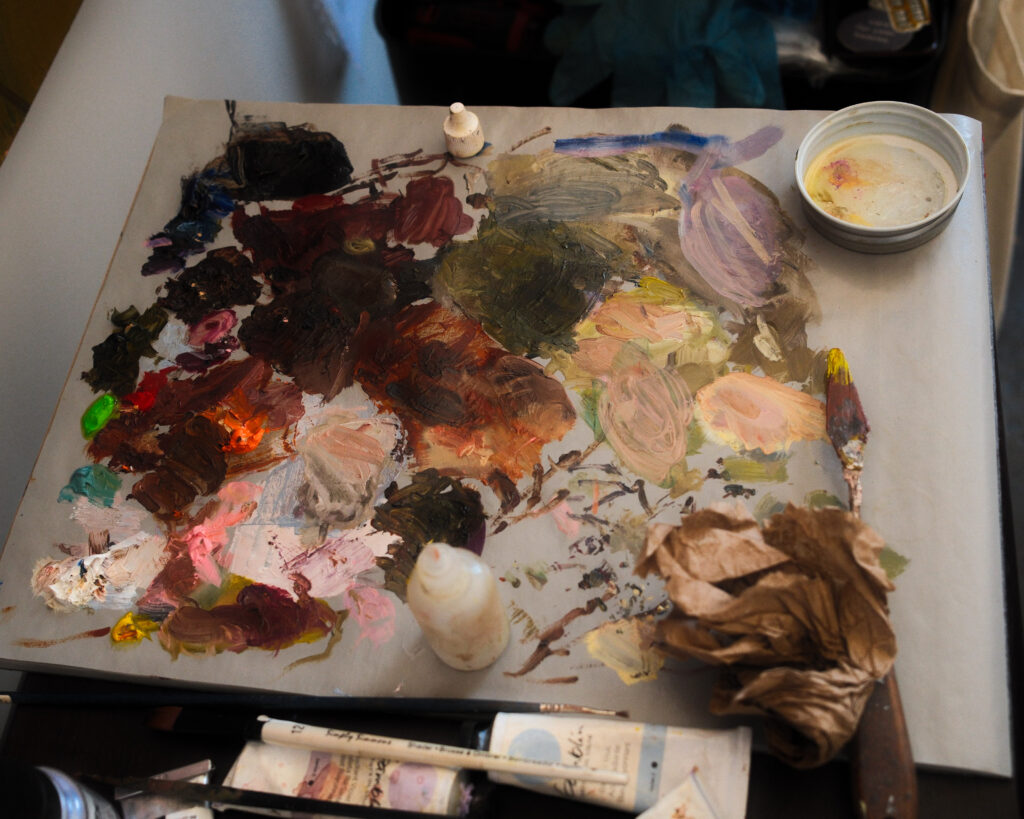
Once she begins painting, that structure loosens. Working primarily in oil, she builds her surfaces through layers, starting often with a warm, rosy underpainting that subtly glows through the final image. Her approach to mark-making is intuitive: smears, dots, drips, and gestures accumulate into environments that feel alive.
There’s an embrace of imperfection here. Isaac resists over-control, allowing the material to guide her. Colors shift once they hit the canvas. Forms emerge through repetition rather than precision. The result is a surface that feels both constructed and organic.
Isaac’s paintings extend beyond the visual. They carry an implied soundscape: the hum of conversation, music spilling from storefronts, the layered noise of a city in motion. Language, too, plays a role: Haitian Creole, patois, and other dialects shape the environments she references.
Smell, memory, and atmosphere are embedded as well. Food, plants, humidity, density, these are not explicitly depicted but are deeply felt. Her work operates on recognition. Viewers often feel they have “been there,” even if the place itself does not exist.
In more recent works, water appears with increasing frequency. It cuts through environments, floods spaces, or quietly exists at the edges of a scene. It is both literal and symbolic.
Water speaks to migration, the crossings that define diasporic histories, the distance between homelands and new settlements. It also signals environmental instability, a reminder that landscapes are shifting in real time.
Yet even within these conditions, Isaac’s worlds remain active. People gather, play, and exist in community. There is no absence of joy, only a recognition that it coexists with uncertainty.
Isaac approaches her practice with a grounded sense of purpose. In an industry often shaped by external validation, she emphasizes self-definition, prioritizing what feels necessary over what is expected.
Success, for her, is not tied to scale or visibility but to continuity: a studio filled with work, a practice that remains generative, and the ability to move fluidly between ideas and materials. While painting is central, she remains open to textiles, ceramics, and other forms.
This openness mirrors the ethos of her work. Nothing is fixed, and everything is in process.
There is a forward-looking quality to Isaac’s work. While rooted in memory, it is equally concerned with what comes next. Her paintings function as both archive and proposal, holding onto what has been while imagining what could be.
She considers how future generations might encounter these images: as records of a changing landscape, as reflections of diasporic life, or as prompts for building differently.
At its core, her practice is about a care for memory, for community, and for possibility. In constructing these worlds, Isaac offers not just images, but ways of thinking about how we might live together, more intentionally, within them.
About the Author
Sam Burke is an American artist and writer based in New York City. Working across film, performance, and writing exploring storytelling, identity, and place. As co-founder of Timestamp, Burke interviews artists, shares insights, and highlights conversations shaping art world today.
Gonçalo Preto
For Portuguese painter Gonçalo Preto, a painting is never simply a representation of something seen….
The Armory Show 2026: Highlights from New York’s Contemporary Art Fair
From experimental painting to immersive installations, a look at the artists, booths, and ideas that…
Mia Goldstien
Born in Los Angeles and now working in New York City, Mia Goldstein has built…
Michael Alexander Campbell
Michael Campbell once tried to give up making art. The idea, as he explains it,…
Andrew LaFarge Hamill
Andrew LaFarge Hamill describes himself as an artist and garden designer, but he is interested…
Felix Benton
Felix Benton grew up surrounded by people who made things. His grandmother was a glass…