
Brenda Zlamany has been painting for most of her life, and she speaks about it as a continuous, accumulating act rather than a series of isolated achievements. One painting leads to the next. Each body of work grows out of the previous one. What drives her is not competition with art history anymore, but a quieter and more exacting pressure. She is competing only with herself, measuring each new painting against what she has already done and asking whether she can push it further, refine it more, and make it speak more truthfully to her present moment.
She describes painting as a lifelong process of learning. In the beginning, she says, you might feel like you are competing with the old masters. Over time, that shifts. Now the question is whether the work deepens what came before it. She is always trying to make an image that tells the truth of what her truth is at that moment, in much the same way that she did as a child, when drawing felt like a way of defining who she was.
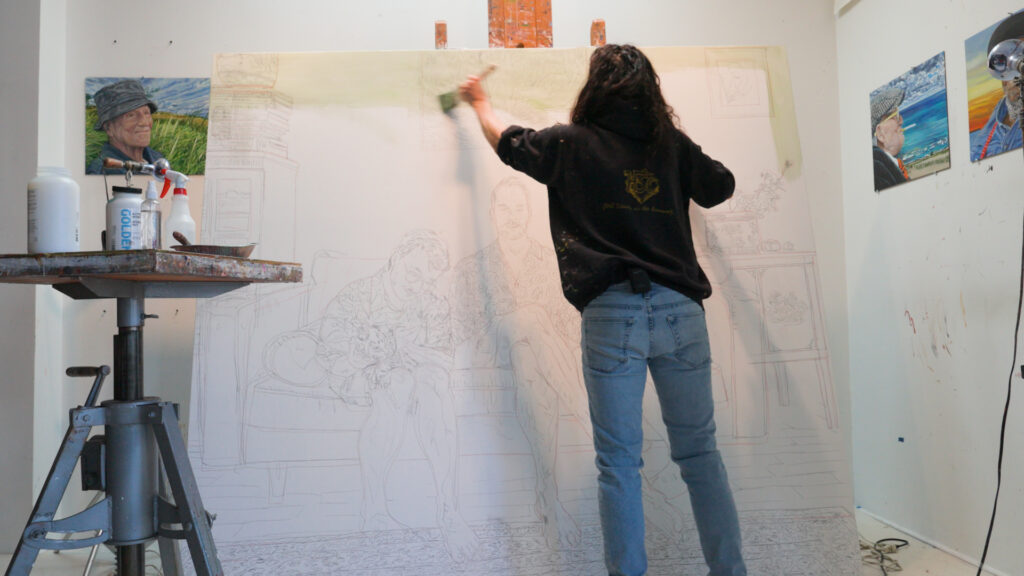
Zlamany lives in Williamsburg, Brooklyn, and part time in Calabria, Italy. She was born in New York City and has identified as a painter for as long as she can remember. Her earliest recollection of wanting to be an artist goes back to Catholic school, when she was five or six years old. Asked to name a future career, she first said she wanted to be a nun, only to be told she could not because she was left handed. Her second choice was to go to the moon, which was dismissed as something for boys. Painting became her third choice, a choice she ultimately believes was the right one.
As a child, drawing was not simply a pastime. It was a means of survival. Because she was left handed, she was not allowed to use her left hand and learned to write with her right hand in reverse, becoming a mirror writer. This made reading and writing difficult, and she did not fully learn until she was about eight years old. She remembers being punished and marginalized by the nuns at school, and drawing became the one way she could earn approval. She was pulled out of class to decorate the church for holidays and events. Very early on, she took drawing seriously because it gave her a place of value.
At night, she developed a private belief that if she died in her sleep, she would become the drawing she had made before going to bed. Every evening became a race to draw the perfect family or the perfect image. Art became something she made as if her life depended on it. That urgency never left her. She did not imagine a future for herself because she did not expect to live very long. She remembers turning thirteen and feeling shocked that she had survived that far. She did not think she would live past twenty one.
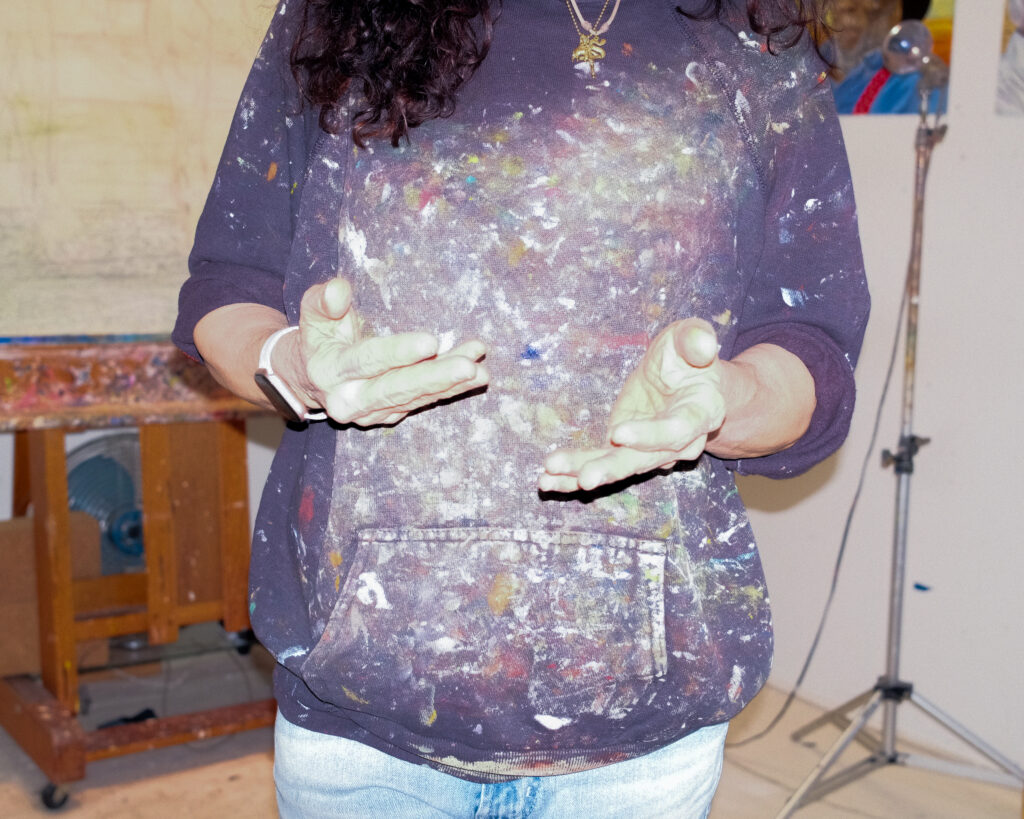
That sense of living without a long horizon shaped the intensity of her commitment. Now, looking at artists like Alex Katz, who continues to paint well into his nineties, she feels differently. She wants to paint for as long as she possibly can. Painting is not something she imagines aging out of. It is something she wants to sustain for a lifetime.
Zlamany is best known as a portraitist, but she resists the idea that portraiture is primarily about likeness. For her, the psychology of a portrait is carried by composition. She often says that it is the math in the rectangle that does the work. If the composition is right, the portrait follows. The way a figure moves through space, the direction of a gaze, the balance of shapes and edges all communicate meaning before any facial detail does.
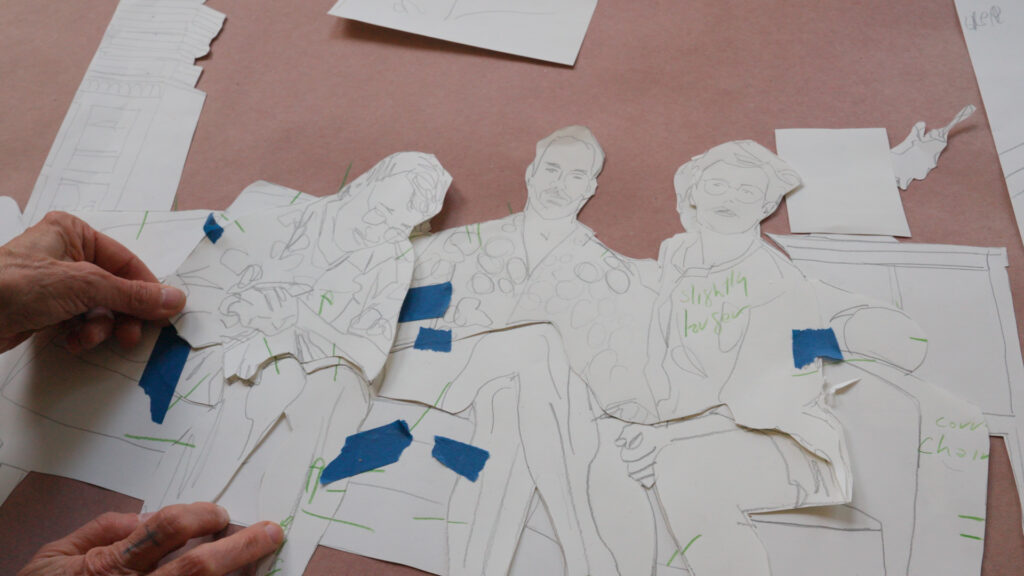
She works through this by building compositions out of cutouts. For complex paintings, she makes hundreds or even thousands of paper figures, moving them around like paper dolls until the composition resolves. She does not draw traditionally on paper. She draws through this process of arranging, adjusting, resizing, and rebalancing figures until the emotional moment feels correct. She lives with these compositions for a long time before committing them to canvas.
For Zlamany, portraiture exists within a larger conversation with art history, contemporary figuration, and technology. She speaks about artists like Vermeer as if they are alive, as if she is in active communication with them. At the same time, she thinks deeply about what portraiture can mean now, in an era saturated with photography, artificial intelligence, and mediated images. As faster and more technologically driven ways of seeing multiply, she believes painting becomes more specific and more powerful. The act of painting with a brush, something slow and physical, gains weight in contrast to those systems.
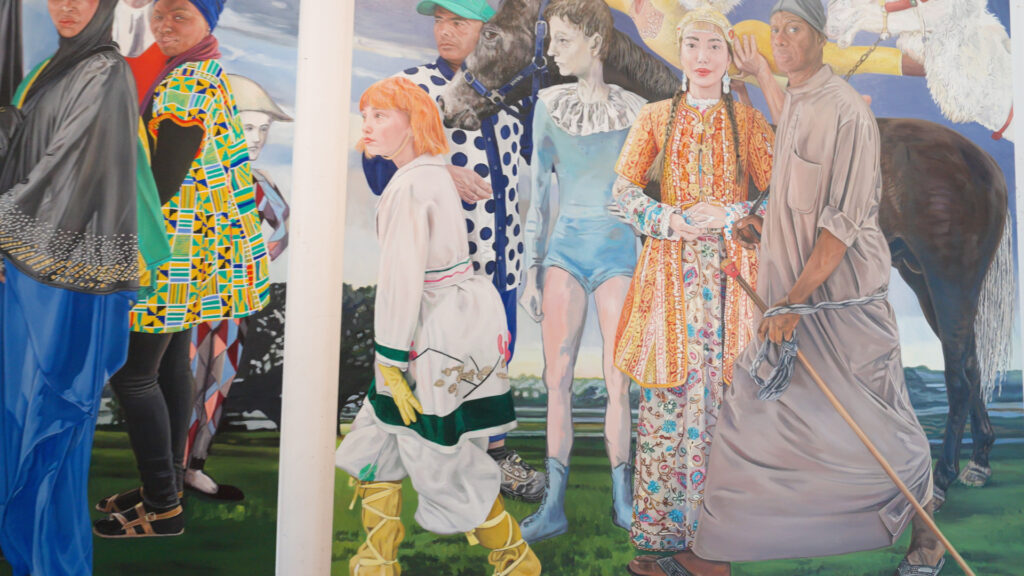
A central concern in her work is who gets painted. Historically, portraiture has been reserved for aristocracy, political figures, and those with power. Zlamany deliberately focuses on people who are often excluded from that tradition. She paints underrepresented people and has undertaken large scale projects around the world. In Taiwan, she painted 888 Taiwanese Aboriginal people from direct observation. She is currently working on a project in her ancestral village in Calabria, which is facing depopulation. There, she is thinking about making an opera that combines faces and music.
She tells a story from Saudi Arabia that clarifies this impulse. Invited to attend a camel festival by a prince, she painted two portraits. One was of a wealthy man whose camels were competing. The other was of a Syrian camel handler. The reaction to the second portrait was confusion and disbelief. People questioned why she would paint him at all. For Zlamany, that question is precisely the point. She is interested in the meaning of portraiture beyond likeness. Who is painted, when they are painted, and in what context the image is shown all shape its meaning.
Her process varies depending on the project. For her itinerant portrait series, she works in watercolor from direct observation. Subjects sit for her while she interviews and films them. She works quickly, using a camera lucida to establish outlines and focusing on capturing a likeness in real time. These sessions are intense and immediate. The oil paintings, by contrast, are slower and built through the cutout process before any paint touches the canvas.
Although she attended art school, Zlamany considers herself largely self taught as a painter. She studied during the 1970s, when painting was unfashionable and often dismissed as a white male language. She studied with Judy Chicago and later with Lester Johnson, but much of her technical development came from her own research and experimentation. One of her most influential teachers was Frank Bowling, whom she worked with at Skowhegan. Although Bowling is an abstract painter, his deep knowledge of materials and his encouragement to push them left a lasting impact.
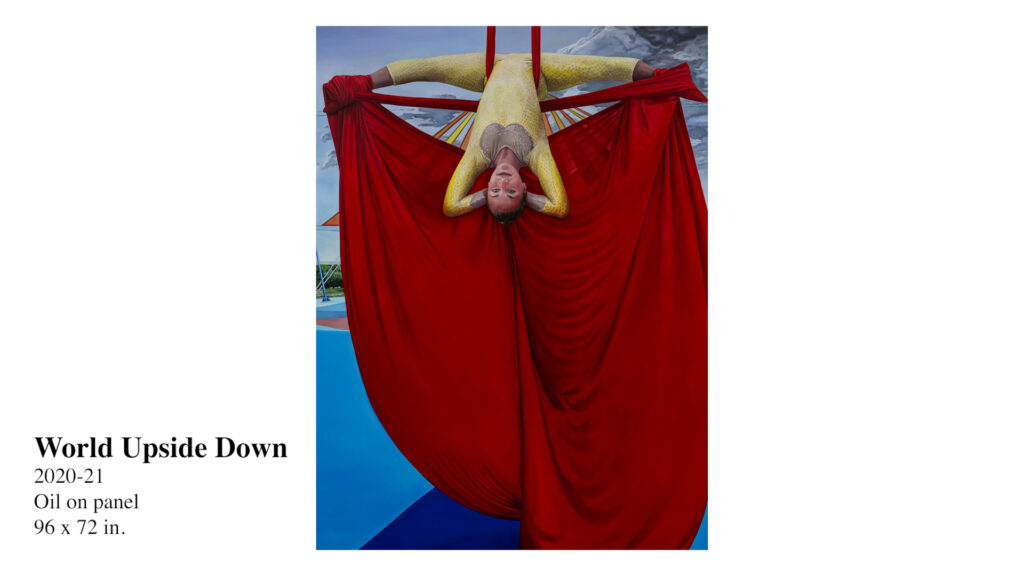
Her relationship to materials is precise and controlled. She uses a limited palette and avoids black and brown altogether, mixing her darkest darks instead. She does not do this out of purism but out of predictability. When all colors are mixed from the same pigments, she knows how they will interact. This allows her to control the painting more fully and to trust the behavior of the paint.
Over the last several decades, her focus within portraiture has continued to evolve. She has explored monochrome backgrounds, studying how color alone can change the meaning of an image. In one series, she painted the same portrait against different colored grounds to see how contrast shifts emotional emphasis. More recently, she has become deeply interested in how landscape informs portraiture. She points to examples like the Mona Lisa, where the landscape fundamentally shapes how the figure is read.
This interest in landscape expanded during artist residencies, which she uses as opportunities to try things she has never done before. In Newfoundland, she created a series that used figures from art history as stand ins for her own emotional states. These paintings trace a personal arc of self realization through the landscape, eventually leading her to identify herself with an iceberg. The project allowed her to integrate figures and landscape in a new way, something that later informed her mentor series.
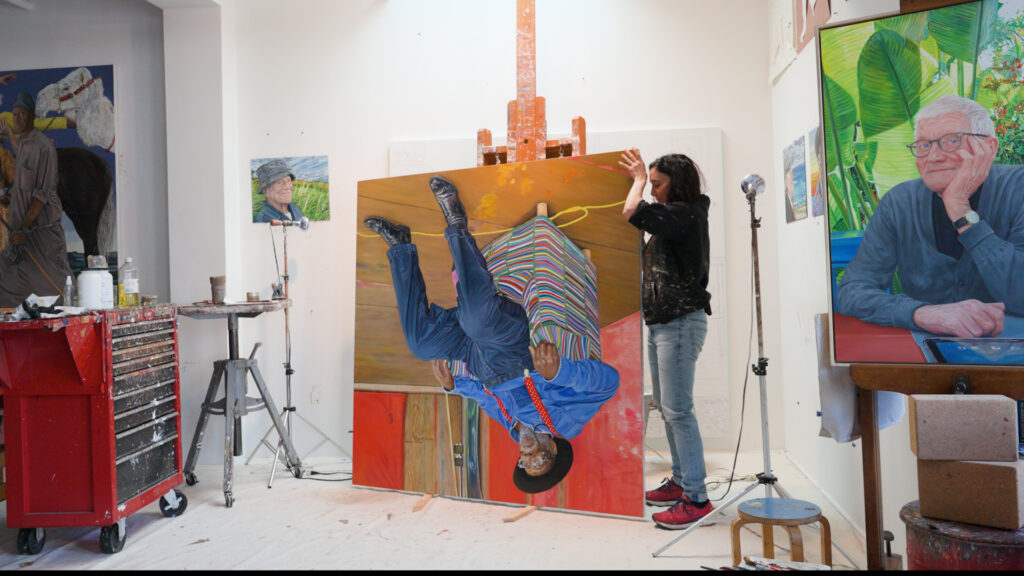
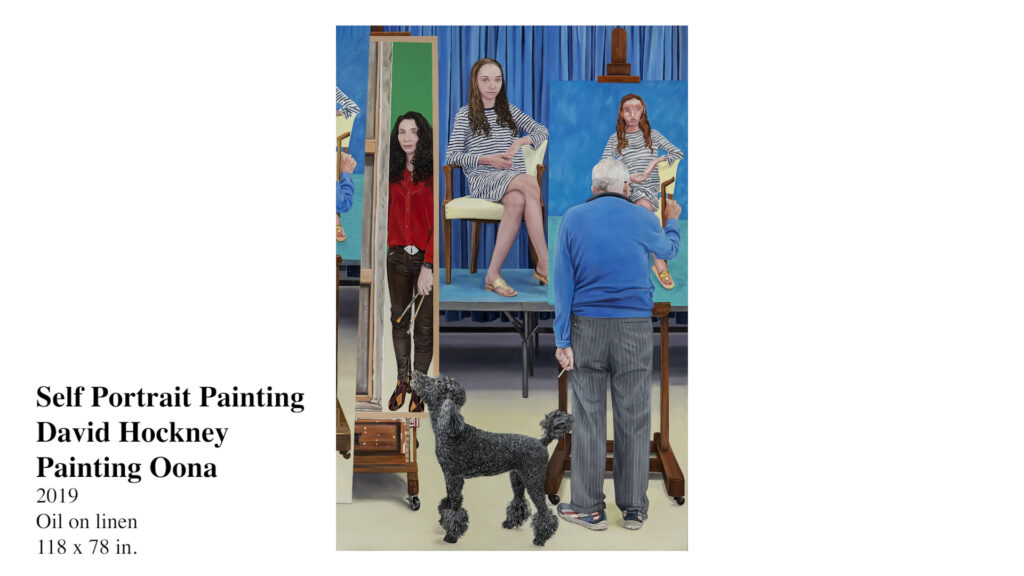
In that series, she paints figures like Frank Bowling, David Hockney, and Alex Katz, associating each with an elemental force. Bowling becomes fire, Hockney water, Katz wind. The landscapes in these paintings are not backgrounds but active conveyors of meaning. They describe how she sees these artists and what they represent to her.
Zlamany speaks about portraiture as her primary way of interacting with people. Painting becomes the real encounter. Once someone is painted, the painting becomes more real to her than the living person. Changes in appearance feel secondary to the fixed truth of the image. This relationship complicates loss and memory but also underscores how deeply she invests in the act of looking.
When asked for advice for young artists, she is direct. If you do not have a burning desire, she says, do not do it. The life is difficult and unforgiving. She cautions against chasing trends or trying to game the system. Fashion comes and goes, and even major recognition can fade. The only sustainable position is to be your own primary audience.
She emphasizes the importance of learning how to think. Technique, she believes, will take care of itself. She recommends a strong academic education, reading widely, and learning how to function in the world. Intelligence and independence matter as much as skill.
Zlamany also believes artists should be collectors. Living with other people’s work demonstrates a commitment to art as a way of life. Her own collection includes works by artists who have deeply influenced her, and she sees the dialogue between those works and her own as ongoing.
After decades of painting, Zlamany remains intensely engaged. She continues to question how images work, how meaning is carried, and how portraiture can respond to the present moment. The urgency that began in childhood has not softened. It has simply become more focused, more deliberate, and more deeply rooted in a lifetime of looking.
About the Author
Sam Burke is an American artist and writer based in New York City. Working across film, performance, and writing exploring storytelling, identity, and place. As co-founder of Timestamp, Burke interviews artists, shares insights, and highlights conversations shaping art world today.
Adèle Aproh
For Adèle Aproh, drawing began long before she knew it could become a career. Her…
Mafalda d’Oliveira Martins
For Portuguese painter Mafalda d’Oliveira Martins, painting is a way of understanding people. Working primarily…
Vasco Del Rey
Vasco Del Rey’s journey as a painter began with a small, bright green and yellow…
Sophia Frese
Painting did not begin as a career for artist Sophia Frese. It arrived instead as…
Ruprecht von Kaufmann
In his Berlin studio, Ruprecht von Kaufmann works surrounded by the quiet textures of linoleum,…
Terry Szpieg
Terry Szpieg grew up in Muskegon, Michigan, and from as far back as he can…