
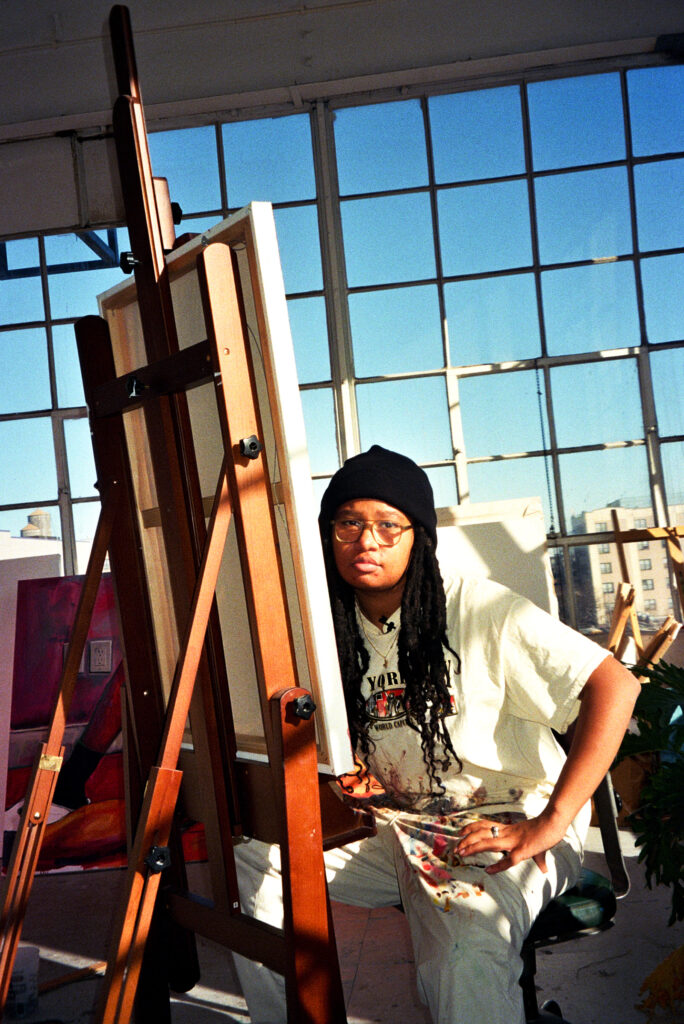
Originally from New Orleans, Louisiana, Hill Spriggins has been living and working in Brooklyn, New York for the past seven years. She identifies herself simply and decisively as a painter. While people often ask whether she draws, photographs, or works in other mediums, her answer is consistent. Painting is her focus, the only practice she has ever truly committed to, and the one that has shaped her life from its earliest moments. Inseparable from survival, mental health, and identity. Without it, she does not see a version of herself that exists.
Some of Spriggins’s first memories are tied directly to paint. As a child, she was captivated by Eric Carle books, especially The Very Hungry Caterpillar. She remembers trying obsessively to recreate the images using Crayola watercolor sets, without fully understanding how paint worked. She did not realize water was needed to activate the pigment, and instead stabbed at copy paper with cheap brushes, destroying the bristles in the process. Very little transferred onto the page, but the sensation itself left a mark. Even then, crayons, colored pencils, and markers never felt as satisfying as paint. The physical act of painting felt instinctive, even before she understood it technically.
That memory, of lying on her stomach on the cold tile floor of her family’s playroom, feet in the air, trying to reproduce a slice of cheese, a pickle, and a lollipop from Carle’s illustrations, remains vivid. It is one of the earliest moments she associates with feeling drawn to painting, and she recalls it not as frustration, but as discovery. The feeling of paint, even unsuccessfully applied, mattered more than the outcome.
Her commitment deepened as she grew older. Spriggins attended an arts conservatory for high school, marking the beginning of what would become a formal path toward a painting career. In college, painting was her major, and after graduating, the decision to pursue it full time felt inevitable. She did not see alternative paths that would offer the same sense of fulfillment. Painting was not a choice among many but the only option that made sense.
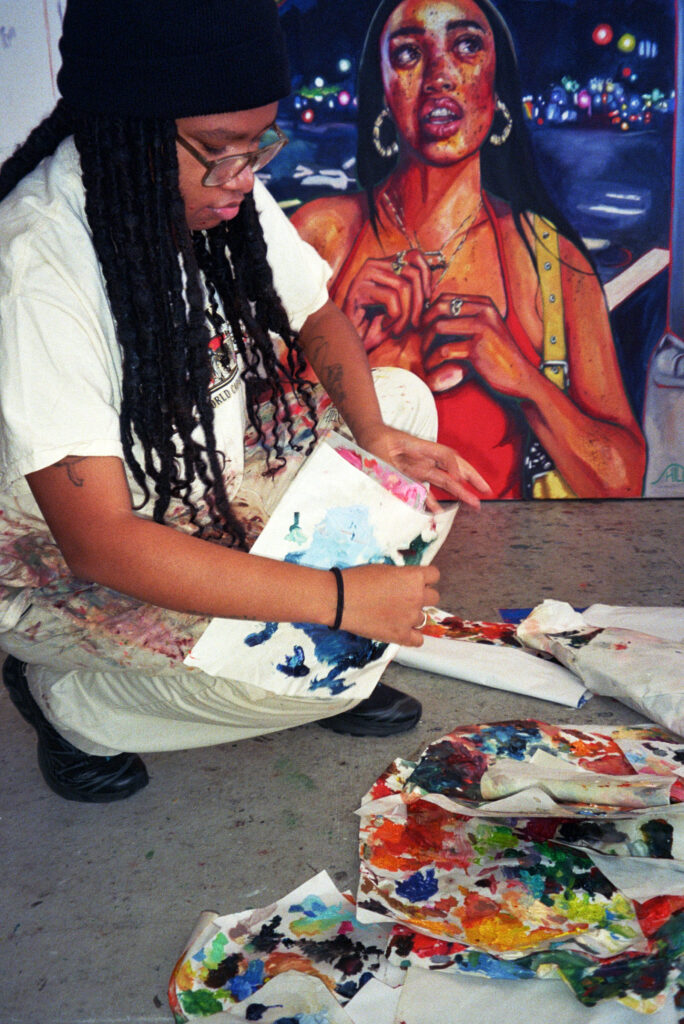
She speaks openly about the privilege of knowing her purpose at an early age. While many of her friends entered corporate jobs they disliked or felt uncertain about their futures, Spriggins never questioned what she wanted to do. The uncertainty lay elsewhere. How to sustain herself financially. How to grow a career. How to meet the right people and gain access to the spaces that shape visibility in the art world. But the act of painting itself was never in doubt.
Growing up in a financially unstable environment shaped her relationship to ambition. Financial stability remains a real and practical goal, but she resists defining her success through rigid milestones. Rather than setting narrow career objectives, she tries to leave room for outcomes she could not predict. In the past, she wanted representation from major galleries and still admits that part of her would like to experience that recognition. At the same time, she recognizes that fulfillment does not hinge on those outcomes. Her central goal is to continue painting for the rest of her life, to sustain a practice, and to remain connected to people through the work.
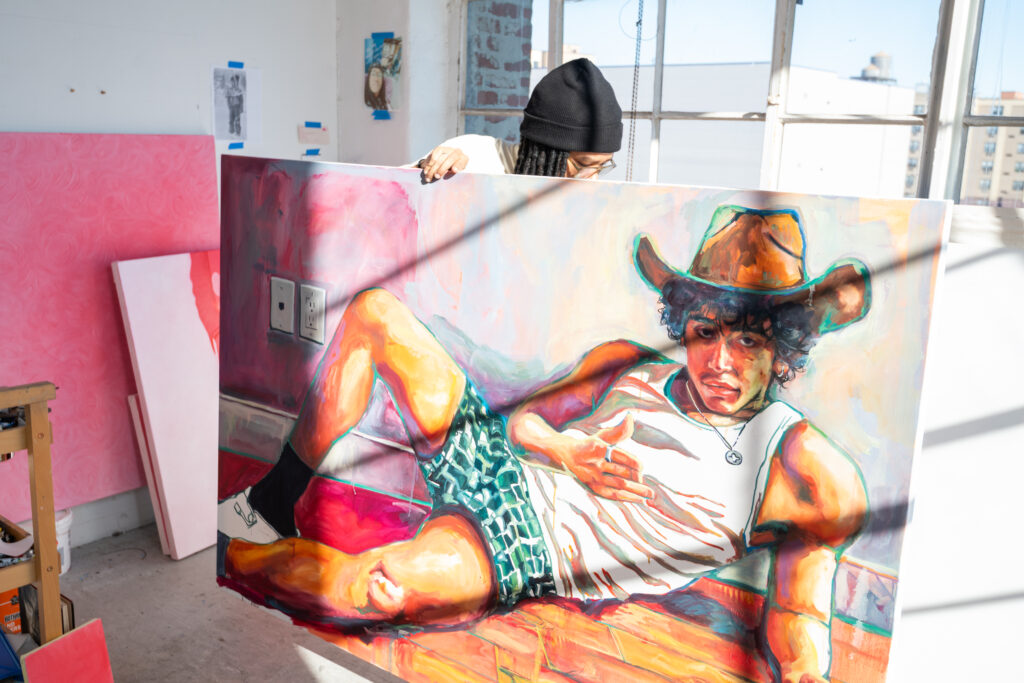
Connection plays a central role in how Spriggins understands painting. One of the most rewarding aspects of her practice is the nonverbal exchange that happens when someone encounters a painting of themselves or a loved one. Seeing a parent react to a portrait of their child, or watching someone recognize themselves in her work, affirms for her that painting can reduce feelings of isolation. Making people feel seen, less alone, and emotionally acknowledged is as important to her as formal achievement.
Her recent work reflects a shift toward restraint. Guided by conversations with her mentor, she has been actively practicing the idea that less can carry more weight. Early in her career, her attention to detail sometimes functioned as a way of overexplaining, leaving little room for interpretation. She was advised that reducing detail could signal trust in the viewer and confidence in her own skill. By allowing ambiguity and abstraction to coexist with figuration, she gives viewers space to meet the work on their own terms.
This balance has become increasingly important as she explores figurative painting and portraiture while incorporating abstraction. She admires painters who convey entire figures with minimal information and sees that confidence as something she wants to cultivate. In a recent show, she noticed viewers focusing on small moments within her paintings rather than the whole image, often gravitating toward the same details she loved most. That feedback reinforced her interest in zoomed-in gestures and intimate fragments.
Spriggins is intentional about resisting elitism in fine art. She is critical of systems that prioritize academic credentials and conceptual opacity, which she believes can exclude those without financial access to advanced degrees. Her goal is not to create work that requires specialized knowledge to decode. She wants viewers to feel something immediately, whether that feeling comes from color, familiarity, or recognition. For her, a painting does not need justification beyond its ability to resonate.
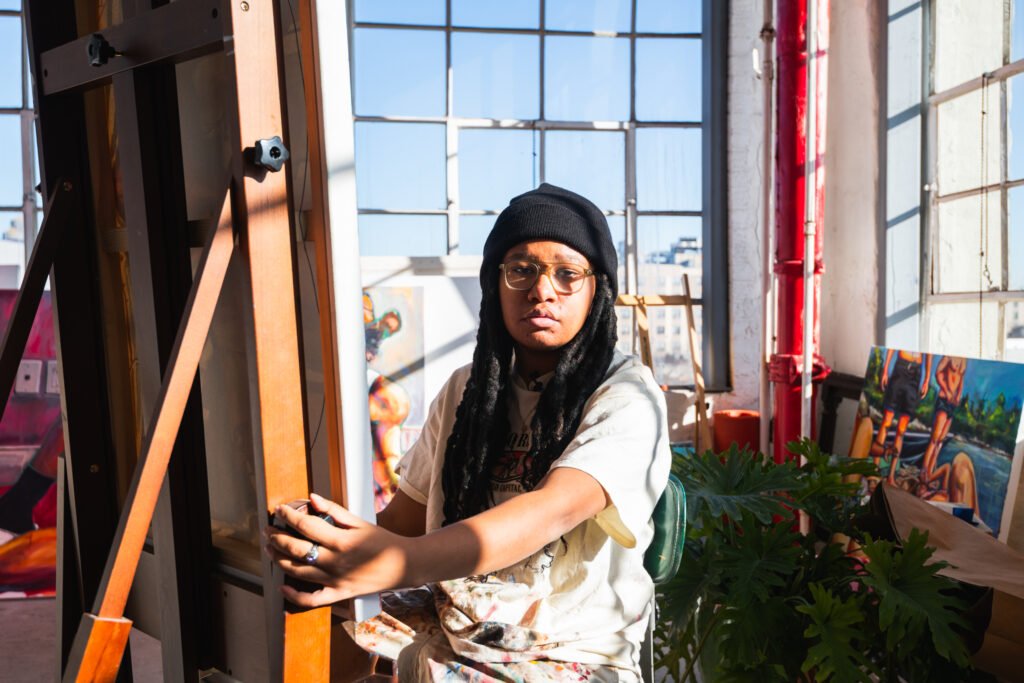
Her work often documents her life as it unfolds. She describes her paintings as an ode to being in her twenties in New York, a love letter to the people around her, and an act of appreciation for relationships that may not last forever. By painting friends, partners, and everyday moments, she preserves experiences that are inherently fleeting. Viewers often sense the affection embedded in these images, which reinforces her belief that love and joy can be communicated visually.
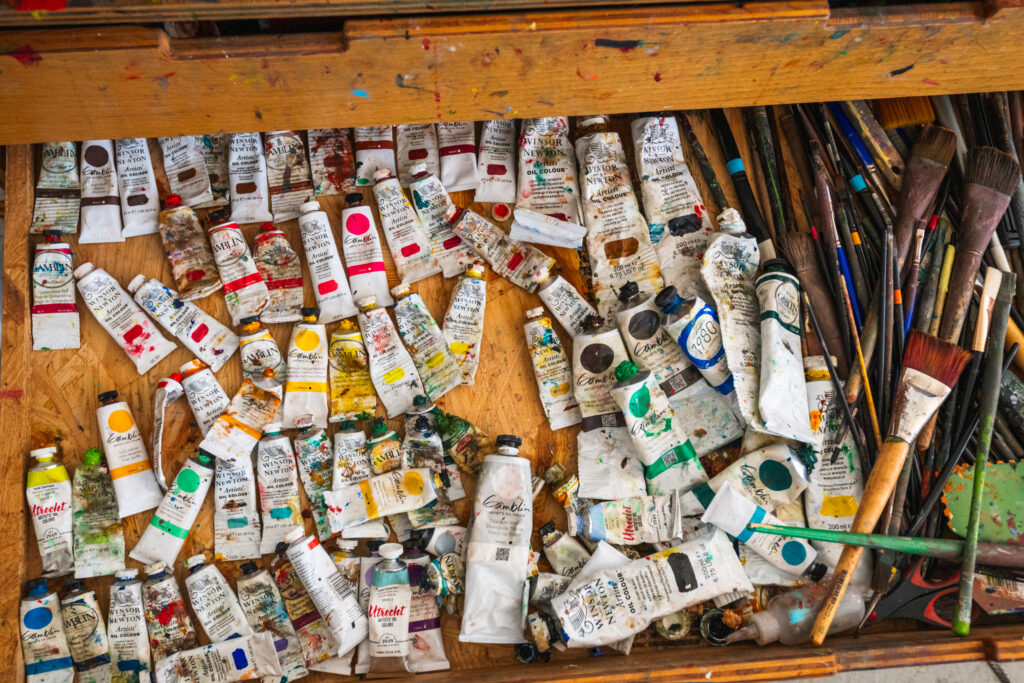
The act of painting itself is guided by intuition rather than a fixed formula. She begins each painting unsure of how it will unfold. Sometimes she starts with graphite, other times directly with paint. Washes appear in some works and are omitted in others. Over time, she has grown more comfortable leaving areas of white canvas visible. Her materials are straightforward. She works primarily with oil paint, favoring specific colors that recur throughout her work, including cadmium scarlet, Indian yellow, emerald green, phthalo turquoise, and deep blues. She keeps old palettes as physical records of time and process, treating them as objects with memory.
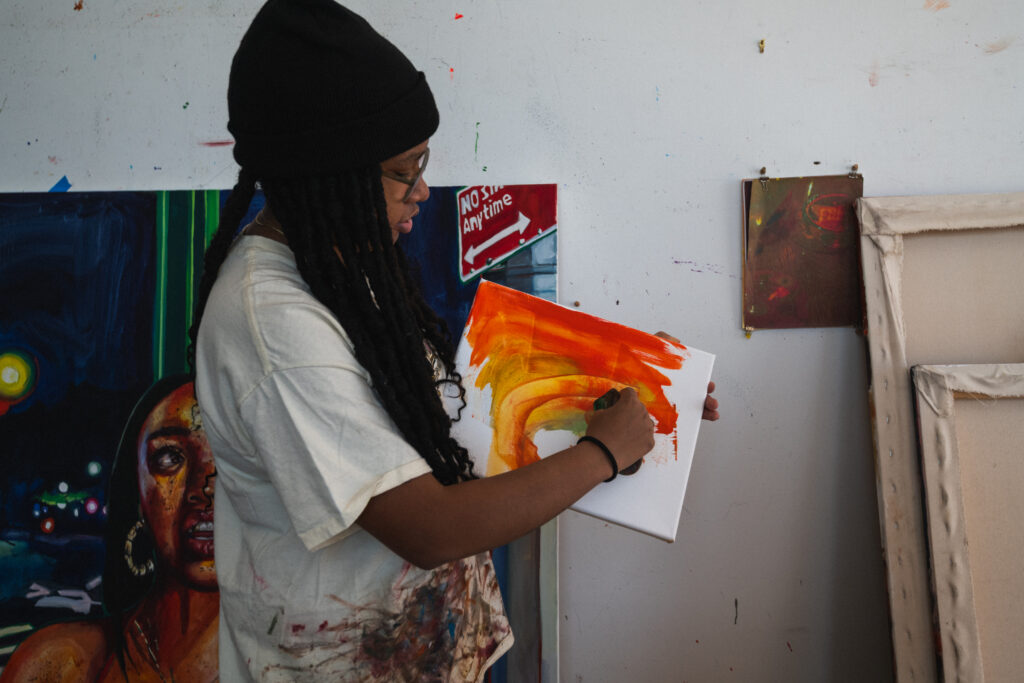
Color choices are often emotional and sensory. Spriggins describes experiencing synesthesia, where colors are connected to feelings associated with people or moments. When painting a subject, she selects colors based on how that person feels to her rather than strict visual accuracy. In one painting influenced by her reading of Vincent van Gogh’s letters, she found herself channeling emotional intensity rather than stylistic imitation. The result felt deeply personal, and feedback from peers confirmed that something had shifted. The painting captured presence rather than restlessness, reflecting a period in her life where she felt grounded and attentive.
Her paintings function as love letters to their subjects. This sense of care extends beyond the canvas into her broader understanding of community. Spriggins emphasizes the importance of surrounding oneself with supportive people, especially during moments of doubt. She credits friends who showed up in simple but meaningful ways, whether through shared meals, walks, or messages. That support, she believes, is reciprocal. Community requires both receiving care and offering it.
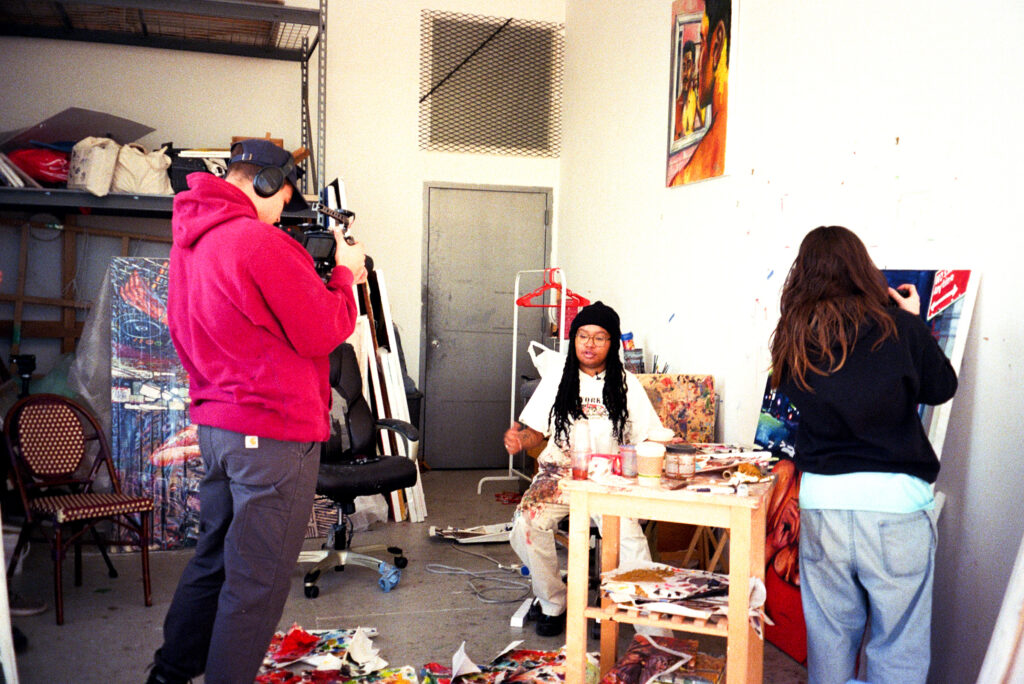
Every painting ends when it begins to feel tedious. She stops not based on completeness but on instinct, trusting her sense of when a work has captured what it needs to capture. The goal is not perfection but presence. Through this approach, her paintings remain open, generous, and emotionally direct.
For Spriggins, painting is documentation, connection, and survival. It is how she understands herself and the world around her. It is also how she honors the people and moments that define her life, knowing that nothing remains static. By continuing to paint through uncertainty, financial strain, and self doubt, she builds a body of work rooted in gratitude, intimacy, and the insistence on feeling something real.
About the Author
Sam Burke is an American artist and writer based in New York City. Working across film, performance, and writing exploring storytelling, identity, and place. As co-founder of Timestamp, Burke interviews artists, shares insights, and highlights conversations shaping art world today.
Stéphane Koyama-Meyer
French visual artist and designer based near Basel, Stéphane Koyama-Meyer grew up surrounded by art,…
Yuval Bezalel
For Yuval Bezalel, painting begins with the hands, before there is a narrative, before there…
Adèle Aproh
For Adèle Aproh, drawing began long before she knew it could become a career. Her…
Félix Deschamps Mak
Félix Deschamps Mak is a French painter based in Paris, working in large scale figurative…
Katya Quel
Katya Quel is an artist and multidisciplinary creator, born and raised in Moscow, who now…
Why Dia Beacon Deserves a Full Day of Your Attention
There are museums you visit to check a box. And there are museums that quietly…