
Felix Benton grew up surrounded by people who made things. His grandmother was a glass artist, his mother was a chef and painter, and his father designs furniture, including the chair sitting in his studio during our conversation. For a while, that creative environment had the opposite effect one might expect. Benton was determined not to become an artist. He had seen the life from the inside and thought he wanted nothing to do with it. But he was always making things, and eventually he started making work seriously. Painting was the medium that stayed. Now based in Brooklyn after growing up in Marfa, Texas, Benton describes being a painter less as a fixed identity than as a decision he continues to make.
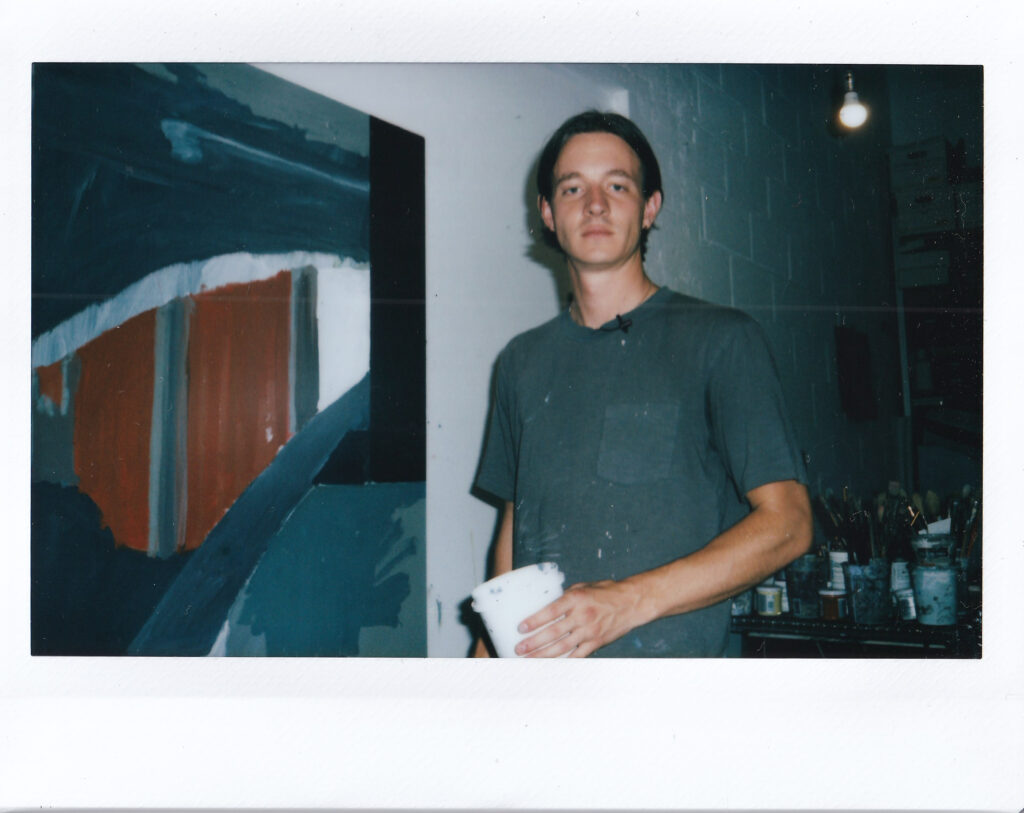
He studied painting at RISD, with a concentration in nature, culture and sustainability, and came away with an appreciation not only for the education itself but for the attitude surrounding it. The most valuable lesson was the idea that being deeply invested in your work could be its own kind of ambition. The people he met became as important as anything he learned in the classroom, but the mindset stayed with him. After school, Benton spent time working in curation and at a museum, a role that gave him a way to remain close to the art world while providing the stability that painting did not. He had already had his first solo show in Marfa, but the offer of a salary and a career was difficult to ignore.
The problem was that the job began to pull him away from the studio. He enjoyed being involved in other people’s practices, but eventually realized that he was missing the thing he actually wanted to be doing. Painting is unstable and difficult, Benton says, and the possibility of financial security can make it very easy to step away from it. Eventually he chose to return to his own practice, deciding that making his own work was not something he could keep putting off.
That decision has shaped much of how he thinks about painting now. Benton is deeply skeptical of efficiency, particularly the idea that the quickest or most productive route is necessarily the best one. He sees the studio as a place where inefficiency can be productive, where taking the longer route can allow you to notice things that would otherwise disappear. He compares it to walking somewhere instead of driving. The walk takes longer, but you see more, think more clearly and arrive having experienced something that could never have happened inside the faster version of the journey.
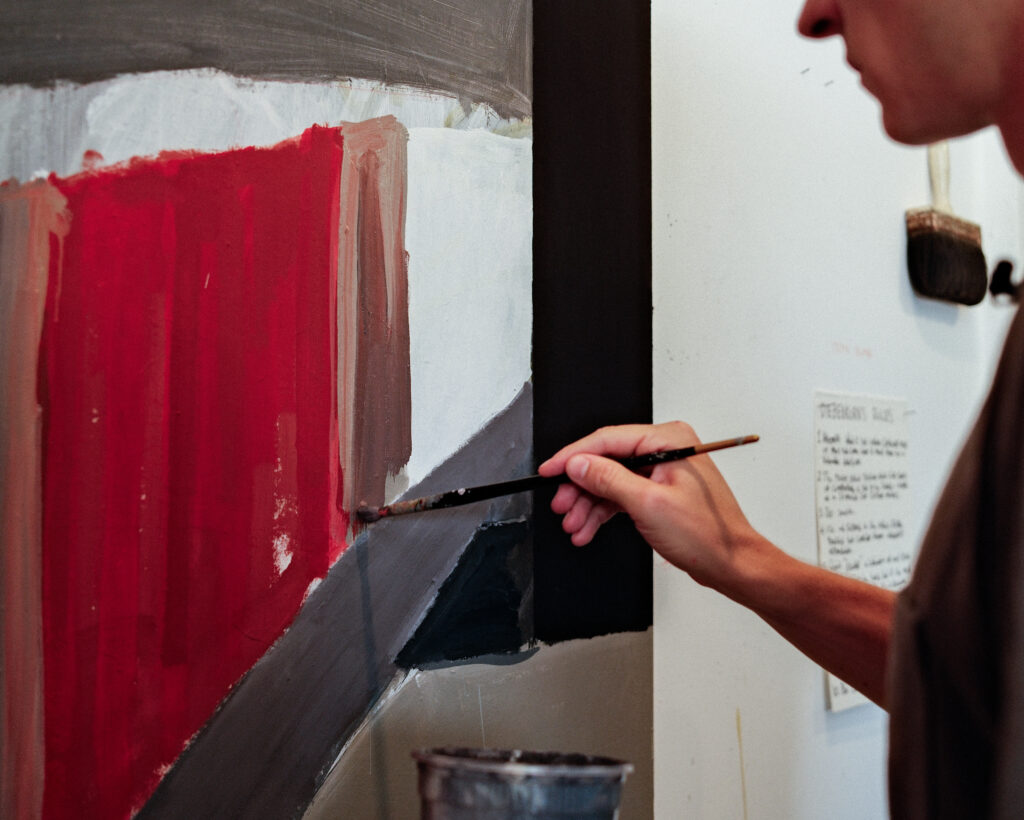
Painting, for Benton, operates in much the same way. It is deliberately slow, physical and limited. A painting is an object on a wall that requires someone to stand in front of it. It documents the time spent making it in a way that a digital image cannot. At a moment when images are increasingly generated, circulated and absorbed through systems of algorithms, data and constant reproduction, he sees something important in the stubborn physicality of paint. The painting cannot be everywhere. It cannot be instantly consumed in the same way. You have to encounter it.
That physical limitation is part of what makes painting meaningful to him. He describes the medium as deeply human precisely because of what it cannot do. Rather than competing with the speed and abundance of digital images, painting can exist outside of that logic. It can hold onto the evidence of time, attention and decision making. Its limitations become part of its strength.
Benton’s paintings rarely begin with a complete image in mind. Instead, they often start with something small that he notices in passing, a crack in a sidewalk, a plant from home, a particular arrangement of shapes or some brief visual moment that catches his attention. These observations become the beginning of a painting, but they are not necessarily preserved as recognizable subjects. From there, the work develops according to its own internal logic.
The paintings are built through accumulation and subtraction. One painting can contain dozens or even hundreds of paintings underneath it, with earlier decisions disappearing beneath later ones. Acrylic is particularly suited to this process because of its speed and flatness. Benton likes that the paint dries quickly and forces him to respond to what he has already done rather than endlessly working into a wet surface. Every decision becomes evidence, and every new layer has to contend with what came before it.
For a period, this process became too controlled. Benton found himself making paintings that were highly worked and compositionally resolved, but eventually realized that they had become so considered that there was nowhere for the viewer to enter. Everything had been solved. The paintings had become too certain of themselves.
That realization pushed him toward openness and clumsiness. He began trying to simplify the work and identify the one thing that was actually holding a painting together. It might be a particular relationship between colors or a tension between flatness and depth. He gives himself a temporary rule and tries to make decisions according to it, even knowing that the rule will eventually collapse. A painting might begin with the intention of being yellow and somehow end up containing every color in the rainbow. The point is not to successfully follow the rule but to use it as a way of paying attention.
The moment a painting begins to develop its own internal tension is when Benton knows it is getting somewhere. He is less interested in making something that is simply beautiful than in making something that confronts the viewer. Awkwardness, unresolved shapes and moments that do not immediately make sense can be more valuable to him than polish. A painting should have some resistance. If it becomes too pretty or too seductive, he starts questioning what that beauty is actually doing.
This skepticism toward beauty for its own sake extends to his relationship with technique. Benton is interested in discovering useful methods, but he is wary of allowing a trick to become the reason a painting exists. He might discover an effect he finds beautiful, such as water moving across a surface or a particular material response, but his next question is always why. If the technique is only there because it looks good, he does not necessarily want it.
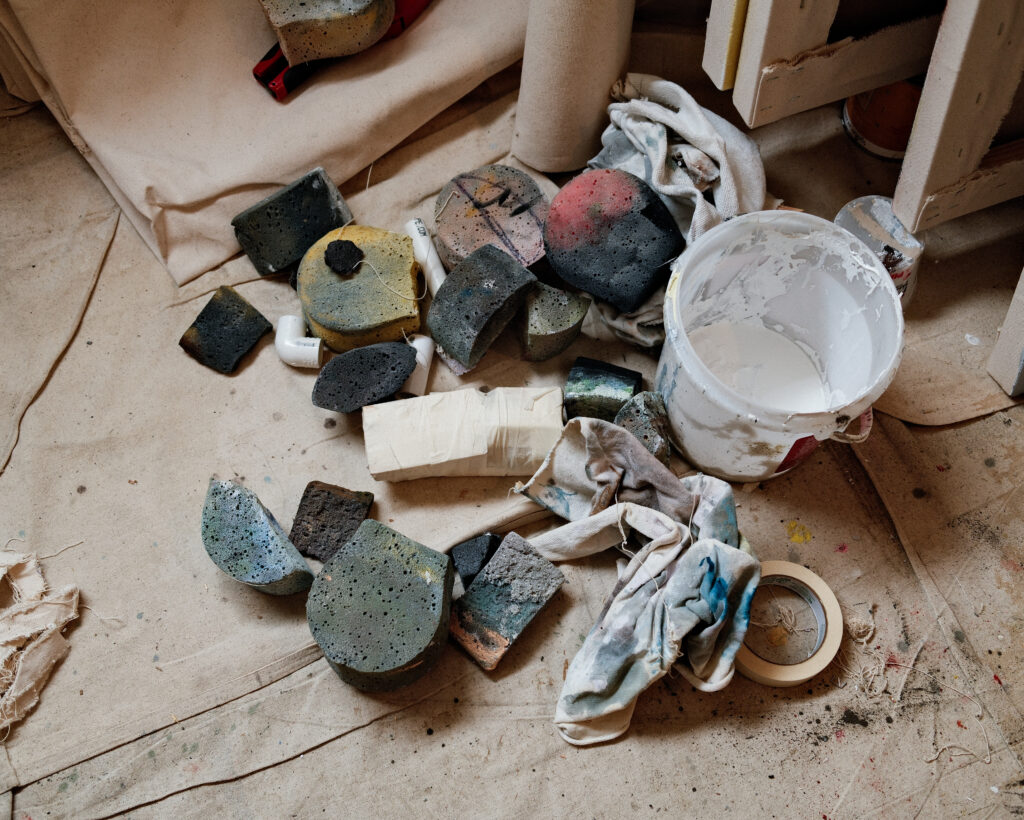
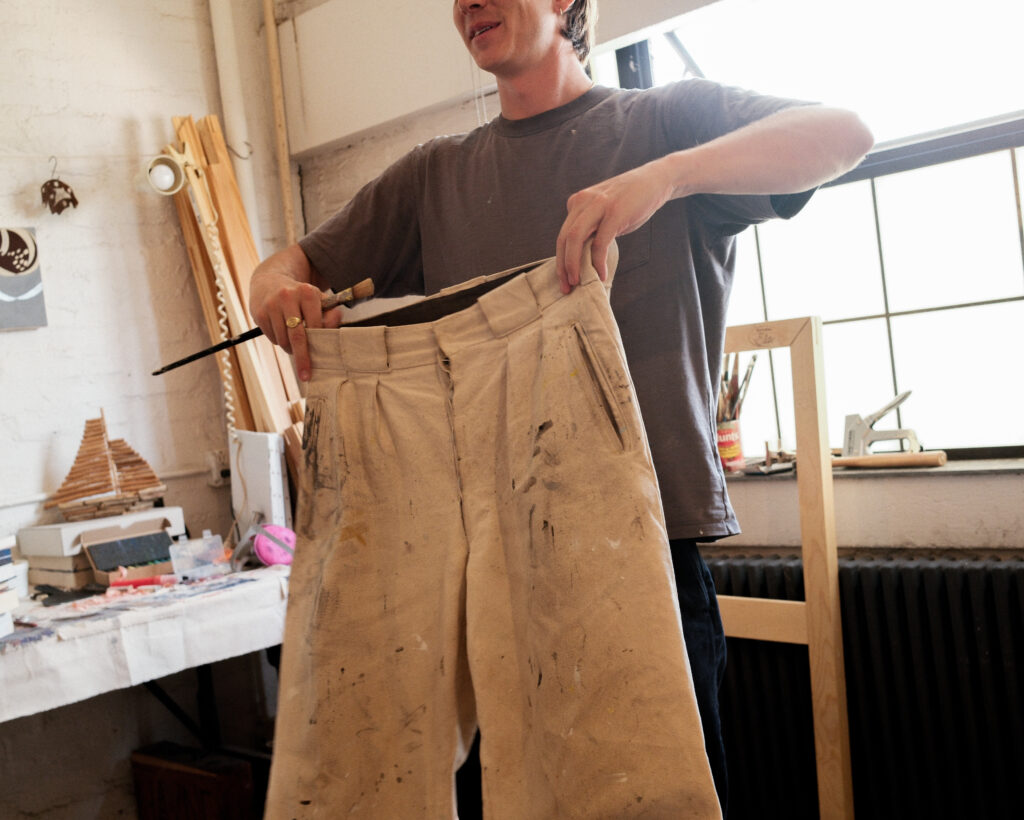
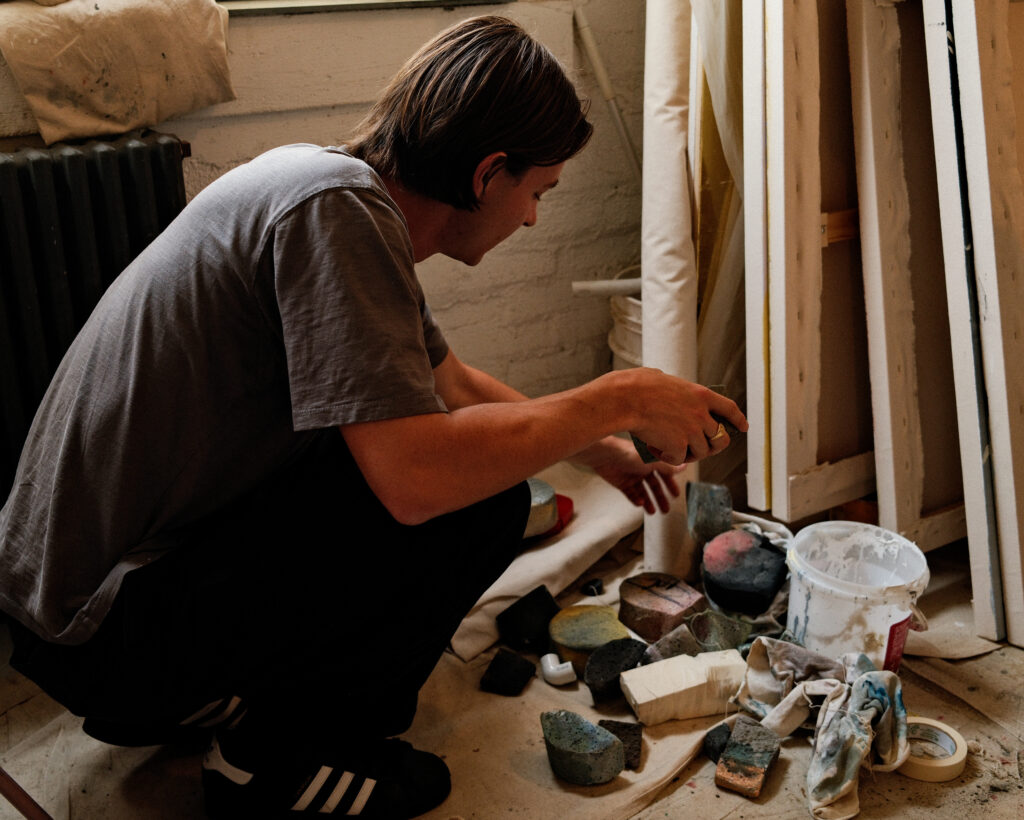
His materials reflect the same balance between control and immediacy. He primarily works with acrylic, often mixing his own colors and using materials such as marble dust and matte surfaces to maintain the flat quality he likes. He makes his own canvases because he wants a good surface to begin with, though he does not treat every part of the process as sacred. More recently, he has introduced sponges as a way to move away from the brush and work with his whole body. The sponge creates drips and marks that are harder to control, helping him escape the tightness that had entered the paintings.
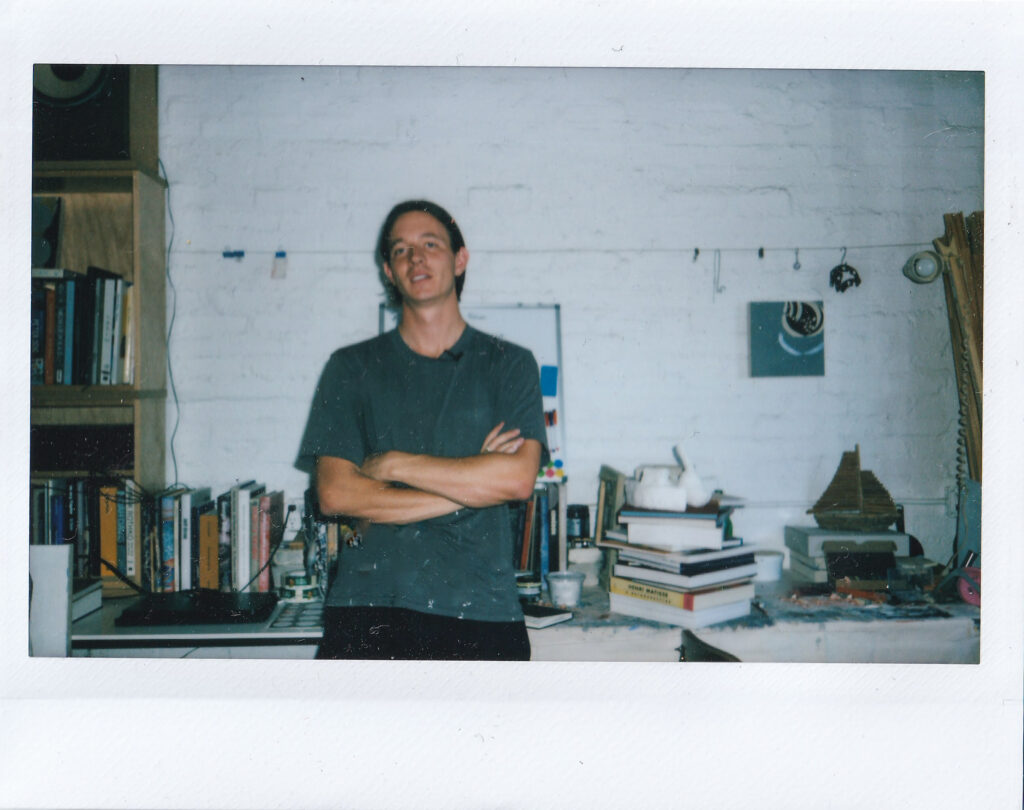
Even the discarded sponges can become part of the process. After becoming saturated with paint, some have been turned into small sculptures, including a little boat made from a sponge, tape and air dry clay. Benton describes these experiments as ways of changing his headspace, but they also embody his larger belief in inefficiency. Making a boat from a paint soaked sponge may have no practical outcome, but that is exactly why it can be useful. It gives the mind permission to follow an idea simply because it is interesting.
That willingness to take a seemingly dumb idea seriously is important to Benton. Not everything needs to lead somewhere. Some experiments exist only to interrupt the habits that develop when you spend too much time doing one thing. In the studio, these detours can return him to the work with a different perspective.
Moving to New York has sharpened that perspective. Benton came to Brooklyn partly because of the city’s place within the art world, partly because he already had friends there, and partly because he wanted to take his practice more seriously both physically and mentally. Living in Marfa had given him space, but it could also make the studio feel distant from the larger conversation around contemporary art. New York brought the opposite condition. The city was loud, crowded and full of competing ideas, and that pressure forced him to become more decisive.
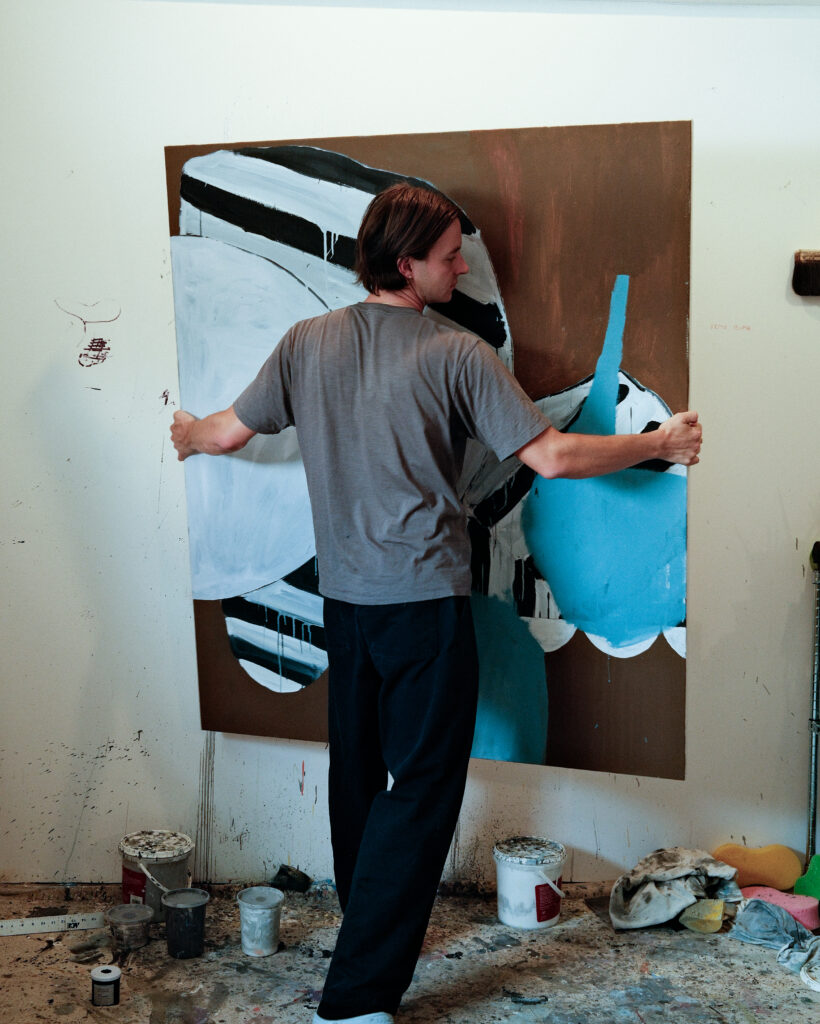
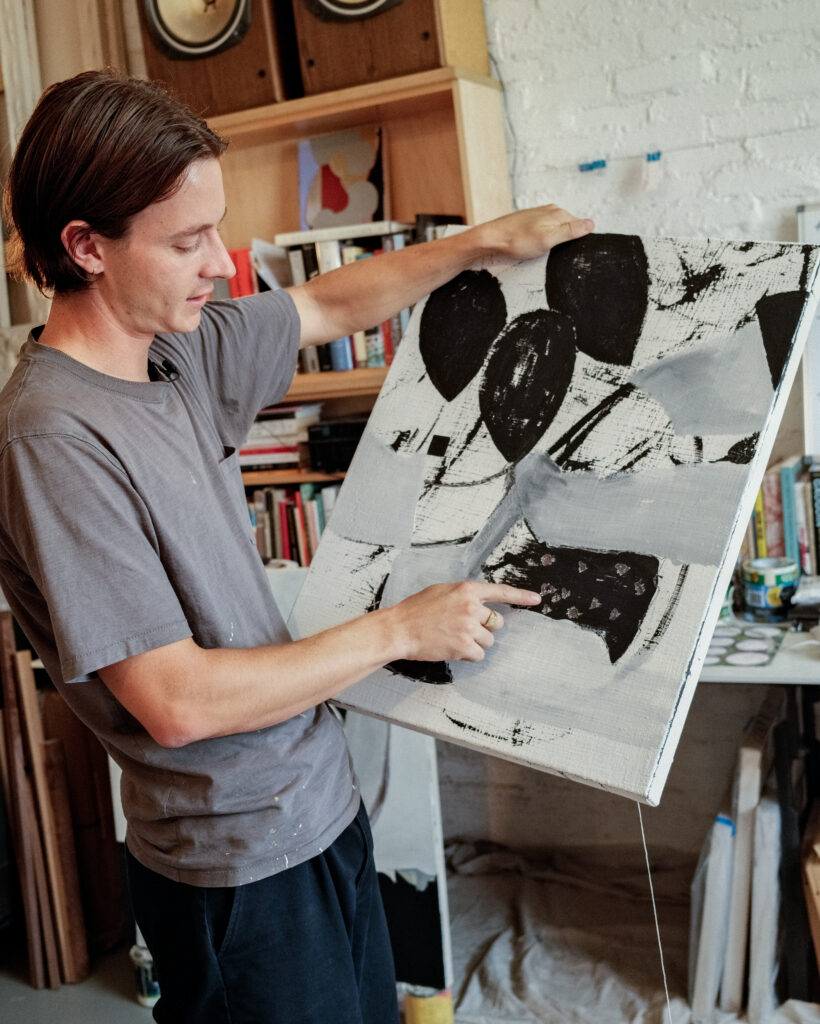
He found that the energy of New York compressed the paintings. They could no longer wander indefinitely between different interests. The city made him ask what the work was actually doing and what direction it needed to take. The paintings did not necessarily become simpler, but they became more intentional.
That movement from openness toward clarity does not mean that Benton has found a formula. In fact, uncertainty remains one of the most important parts of his practice. He is wary of the moment when an artist begins to believe they have figured everything out. There is always the temptation to find a successful painting and make another version of it, to turn something that once felt alive into a repeatable style.
For Benton, that kind of manufactured certainty can be just as dangerous as insecurity. He would rather return to the position of not knowing. The work becomes more interesting when he is unsure what will happen next, when he has to pay attention to what is actually happening rather than simply execute an idea he already understands.
That uncertainty is also what he hopes people understand about being an artist. Benton rejects the idea that art exists on some higher plane, accessible only to a select group of people. Making art, he believes, is fundamentally available to anyone willing to invest time in it. He compares it to meditation. The difficult part is sitting down and beginning, but the more consistently you practice, the more capable you become.
There is something optimistic in that belief, particularly because it comes from someone who has experienced the instability of trying to make art professionally. Benton does not present painting as easy or romantic. He knows the financial pressures, the uncertainty and the temptation to choose a more secure path. What he believes is that the difficulty does not make the practice less valuable. If anything, it makes the decision to continue more meaningful.
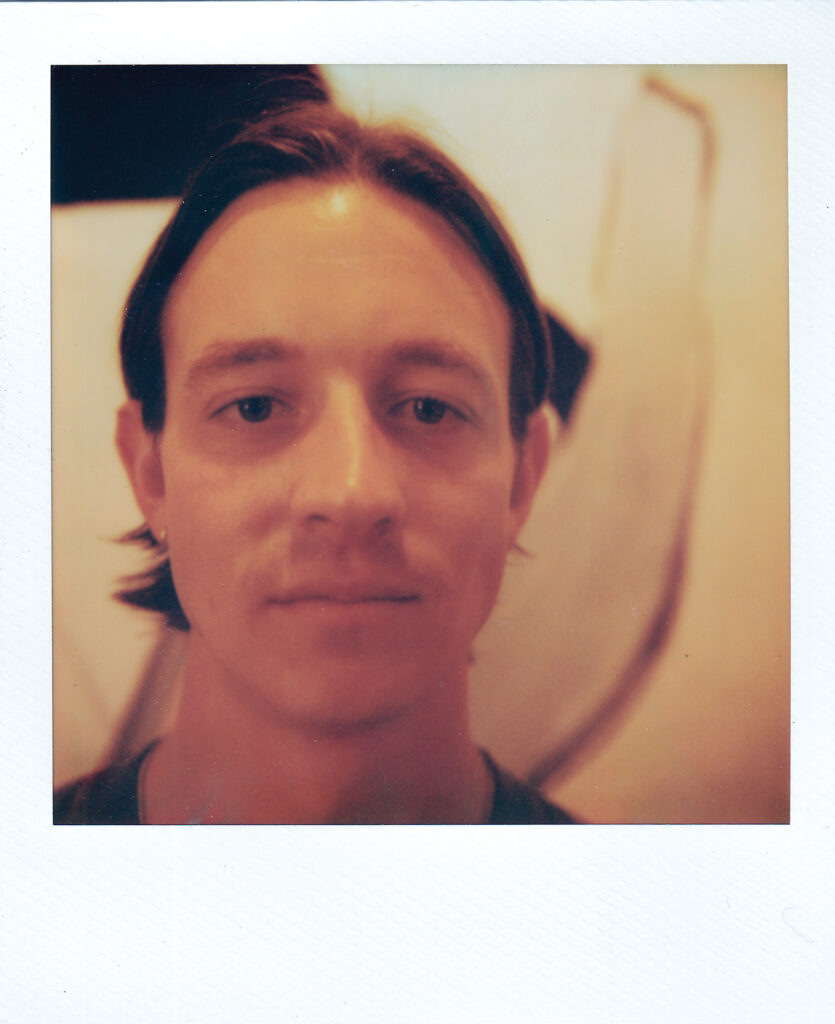
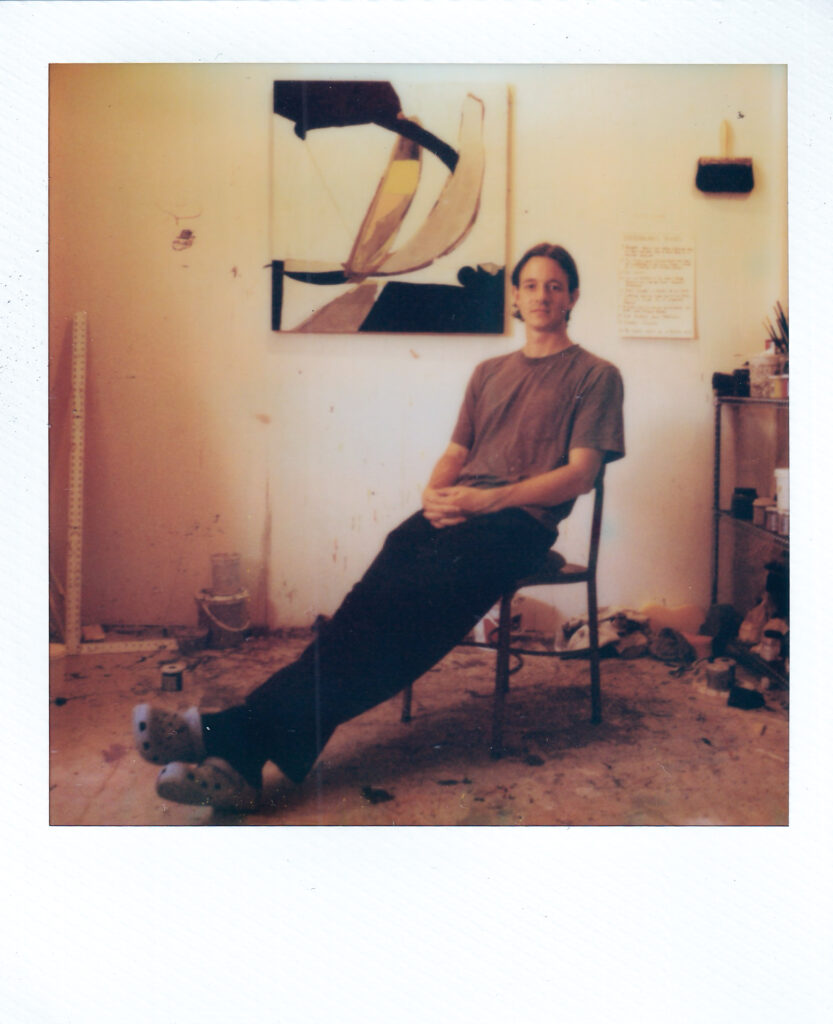
His own practice remains unfinished in that sense. He is still figuring out what the paintings should be, still questioning what deserves to remain and what needs to disappear, still looking for ways to prevent the work from becoming too resolved. The studio is not a place where he arrives at answers so much as a place where he can stay with questions long enough for something unexpected to happen.
At the center of that process is a simple resistance to speed. In a culture increasingly organized around efficiency, instant images and constant production, Benton has chosen a medium that demands physical presence and time. His paintings record not only what he saw but the decisions, failures, revisions and uncertainty that accumulated around that initial moment.
For Benton, that may be the real value of painting. It does not need to compete with everything else an image can do. It can simply remain stubbornly itself, an object that asks you to slow down and look. The inefficiency is not a flaw in the process. It is the process, and somewhere inside that wasted time, the uncertainty and the unresolved shape, the painting begins to become something of its own.
About the Author
Sam Burke is an American artist, filmmaker and writer based in New York City. Working across film, performance, and writing exploring storytelling, identity, and place. As founder of Timestamp, Burke interviews artists, shares insights, and highlights conversations shaping art world today.
Felix Benton
Felix Benton grew up surrounded by people who made things. His grandmother was a glass…
Jackie Reeves
Jackie Reeves grew up in Montreal in a family where making things was part of…
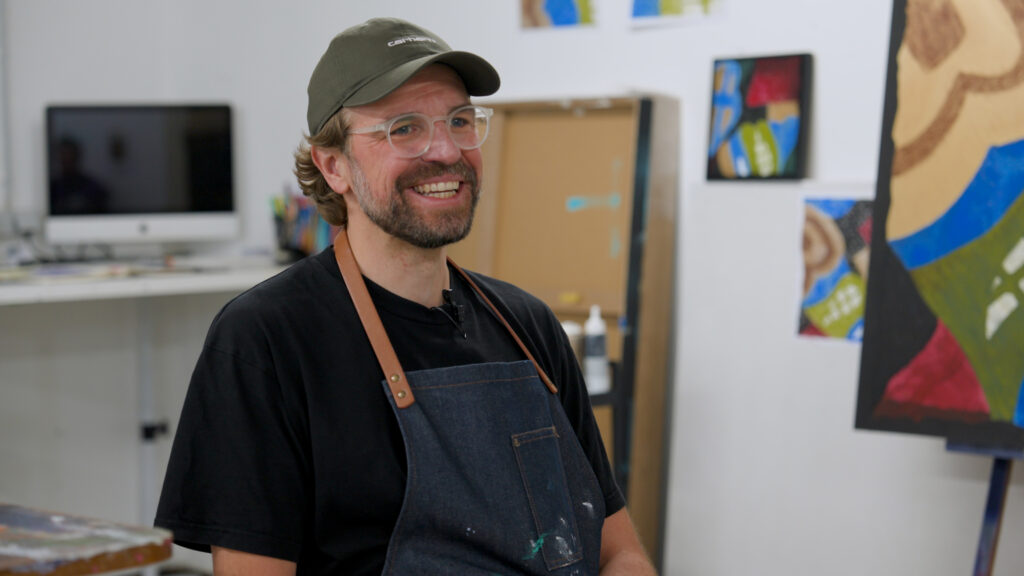
Stéphane Koyama-Meyer
French visual artist and designer based near Basel, Stéphane Koyama-Meyer grew up surrounded by art,…
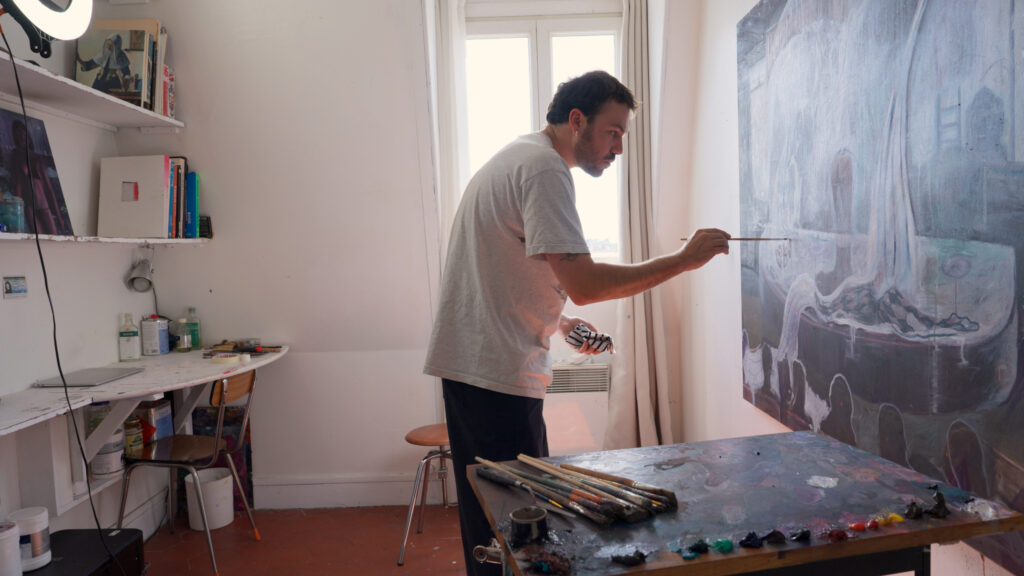
Yuval Bezalel
For Yuval Bezalel, painting begins with the hands, before there is a narrative, before there…
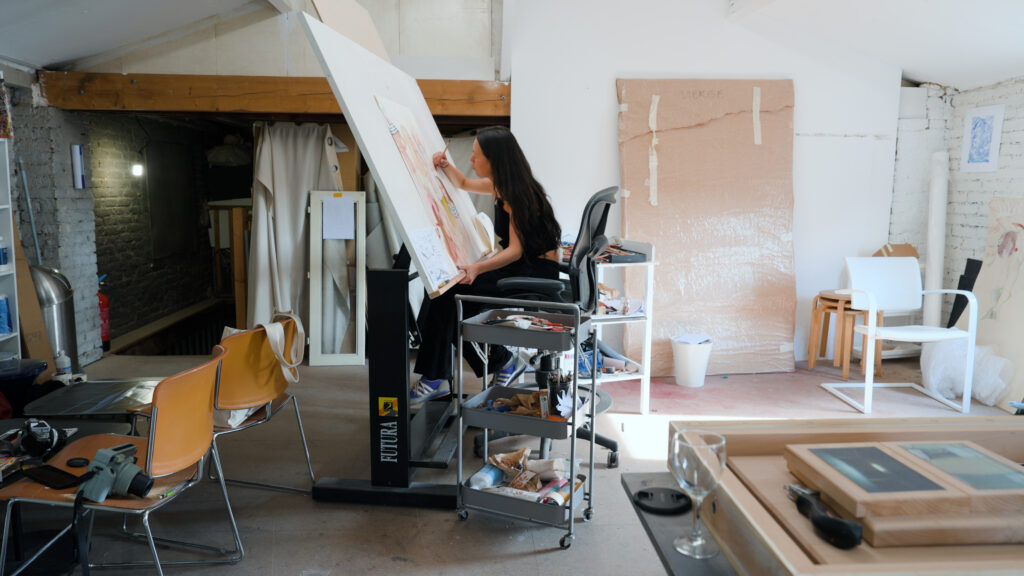
Adèle Aproh
For Adèle Aproh, drawing began long before she knew it could become a career. Her…
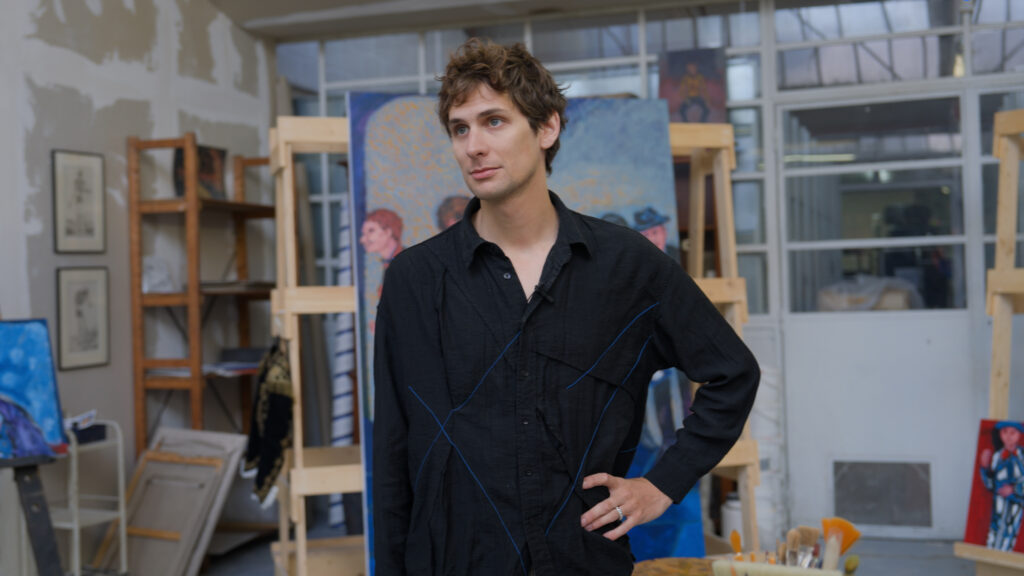
Félix Deschamps Mak
Félix Deschamps Mak is a French painter based in Paris, working in large scale figurative…